Fake Retro Cartridge: How to Tell Before You Pay
Nov 17th '26 5:24pm:
For decades there was a rule that needed no magnifying glass: a PlayStation disc that was black underneath was genuine, a silver one was a copy. In September 2024, modder Voultar warned that a wave of fake PS1 games pressed on dark substrate had turned up, sold on places like AliExpress, and called them "visually indistinguishable." Time Extension picked up the story on 7 October.
Some people replied that fakes can still be caught if you know what to look for, and that these discs won't even boot on an unmodified PS1. The article says as much. Voultar's counterpoint is that not everyone knows what to look for, and that shops and online buyers get fooled all the time. Both are right. But the black-disc rule can no longer do the job on its own.
What's left is stacking small clues, where the counterfeiter has to get every one right at once. What follows is the inventory, ordered by where you are: cartridge in hand, shell open, disc flipped over.
## Game Boy: start with the screw
The fastest test doesn't require opening anything. An official cartridge is held shut by a screw at the bottom of the shell that needs a 3.8 mm "gamebit" driver. Developer Remy Sharp, who wrote a short guide on this, shows a common reproduction with the screw in a different place and without "Made in Japan" molded in. The Johto Times guide to Pokémon games says the same about the screw: all of them left the factory that way, and any other type is grounds for suspicion.
Then the label. Originals usually have a number embossed on it, but Sharp warns that it can be missing on a genuine one or replaced by an aftermarket sticker. It's a clue, not a verdict. He considers another one close to foolproof: a mark with a number on the inside of the front of the shell, which also exists on Game Boy Color and Advance. And the bottom of the cartridge, on many copies, is cut away to make room for chips on a different board.
With Pokémon, color helps. According to iMore, Nintendo never made Pokémon games for Game Boy or Game Boy Color in a gray shell in the North American and European versions: Red is red, Blue is blue, Yellow is yellow, and Gold, Silver and Crystal are gold, silver and ice blue. Nintendo Life showed a Pokémon Gold that mixed the North American and Japanese styles, had no "Nintendo Game Boy" across the top, and wasn't even gold.
## GBA: flip the board
The Game Boy Advance is where copies are hardest to catch by eye. The Nintendo Life guide lists what a correct label should carry: the game's logo, the Nintendo logo, the seal of quality, the rating symbol and a product number. If one is missing, be suspicious. There's a trap: a Mario Kart: Super Circuit had the seal reading "Original" rather than "Official," and that was fine, because it's how Nintendo used the seal in PAL territories. What gave it away was the region code ending in NEU6 when it should have been EUR.
Every genuine GBA also has a number stamped into the label, visible mostly in the right light. On the FireRed test pair, the original had two sets of characters on the right side and the copy had none. A reader in the comments said he'd come across plenty of copies with "Nintendo" misspelled "Nintondo" on the back. That's comment-section anecdote, but it's worth keeping.
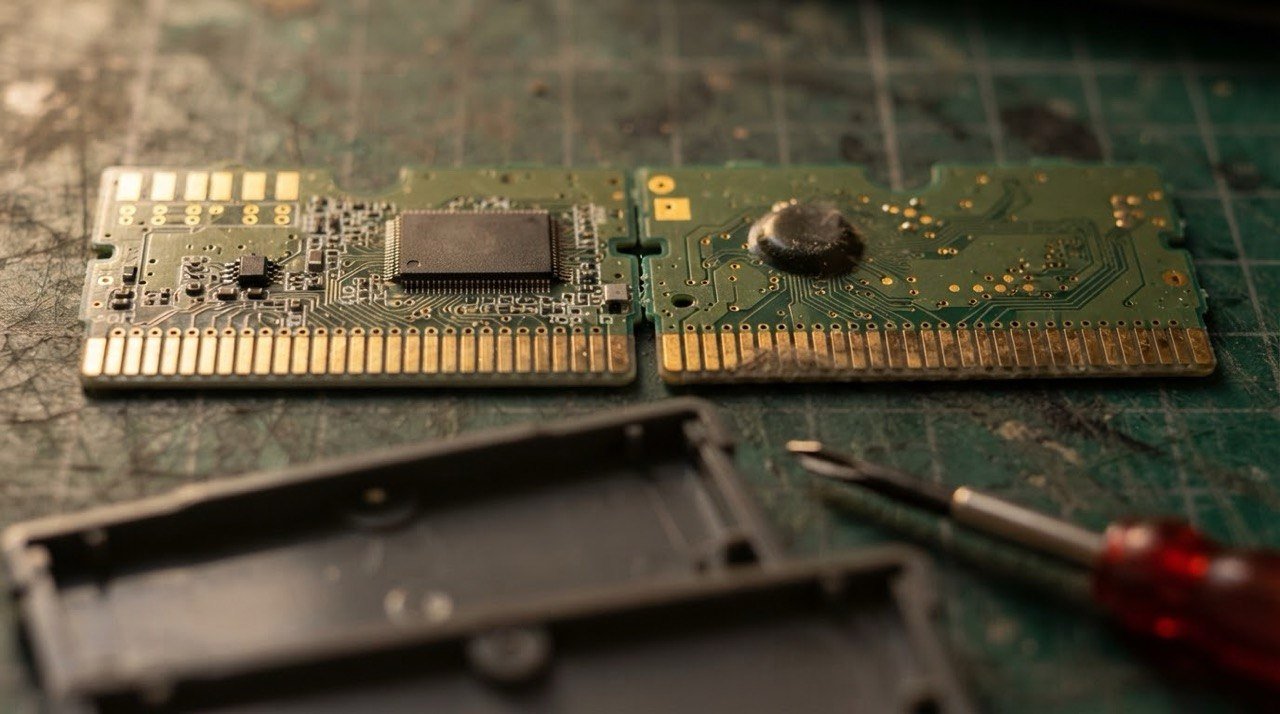
The best proof is still the board, which opens with a small tri-wing screwdriver. The fake Mario Kart had a battery, which the originals don't have for that title, a numbered sticker and an "E4" inked on the back. On a FireRed or LeafGreen you don't even need to take the shell off: official boards have four etched gold rectangles on the left, and both copies in the test showed loose gold circles instead.
## DS: the number that wears off
On a DS cartridge, look under the label for the code starting with NTR, followed by four product characters and the region. The code on the back must start with the same four characters. But the ink is light and wears with handling, so a game without a number isn't automatically fake. And some counterfeiters have learned this: the Pokémon Diamond Nintendo Life examined had the right numbers front and back, and it was the blurry logo that gave it away.
Pokémon HeartGold, SoulSilver, Black and White (and their sequels) came in black shells that, held to the light, show a nearly translucent purple.
## SNES and the database nobody reads
Every Super Nintendo cartridge closes with special-head metal screws. Plastic-looking screws that open by hand give it away at once. Inside, the board should say Nintendo, show the year and carry a serial code, and that code can be looked up on the SNES Central database to see whether that board type was ever used for that game. Nintendo Life recalls the old trick that isn't quite counterfeiting: swapping the board of an expensive game into the shell of a cheap one and closing it up again.
## Discs: color proves nothing now
With discs, the question moves. It's no longer the color, it's the inner ring.
Most discs pressed since 1994 carry two source identification codes, one for the mould and one for the mastering, each reading "IFPI" followed by four or five digits, in an area of the ring outside the data zone, according to PSDevWiki. A Denver shop's PS1 guide says fakes can have the matrix code missing or sloppy, or a blank hub. What I couldn't find is a source describing the inner ring of the pressed black discs that appeared in 2024. It's the most interesting gap in this story, and I'd rather say so than invent something.
On PS2 it's the opposite: the typical mistake is rejecting a good disc. According to a CloudsPress guide that draws on Game Verifying's verification guide, blue or purple indicates CD-ROM and silver indicates DVD-ROM, which describes the format, not the authenticity. Legitimate PS2 games on CD exist, and the guide gives *Little Britain: The Video Game*, from 2007, as an example. Many DVD-ROMs carry a faint PlayStation logo in the foil layer, visible by tilting the disc under strong light, but some bonus or giveaway discs don't have it and CDs never do.
Cases say things too. According to the same guide, PAL cases have a holographic sticker at the bottom left of the back, and NTSC-U and NTSC-J cases don't. A hologram on a case claiming to be American needs explaining. And there's a warning that applies to any disc: booting proves nothing, because a copy can be made to boot. The guide takes care to note that no published figure exists for how many PS2 copies are out there, so nobody knows the real prevalence.
## The Dreamcast reads factory copies
The Dreamcast has a problem of its own: it boots CD-Rs burned at home. Sega included support for the MIL-CD format and, once the scene worked out how to exploit it, self-booting copies spread with no chip needed. Only the last production revisions closed that gap, according to the guide from Golisto, a European retro marketplace.
The test here is simple. A genuine GD-ROM shows two visibly different data bands with a seam between them, while a CD-R is uniform, with a green, blue or purple tint. The official hub carries Sega markings, the CD-R's is blank or hand-written. And the official label is silkscreened, not a printer sticker.
## When the fake works (and then stops working)
Almost all fakes play. What people report, when they do, comes later: Nintendo Life readers, in 2021, described a Pokémon Emerald that wiped the game when transferring Pokémon to DS, a Fire Emblem whose save battery ran out, and a Final Fantasy VI that crashed every five minutes and destroyed the saves. That's a pile of comment-section anecdotes, not a study, but they all point at the same place: the save memory is where the cost-cutting shows.
It's worth separating two things. An openly declared copy, sold at copy prices, is another matter, and Sharp himself admits many people just want to play and that cheap rewritable cartridges exist. The problem is the copy sold as an original, at original prices. That's deception, not an alternative, as a Power Up Gaming guide puts it.
Ask for two photos before paying: the back of the board and the inner ring of the disc. A seller who won't take them has already answered.
The author of the Nintendo Life guide bought a Silent Hill 4 manual for PS2 and only realized it was a copy when he opened the cover and read "REPRODUCTION," in capitals, inside. At least it came with a warning.
---
- How To Spot Fake Nintendo Video Games, Nintendo Life, 17 Aug 2023 (originally published 15 Feb 2021): https://www.nintendolife.com/guides/how-to-spot-fake-nintendo-video-games
- "This Could Be Crippling" - Fake PS1 Discs Just Got Harder To Spot, Time Extension, 7 Oct 2024: https://www.timeextension.com/news/2024/10/this-could-be-crippling-fake-ps1-discs-just-got-harder-to-spot
- How to quickly spot a fake Game Boy cartridge, Remy Sharp (blog), 4 Jan 2023: https://remysharp.com/2023/01/04/how-to-quickly-spot-a-fake-game-boy-cartridge
- What Actually Fails on a Dreamcast, and How to Spot Fakes, Golisto, no visible date: https://golisto.com/blog/sega/dreamcast/what-actually-fails-on-a-dreamcast-and-how-to-spot-fakes
- How to Tell if a PS2 Game Is Fake: Disc, Case and Seller Checks, CloudsPress, 20 Oct 2026: https://www.cloudspress.com/how-to-spot-counterfeit-or-reproduction-ps2-games/
- The ultimate guide to spotting fake Pokémon games: Game Boy, Advance, DS, and more, iMore, no visible date: https://imore.com/ultimate-guide-spotting-fake-pokemon-games
- How to spot fake Pokémon games, Johto Times, no visible date: https://johto.substack.com/p/how-to-spot-fake-pokemon-games