PlayStation Fighting Game Ports: What the Arcade Lost
Nov 16th '26 12:15pm:
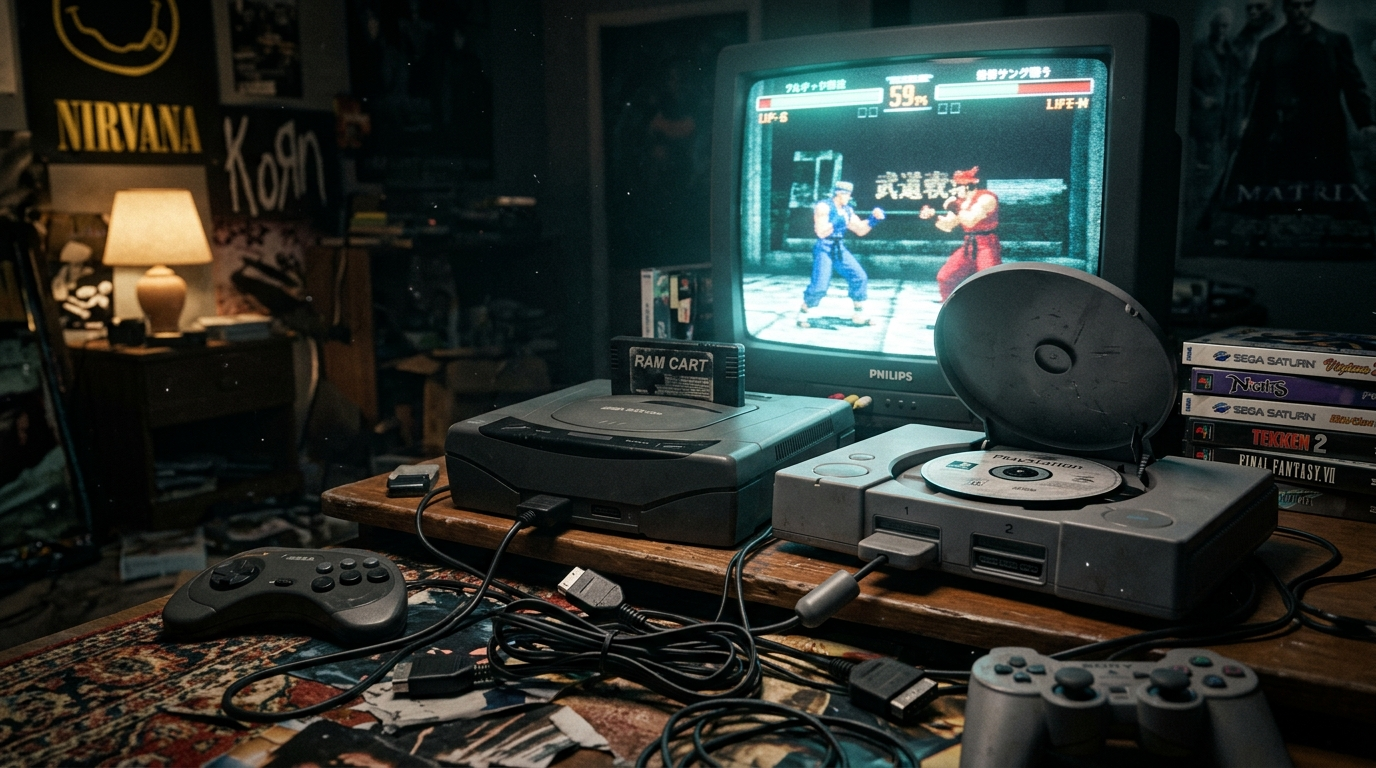
The board Namco used to run Tekken 3 in arcades, in March 1997, was a PlayStation. An upgraded one, but a PlayStation: the same MIPS R3000A processor, the same Sony graphics chip logic drawing polygons. Nicole Express, in a 2022 piece on the hardware, puts the two machines side by side. The System 12 ran its CPU at 48 MHz against the console's 33.8, both had 2 MB of main RAM, and video memory was 2 MB against 1 MB. (Wikipedia says the CPU was 50% faster, while 48 over 33.8 comes closer to 42%. I don't know which figure better reflects the board, and for what matters here it changes nothing.)
On paper, then, the distance between the arcade and the living room was one megabyte of VRAM and a slower clock. And the home version still lost things. With Tekken 3 it lost little. With Capcom's 2D games it lost a piece of what made them what they were. The underlying cause is the same, memory, but the damage is of a different order, and that difference is what interests me.
## The megabyte of VRAM Tekken 3 didn't have
For Tekken 3, that megabyte was enough to force Namco to give ground. Wikipedia sums it up: the 1998 PlayStation version shipped with reduced visual quality because of the smaller VRAM and the slower clock. On a collectors' forum, Insert Credit, a user discussing what a "perfect" port would be says the PS1 backgrounds were simplified and that he actually prefers them that way. That's forum opinion, not data, but it shows something: the cut existed and almost nobody mourned it.
There's a reason for that, and it's commercial. According to Wikipedia, Tekken 3 sold 8.36 million copies on PlayStation and about 35,000 arcade units. With those numbers, the home version was the main product, and Namco made up for what it cut with what it added: the Tekken Force and Tekken Ball modes, and the video endings that Fighters Generation singles out as one of the conversion's high points. That same site insists the release was much more than a port, while Wikipedia talks about a visual downgrade. Both things fit on the same disc.
When the gap was bigger, the port never happened at all. In its Soulcalibur review, GameSpot explains that the arcade version, still on System 12, used so much RAM on effects like z-buffering that it couldn't move to PlayStation. The Dreamcast, it adds, reproduced the 3D backgrounds without the compromises Tekken 3 had made.
Back in 1997, GameSpot had already noted that the System 12 was essentially a PlayStation with more RAM, and wondered whether Namco would have to sacrifice graphics in the port. It did.
## Frames that don't fit in 2 MB
Capcom's 2D games ask something different of memory. This is my reading, not a source's: a 3D model reuses the same mesh across every move, while a hand-drawn fighter needs each pose stored as an image. More frames, smoother animation, more data.
X-Men vs. Street Fighter shows the problem in its purest form. The 1996 arcade version let each player pick two characters and swap between them mid-fight. When it reached PlayStation in 1998, the console had just 2 MB of RAM and 1 MB of VRAM, and keeping four fighters and their animations available during a match proved difficult, according to GenerationAmiga. Capcom restructured the normal matches. You picked two characters, but the second showed up mostly in special attacks and counters. There was a limited tag option in a separate mode, and normal matches were one-on-one. Animation frames disappeared, and the original single-round team format gave way to the usual best-of-three rounds.
Street Fighter Alpha 3 has a similar, quieter profile. The Saturn version used its extra RAM for more frames, more sprites and faster loading than the PlayStation's, according to Wikipedia. ComicBook.com points out that the AI is a bit wonky in the PlayStation's Dramatic Battle and Survival modes, apparently because of a lack of RAM.
And then there's the disc. According to the console's specifications, the double-speed drive delivered 300 KB/s at best. Filling 2 MB at that speed takes almost seven seconds, in the best case (that's my arithmetic, not a source's). Swapping partners mid-fight by going back to the disc was unthinkable, and that's what nearly all the ports ended up reflecting. As the Insert Credit user put it, decent fighting-game ports only showed up with the Dreamcast and the PS2.
## The cartridge almost nobody wanted to pay for
The Saturn had a way out, and it was a piece of plastic. X-Men vs. Street Fighter reached Sega's console in Japan on November 27, 1997, and was the first game announced for the 4 MB expansion cartridge, which came in the box and without which the game wouldn't boot. With it, Sega Retro writes, the conversion is the most faithful the game has had, and the Marvel characters get more animation frames than in the Saturn's X-Men: Children of the Atom. The PlayStation got its port a year later.
The story gets crooked here. In November 1996 Capcom had announced the home version would be Saturn-exclusive, then backtracked, promising two versions faithful to the arcade. On PlayStation, that promise wasn't kept.
Outside Japan, the best version barely existed. Virgin, Capcom's usual European publisher, was reluctant to release Saturn games with the cartridge because of the cost of manufacturing it, and Sega decided not to produce the 4 MB version in the United States, according to Wikipedia. Shacknews sums up the result: the best version required an accessory that never reached North America. My reading is that Sony won by default, not on technical merit. The fixed 2 MB was a commercial advantage (you bought the console and that was it) and a ceiling for 2D.
## Twenty-eight years later, with the same 2 MB
In November 2026, GenerationAmiga reported something that looked unlikely: a patch that brings tag team back to the PlayStation's X-Men vs. Street Fighter. The author, pepasjc, released version 1.0 of the X-Men vs. Street Fighter Tag Team Hack, which reorganizes memory management to keep all four fighters loaded during combat without going to the disc. There's character switching mid-fight, tag attacks, separate health bars, partial health recovery for whoever is off-screen, and the one-round team format is back. The standard version runs on an ordinary PlayStation, no expansion needed.
There's also an optional 8 MB configuration, aimed at modified consoles, FPGA systems and emulators, that restores frames and effects cut from the conversion, including improved animations for 11 characters. And elsewhere in the community, according to TweakTown, a group led by TunerTom took the console's RAM from 2 MB to 16 MB by swapping memory chips.
What I don't know is how it plays. The report describes what the patch does, not what it feels like, nor how it behaves in the load times between fights. But the point stands: 2 MB wasn't a wall, it was a budget, and budgets can be managed. What Capcom had in 1998 was a deadline and funding, which I don't know. What pepasjc has is 28 years of tooling and no release date. I lean toward thinking the 1998 cut was more a choice than a fatality, though that lean is mine and no source's.
The 8 MB patch, by the way, doesn't ship with the frames built in. It asks for the original arcade data, which the user has to find on their own.
---
- A new X-Men vs. Street Fighter PS1 hack fixes the biggest compromise of the 1998 port, GenerationAmiga, November 13, 2026: https://www.generationamiga.com/2026/11/13/a-new-x-men-vs-street-fighter-ps1-hack-fixes-the-biggest-compromise-of-the-1998-port/
- The closest I'll get to covering the PlayStation, Nicole Express, 2022: https://nicole.express/2022/the-closest-ill-get-to-covering-the-playstation.html
- Namco System 11 and System 12, Wikipedia (en), no visible date: https://en.wikipedia.org/wiki/Namco_System_11_and_System_12
- Tekken 3, Wikipedia (en, via mirror), no visible date: https://ipfs.ssi.eecc.de/ipns/en.wikipedia-on-ipfs.org/wiki/Tekken_3
- Tekken 3, Wikipedia (en, via Wikiwand), no visible date: https://wikiwand.com/en/Tekken_3