Final Fantasy V Without a Translation: Who Played and How
Nov 15th '26 8:06am:
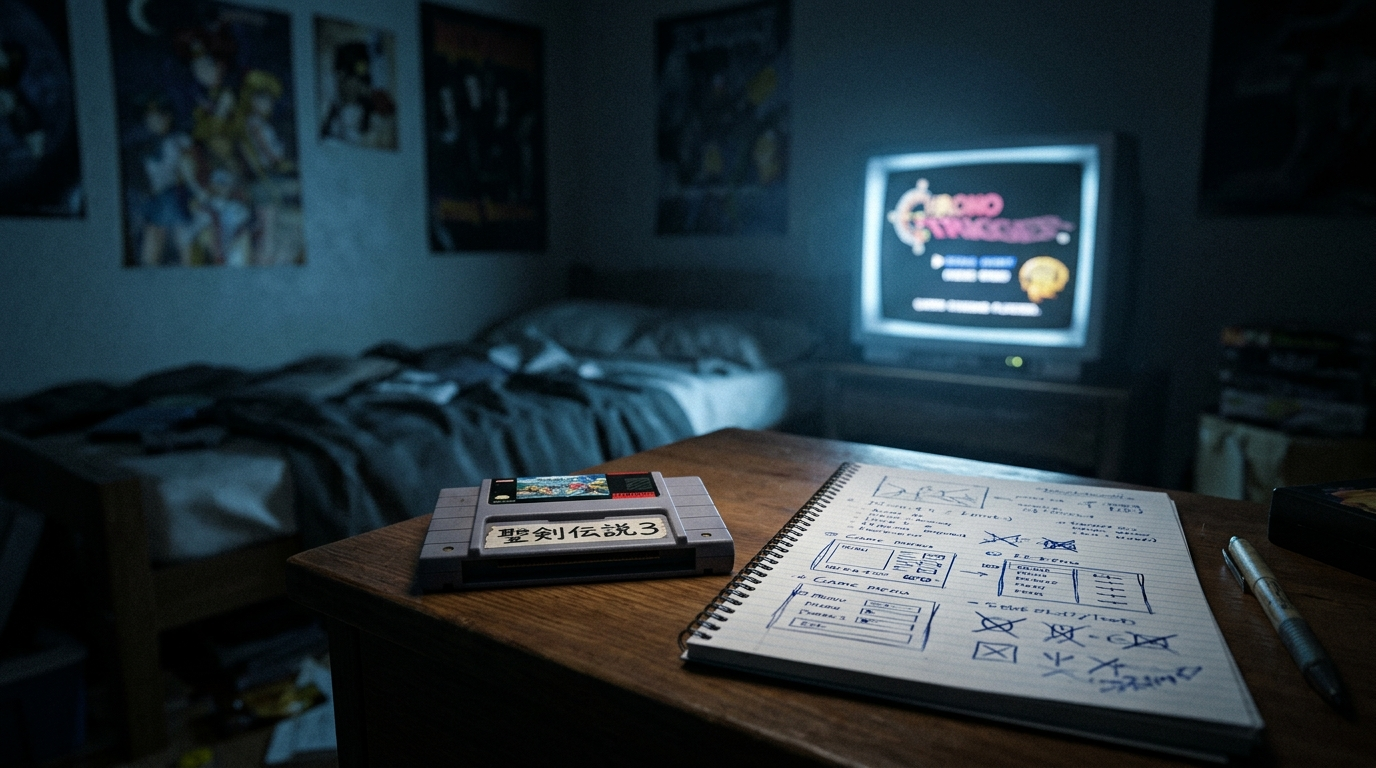
One late afternoon in the late 90s, a girl named Myria walked into the computer room of a California high school and saw a classmate playing Final Fantasy V. The scene had two problems. The game had come out in Japan in 1992 and had never been released in the United States. And the boy was playing it in English. The explanation, which Kotaku told years later, was a file: a ROM and a translation patch circulating online, made by three kids like her.
That scene sums up an era when a game's language decided who got to play it.
## The numbering that lied
Anyone following Final Fantasy in the West had a series with holes in it. Japan's fourth game came out in the US as Final Fantasy II, the sixth as III, and the fifth simply never appeared. Square thought using the real numbers would confuse the public, and Den of Geek recalls that this was the reason for packaging the fourth as the second. Of the fifth, players only knew what magazines said: that it was excellent.
There was a commercial explanation, and it's worth not caricaturing it. According to The Escapist, Ted Woolsey, who worked at Square, describes Japanese developers frustrated by US sales below expectations, and the same piece cites Square's disappointment with how the fourth Final Fantasy performed in the American market. Jeremy Blaustein, a Konami translator in that decade, says the received wisdom was "RPGs are for the Japanese, action is for the West." For him, the problem was translation, not genre: audiences weren't getting it, and anyone who did would love it.
An interesting thesis, and an untestable one, because the alternative to a bad translation was no translation at all.
## Sixteen characters
Translating Final Fantasy V by hand, as a fan, wasn't a question of willpower. The game capped each line of dialogue at 16 characters, which is plenty in Japanese and produces truncated, unreadable text in English. Latin letters also have different widths, unlike Japanese characters, so the patch had to teach the game to cope. A summary of the project describes the work as locating where Square kept the text, understanding its custom compression, and rebuilding the ROM without breaking everything else. All this from a group of teenagers, with tools that didn't yet exist in friendly form.
The result was, in the words of those who assessed it at the time, near-official quality, far above what other fan translations managed. How many people played it? Kotaku admits nobody knows: the patch was hosted on so many shady sites that counting downloads is impossible. The game's official history in the West was only fixed in 1999, with the PlayStation version, and in 2006, on Game Boy Advance. Until then, you used the patch or you read Japanese.
The fan translation community grew out of emulation in the late 90s, and Final Fantasy V was one of its first big projects. By 1996 groups were already announcing plans to translate it, and one eventually gave up and turned to the NES Final Fantasy II, a more achievable goal. Square Enix doesn't always stay quiet: in 2014 it sent a cease and desist to a translator who had finished a patch for Final Fantasy Type-0, right after announcing an HD version.
## The RPG Brazil had in Portuguese in 1991
On the other side of the Atlantic, the story ran the other way, and it's the part least often told.
Tec Toy, which distributed Sega in Brazil, translated Phantasy Star for the Master System into Portuguese in 1991. It is cited as the first RPG translated into the language. Canaltech stresses that this wasn't subtitles or a translated manual: the game had text essential to progression and was translated in full. The same company made adaptations that never existed elsewhere, such as an exclusive version of Street Fighter II playable only in Brazil.
A graduation thesis at UFRGS compared the Japanese script, the North American localization and the Brazilian one, looking at names, lines, grammar and cultural markers that were adapted or erased. In other words, how it was translated has been studied, not just whether, which says something about the case's weight.
The Master System kept selling in Brazil long after Sega abandoned the hardware. According to one source I consulted, it still sold about 150,000 units a year in 2015. I have no independent data confirming that figure, and one source is a Wikipedia mirror, so I treat it with caution. More recently, a group of Brazilian fans prepared a cartridge re-release with a retranslation made in 2017, different from Tec Toy's original.
The contrast is this. In the West, translation came from teenagers racing the clock. In Brazil, it came from a company that decided Portuguese was worth the cost. In both cases the game needed someone who believed the audience deserved to understand.
## What you play when you can't read
Here I stop having sources and start having opinions.
Anyone who played without understanding the language didn't play the same thing. They played menus by trial, symbols by repetition, the map by visual memory, the story by guesswork. I can't say that was worse. In some games the text layer is decorative; in an RPG like Final Fantasy V, where characters talk and the story advances through dialogue, a lot is lost. But those who played that way kept something else: the stubbornness of getting out of a dead end without help, and the feeling of decoding a foreign object.
And it's no accident that fan translation continued after the games were released. Aftermath notes that many PS1 games are almost impossible to play today simply because they were never translated, and that a community has been translating them for decades.
There's a racing game called Racing Lagoon that stayed out of the West's reach for 22 years. Its translator, according to Jalopnik, describes the main challenge as making English-speaking players feel what Japanese players felt: the game is famous in Japan for its overly poetic text, full of broken English. The Japanese also played without quite understanding.
**the sources I used...**
---
- Why Weren't the Real Final Fantasy 2, 3, and 5 Released Outside of Japan?, Den of Geek, n.d.: https://www.denofgeek.com/games/why-werent-the-real-final-fantasy-2-3-and-5-released-outside-of-japan
- How three kids beat the odds and translated Final Fantasy V, Kotaku, n.d.: https://kotaku.com/how-three-kids-beat-the-odds-and-translated-final-fanta-1794628286
- Fan translation of video games (DeJap Translations), Wikipedia, n.d.: https://Www.Wikipedia.org/wiki/DeJap_Translations
- Final Fantasy V import story, Bosnan, n.d.: https://bosnan.vercel.app/imports/final-fantasy-v-import
- Localization of Japanese games, The Escapist, n.d.: https://escapistmagazine.com/?p=51535