Spyro 1998: The 3D Platformer That Never Tried to Be Hard
Nov 8th '26 4:05pm:
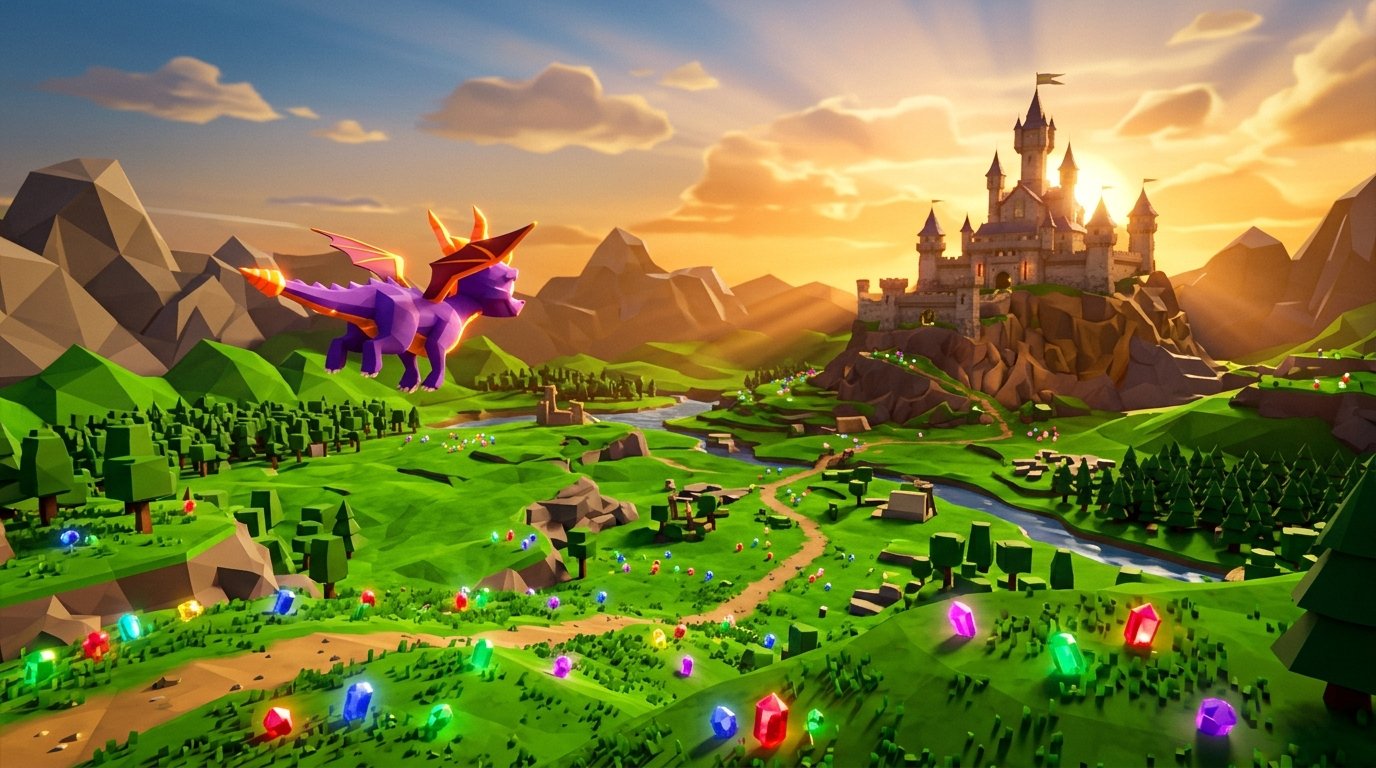
Twelve thousand. That's the number of gems scattered through *Spyro the Dragon*, and it's the best explanation I can find for why the game is still remembered fondly, almost thirty years after it reached the PlayStation in September 1998.
It sounds like a lazy answer. It isn't, and I'll try to show why.
## A 3D platformer that did everything the opposite of Mario
Insomniac Games came off a first game, *Disruptor*, a 1996 first-person shooter that never found the audience the studio hoped for. Sony, meanwhile, wanted mascots for its console and already had Crash Bandicoot, from Naughty Dog. And over all of it hung *Super Mario 64*, which in 1996 had set the standard: fine control, jumps you measure carefully, a camera that serves precision.
Insomniac didn't try to win on that ground. Spyro jumps, but the jump is almost a pretext for gliding. The glide stretches any fall, corrects misjudgments, and lets you land roughly where you meant to. The charge, a headlong run with horns forward, breaks enemies and some structures. The fire breath has modest range. None of this demands precision. It demands rhythm.
The practical effect is that the game rarely punishes hesitation. You fall, of course, and there's lava and water for the distracted, but the typical mistake costs a few seconds of walking, not ten minutes of retries. The genre's classic moment, missing the same jump fourteen times until you want to throw the controller, is almost absent.
## Gems
There are five values: red is worth 1, green 2, blue 5, gold 10 and purple 25. They sit inside baskets, behind enemies, on tiny islets and in corners the eye catches from a distance. Add them up and you get those twelve thousand.
The trick isn't the number. It's how the game shows you the next gem before it hands it over. Insomniac bet on an unusually long draw distance for the PS1, with scenery opening into wide valleys and without the fog many games of the era used to hide what the machine couldn't draw. You spot a platform far away, work out whether the glide will reach it, and go. Nobody told you to. There's no objective marker, no blinking icon. Curiosity is the only progression system that works from start to finish.
Then there are the eighty dragons, turned into statues by Gnasty Gnorc and freed at a touch, and the six worlds that serve as the base. The story is thin and the villain is easy to forget. The soundtrack, though, is by Stewart Copeland, drummer of The Police, and its percussion accompanies the running without pushing it.
Notice what this does to the pace of play. Every five minutes there's a small reward, and it's almost never one that cost you suffering. It's a generous game, and generosity has very little competition in the genre.
## The fair objection: what if it's just nostalgia?
This is the strongest objection and it deserves to be taken seriously. The PS1 drew coarse polygons. The camera, controlled by the shoulder buttons, doesn't always do what you want. The game is easy, and anyone looking for the challenge of *Mario 64* won't find it here. The sequels, *Ripto's Rage* (1999) and *Year of the Dragon* (2000), brought more moves and more variety, and many players think they're better games. In 2018, Toys for Bob took all three and relaunched them as the *Reignited Trilogy* on November 13, which shows that memory has commercial weight.
I concede all of that. Part of the affection is plain nostalgia.
What nostalgia doesn't explain, though, is why this game is remembered as a place, not as a list of mechanics. Nobody remembers Spyro for its combat system. You remember an open valley, a gem in the distance, the decision to glide or not. The sequels have more stuff, and maybe that's exactly why the first one has the cleaner idea: a whole world built around letting you go and look.
In the end, what stays is the sound of the gem. Not Gnasty Gnorc, who's weak, nor the final boss. The gem.