The 3dfx Voodoo Worked So Well Nobody Saw the Problem
Nov 4th '26 7:09am:
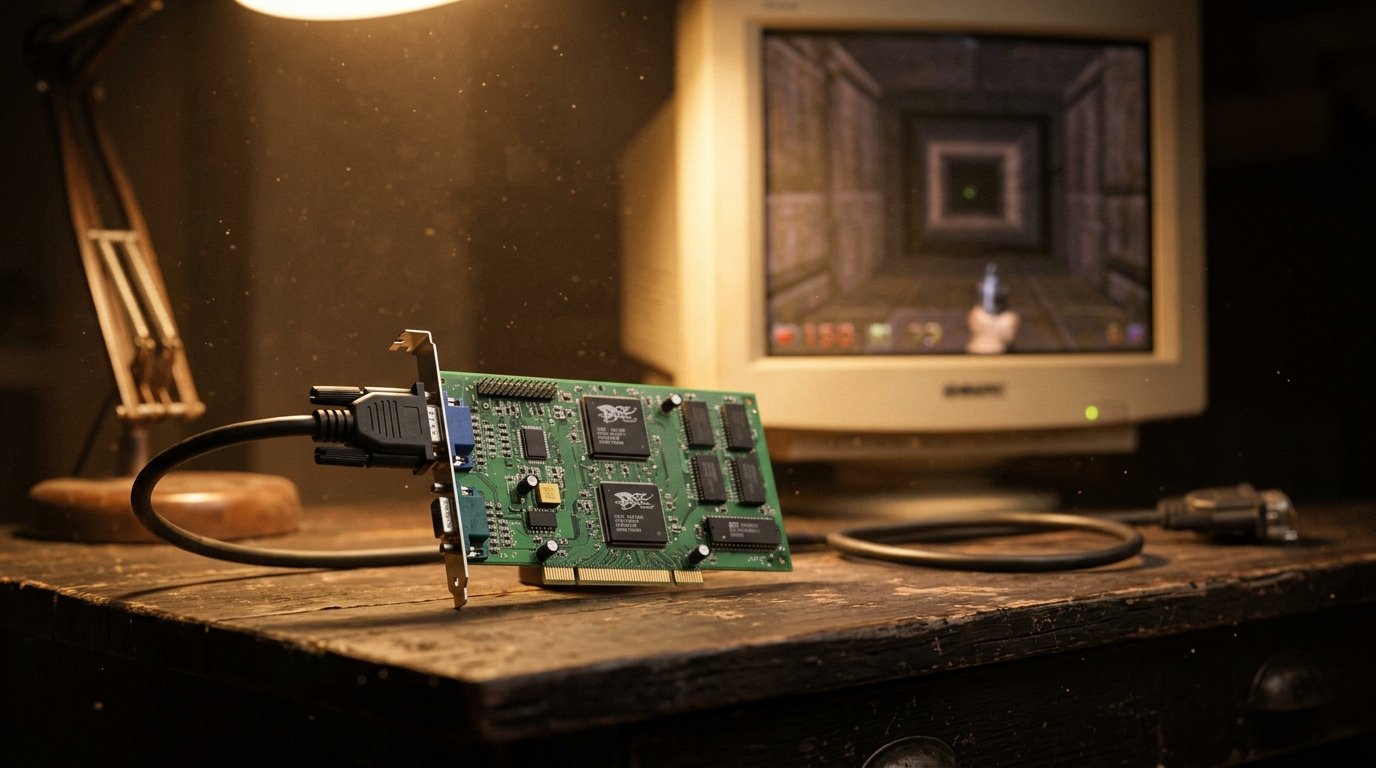
Early 1997. Someone installs GLQuake, connects the VGA cable from the 2D card to the Voodoo, the Voodoo to the monitor, and launches the game. Inside the case, a relay clicks. That is the card taking over the screen.
What appears next is Quake at 640x480, with smoothed textures instead of stair-stepped pixels, and moving without stutter. Anyone who saw this on a PC back then didn't need it explained.
## A card that could only do one thing
The Voodoo Graphics was not a graphics card in the sense we give the phrase today. It didn't draw the desktop or open windows. It was a 3D accelerator that sat beside the 2D card the PC already had, and the signal from the second passed through the first via a short cable. When a game asked for 3D, the relay switched and the Voodoo took over the video output.
The solution had real costs. The signal from the 2D card travelled through more cable and more contacts, and anyone with a good monitor noticed softer text on the desktop. But the division of labor let 3dfx focus on one thing.
The architecture was lean: two main chips, one for the framebuffer and one for texture mapping, running at about 50 MHz, with 2 MB of memory for each function in the base version. The 3D limit was 640x480. Boards from Orchid, like the Righteous 3D, reached stores at around 300 dollars.
Competition existed, and it was weak in a very specific way. The S3 ViRGE earned the nickname "graphics decelerator" because in some games it fell behind software rendering. The Matrox Mystique and the early ATI Rage did excellent 2D and mediocre 3D. The Voodoo did the opposite, and the opposite was what players wanted.
The company had been founded in 1994 by three engineers from Silicon Graphics: Ross Smith, Gary Tarolli and Scott Sellers. They knew what real 3D was, and they wanted a version that would fit in a home PC.
## Glide, or the advantage that seemed eternal
Hardware without games is dead weight. What made the Voodoo a phenomenon was Glide, 3dfx's proprietary API. It was deliberately small and spoke almost directly to the chip. For a game programmer in 1996 and 1997, writing in Glide was simpler and faster than fighting the Direct3D of the day, which had a deserved reputation for being clumsy.
The games came. Quake gained support for the card in early 1997, Tomb Raider received a dedicated patch, and "supports 3dfx" became a selling point printed on boxes. There was a generation of players who picked the game first and then checked whether their card supported it.
This was an enormous advantage. It was also a trap, and we'll get there.
## 1998: two cards, one screen
The Voodoo2 arrived in 1998 and brought the idea that marked the brand most: SLI, Scan-Line Interleave. Two cards in parallel, each drawing alternate lines, and the result allowed 1024x768, a resolution a single card couldn't reach. It was expensive, and that is exactly why it became an object of desire.
In December that year, 3dfx announced the purchase of STB Systems for about 141 million dollars in stock. STB was a board manufacturer. The intent was to build and sell its own boards instead of selling chips to third parties.
## The decision that doesn't show up in the diagrams
It sounds like a dull management decision. It was, perhaps, the most expensive one in the company's history.
Until then, manufacturers like Diamond and Creative bought chips from 3dfx and sold boards under their own brands. By becoming a manufacturer, 3dfx went from supplier to competitor of its own customers. They looked around and found Nvidia, which kept selling chips to anyone who wanted them.
At the same time, Nvidia was doing something else. The RIVA TNT, in 1998, combined 2D and 3D on one card and supported 32-bit color. The TNT2 refined the recipe. And in October 1999 came the GeForce 256, with geometry calculation in hardware, something 3dfx didn't have and wasn't close to having.
The Voodoo3, launched in March 1999, was a fast, well-made card. But it was stuck at 16-bit color and 256x256 textures, at a time when the competition was already advertising the opposite as an advantage. Reviews of the time stressed the contrast with Nvidia, and players read them.
Then came the delays. The Voodoo5 line only arrived in mid-2000, and the four-chip Voodoo5 6000 never reached shelves in commercial volume. Nvidia, meanwhile, kept a six-month product cycle that 3dfx could no longer follow.
## Did Glide kill it?
The easy thesis is yes. Glide gave 3dfx an early advantage and tied the company to it, while the world moved toward Direct3D and OpenGL. There is truth in this: owning an API creates dependency, dependency becomes comfort, and comfort slows you down.
The best objection is that Glide doesn't explain the delays, the STB purchase, or the lack of 32-bit color. A proprietary API doesn't stop a company from shipping products on time. Nvidia won because it delivered more, faster, with room to make mistakes without disappearing.
It's a good objection and I don't knock it down entirely. What Glide did was give 3dfx the illusion that its pace was enough. A company that dominates a market with a technology only it owns has more trouble noticing that the market has stopped belonging to it. That isn't a single cause. It is a mitigating factor for the blindness.
## The end, in small numbers
In December 2000, Nvidia announced the purchase of 3dfx assets for about 70 million dollars in cash and one million shares. 3dfx entered bankruptcy proceedings in 2002. Barely more than four years passed between the Voodoo Graphics reaching stores and the sale of the remains.
Old Glide games still run on modern computers thanks to fan-made wrappers such as dgVoodoo or nGlide, which translate the API calls for today's graphics card. It's a quiet kind of survival.
In 2004, Nvidia launched its own SLI. It no longer meant Scan-Line Interleave but Scalable Link Interface. The acronym stayed. They only swapped the words.