Crash Bandicoot was born to challenge Mario, and it shows
Oct 27th '26 10:52am:
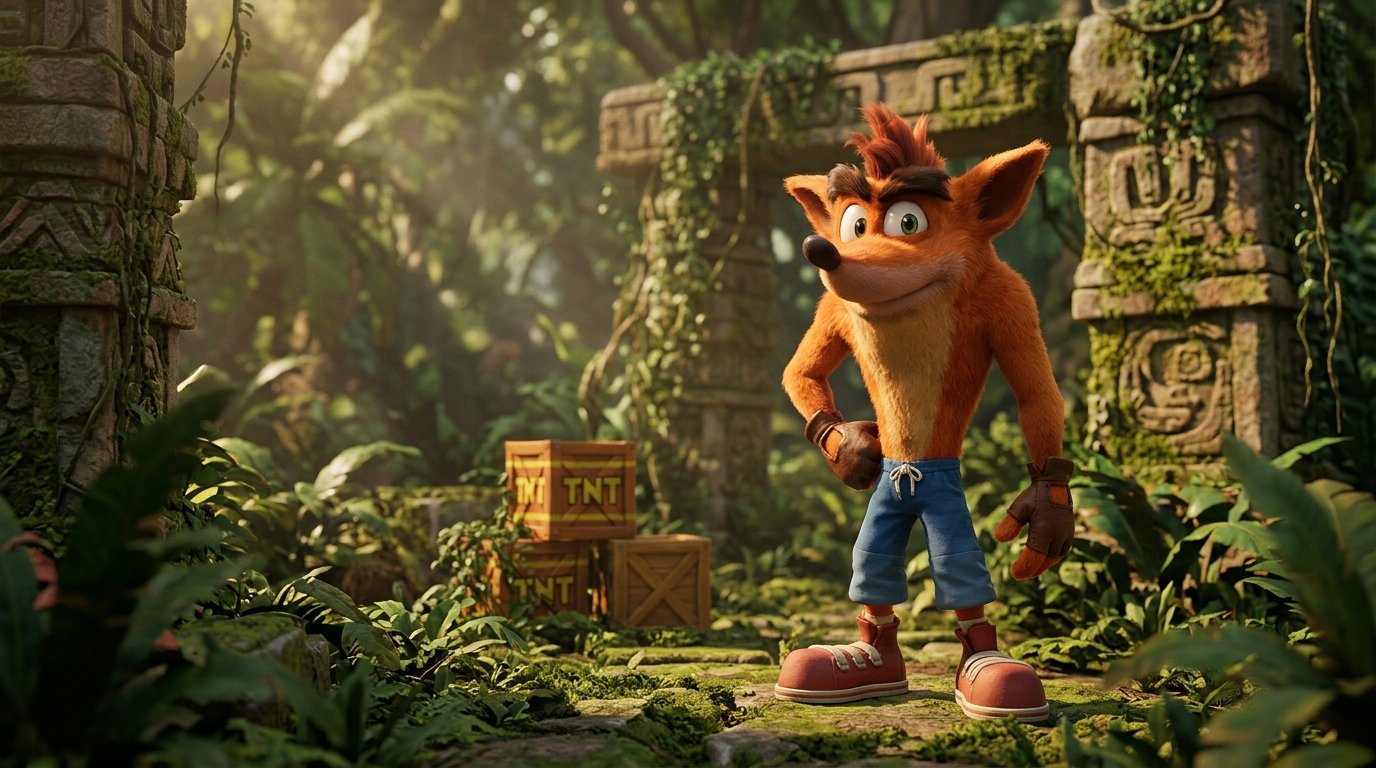
Sony wanted to compete with Nintendo and Sega. What it lacked was a character that players would immediately associate with PlayStation. Mario belonged to Nintendo. Sonic represented Sega. Sony's new console needed something similar.
The answer arrived in 1996: an orange marsupial with oversized eyes, large sneakers and a personality as chaotic as the environments he ran through. His name was Crash Bandicoot.
There is one detail in this story that often disappears when Crash is described as a mascot Sony created to defeat Mario: the idea originated at Naughty Dog, not as an internal Sony project designed to produce an official character. Andy Gavin and Jason Rubin saw a creative and commercial opportunity. Sony eventually benefited from their gamble. 

All Things Andy Gavin+2
## A project that began with a joke about Sonic
In 1994, Andy Gavin and Jason Rubin were preparing for a new phase at Naughty Dog, the studio they had founded. Their plan was to develop a three-dimensional platform game, a genre gaining importance as home consoles evolved.
Their inspiration included games such as Super Mario and Sonic the Hedgehog, but the pair did not want to simply reproduce existing formulas. They wanted to find out how the speed, jumping and spatial awareness of two-dimensional platform games could work in a three-dimensional world.
The project initially had a revealing informal name: Sonic's Ass. The joke came from the camera position. Instead of watching the character from the side, as in traditional platform games, players would follow the protagonist from behind as he ran towards the horizon.
That choice changed the way the game would be played. Players had to judge distances, anticipate obstacles and understand depth before jumping. A perspective error could turn an apparently simple leap into a frustrating fall.
The character concept also served a commercial purpose. Gavin and Rubin realised that PlayStation lacked an action character capable of competing for attention with Mario and Sonic. They decided to create one, even though they were working with Universal Studios' gaming division rather than directly for Sony. 

All Things Andy Gavin+2
The distinction matters: Sony did not have to invent Crash to recognise his potential value.
## The wombat who didn't stay a wombat
The character's development began with a different creature from the one players would eventually know.
Gavin and Rubin considered a wombat and temporarily called their creation Willy the Wombat. They wanted an Australian animal that was recognisable but unusual enough not to feel like another copy of an established mascot. Consulting an Australian wildlife guide helped lead them to the bandicoot.
The name Crash came later. Destructible crates had become a central part of the experience, and the team explored action-related names such as Crash, Dash, Smash and Bash. Crash ultimately won. 

by Eric Alt+1
The visual details also served practical purposes.
The bright orange fur helped distinguish the protagonist from the dense vegetation surrounding him. His oversized face and barely defined neck made his expressions easier to read at a time when console graphics and television resolution placed considerable limitations on character presentation.
These were not merely aesthetic decisions. They were solutions to the technical limits of the period.
Today, Crash can look like an exaggerated cartoon character. In 1996, that exaggeration helped him stand out in a three-dimensional environment that game developers were still learning to master.
## Sony gained a face without commissioning one
Crash made his public debut at E3 in 1996, when PlayStation was still establishing its identity in the market.
The timing was good. Nintendo already had Mario, while Sega had Sonic. Naughty Dog's character gave Sony a figure it could place alongside those two names in promotional campaigns and commercial presentations.
The first Crash Bandicoot arrived on PlayStation in North America on September 9, 1996. According to Evan Wells, Naughty Dog's president, in a PlayStation Blog article, the game had been developed by a team of just eight people. Wells also recalled how the first game's success quickly created demand for a sequel. 

GameSpot+1
The response helped demonstrate that there was room for a character with a distinct identity rather than a generic platform-game protagonist.
Crash also had a visual advantage. His orange silhouette, exaggerated animations and unpredictable attitude distinguished him from the more controlled, familiar heroes of the era. He was easy to recognise in promotional artwork, and watching him play made it clear that the game had a personality of its own.
Still, it would be misleading to describe Crash as the exact equivalent of Mario. The character was never formally established as Sony's official mascot. In an interview with the Crash Mania community, Jason Rubin explained that the team set out to create a PlayStation character without even asking for advance permission to take on that role. 

Crash Mania
Sony took advantage of the opportunity. But benefiting from an idea and creating it are two different things.
## The rivalry was never simply about copying Mario
The Mario comparison helps explain the strategy, but it becomes misleading when used to explain the game itself.
Crash Bandicoot did not attempt to reproduce exactly the freedom of movement that was beginning to define other three-dimensional experiences. Most of its levels were controlled routes filled with obstacles, crates, enemies and carefully positioned jumps.
That structure allowed Naughty Dog to guide the camera and manage what the player could see. Instead of building an open world for unrestricted exploration, the team could arrange challenges around distance, rhythm and obstacle placement.
The crates were more than destructible scenery. They introduced small decisions, concealed rewards and forced players to study the environment before moving forward. In some situations, breaking every crate required a different approach from simply reaching the end of a level.
Crash therefore had his own mechanical identity, even though he emerged from a competitive ambition similar to the one that had helped make Nintendo and Sega's mascots popular.
The character was also not created in isolation. Development involved artists such as Charles Zembillas and Joe Pearson, alongside other Naughty Dog team members. The design we know today resulted from a collaborative process, not a single miraculous drawing. 

by Eric Alt+1
## The part of the story the mascot image hides
There is another irony in Crash's history: although he became associated with PlayStation, he was not always owned by Sony.
Universal Interactive Studios held the character's rights and worked with Naughty Dog under an arrangement involving Sony on a game-by-game basis. In a 2000 GameSpot article, a Universal representative confirmed that the company owned Crash and that its relationship with Sony operated on a title-by-title basis. 

GameSpot
The franchise's publishing history subsequently involved other companies. In 2006, Crash's publishing rights moved to Sierra Entertainment, then associated with Vivendi, which later merged with Activision. In October 2023, Microsoft completed its acquisition of Activision Blizzard, bringing those entertainment properties into its gaming business. 

by Eric Alt+1
This helps separate two things that players often treat as one: a character's cultural identity and the legal ownership of its intellectual property.
For anyone who grew up with the original PlayStation, Crash will continue to evoke crates, jungle levels and the music of Naughty Dog's games. That association does not disappear when the rights change hands. But the power to decide the franchise's commercial future belongs to whoever controls the intellectual property, not necessarily whoever made the character famous.
That is precisely what distinguishes Crash from a traditional mascot developed and controlled directly by a console manufacturer.
In 1994, Gavin and Rubin were looking for an interesting way to turn platform games into three-dimensional experiences. The need to compete with Mario and Sonic gave them a commercial direction, but the camera choices, destructible crates and protagonist's clumsy personality ultimately defined the result.
Perhaps the most curious detail is this: the name that became attached to one of the best-known characters of the original PlayStation emerged because there were so many crates in the way.