Mortal Kombat: How Real Actors Became Pixels in 1992
Oct 20th '26 5:54pm:
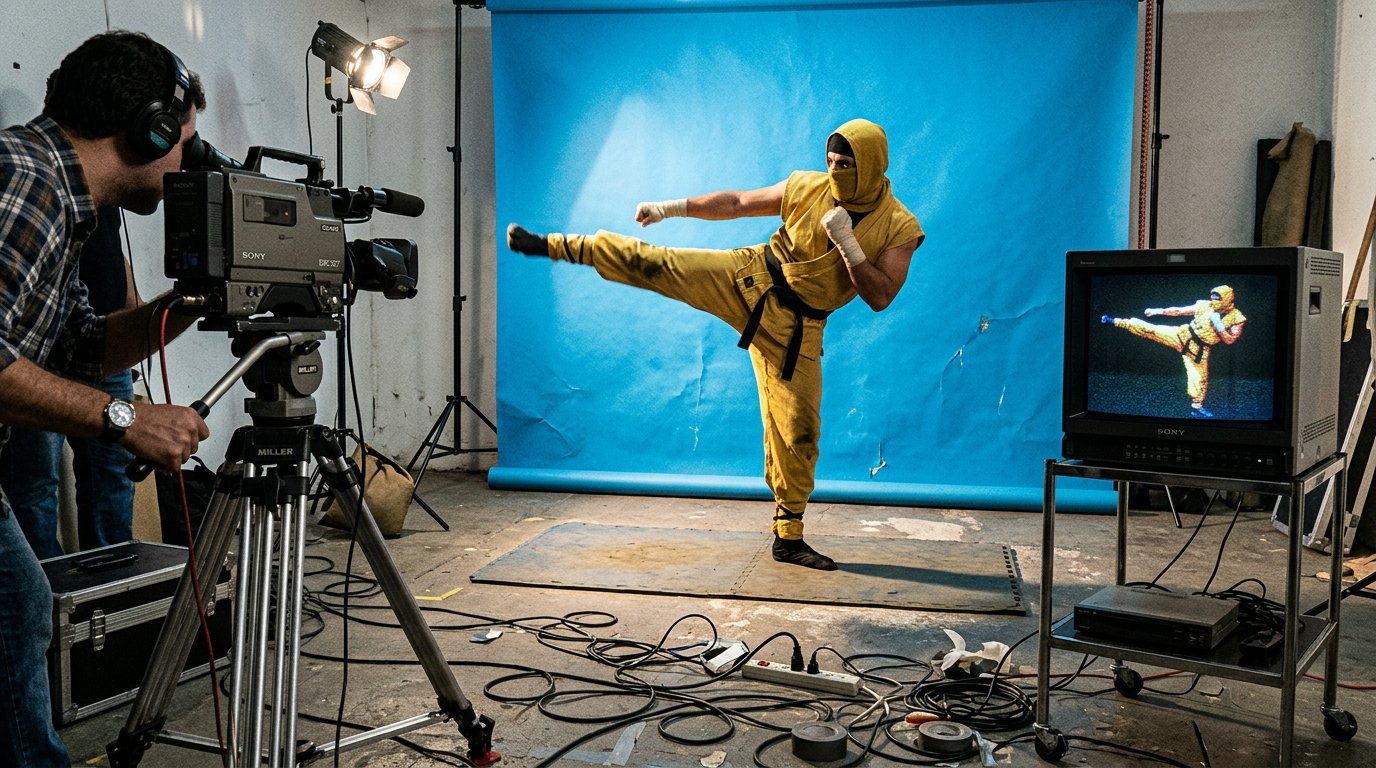
In 1992, four people at Midway in Chicago finished a fighting game whose characters looked like moving photographs. Nobody had used motion-capture sensors. **The actors were filmed on video, each frame was frozen, cut out and cleaned by hand, and the result became arcade sprites.** That is why *Mortal Kombat* looked so different from *Street Fighter II*, and why it was so hard to animate. The technique was the studio's standard for about four years, and its marks still define the series' identity.
## The 1992 pipeline, from mat to cabinet
Calling it "motion capture" is the most common mistake, and it hides how much work the process took. The difference is one of kind: mocap records joint positions to animate a 3D model, while *MK*'s digitization recorded the **appearance** of a real body, frame by frame. According to what the team has described in interviews over the years, the flow went like this:
- **Filming:** the actor performed every strike, fall and reaction in front of a video camera (accounts point to a Hi8-class format, close to consumer grade) against a plain backdrop.
- **Frame extraction:** the video was fed into a computer and broken into still images. A half-second kick yielded a few dozen usable frames.
- **Manual cleanup:** the artist removed the background, fixed outlines and reduced the colors. Skip this step and the character looks cut out with blunt scissors.
- **Palette and size reduction:** an arcade board's memory was tight, so each frame had to fit in a handful of colors and a few kilobytes.
- **Animation assembly:** frames were ordered, trimmed when they went over the memory budget, and tied to the game's collision logic.
Development time was a matter of months for an arcade title of that scale, and the core team was tiny: Ed Boon and John Tobias on programming and design, John Vogel on art and Dan Forden on sound. When you read "digitization," picture a few people spending nights erasing background pixels, not an assembly line.
## The flesh-and-blood fighters
Few people stood behind many characters, and that economy shaped the roster.
**Daniel Pesina** was the face of Johnny Cage and also the body of Scorpion, Sub-Zero and Reptile. The three ninjas came from the same set of frames with palette swaps: yellow, blue and green. The first *Mortal Kombat* is, in part, a game about one actor with many costumes. **Carlos Pesina**, Daniel's brother, played Raiden. **Ho-Sung Pak**, trained in Chinese martial arts, played Liu Kang and Shang Tsung. **Richard Divizio** was Kano, and **Elizabeth Malecki** gave Sonya Blade her body.
The palette trick is the game's most underrated design choice. Swapping colors was cheap and delivered more characters without reshooting anything. It also cost identity: for years, part of the audience looked at Scorpion and Sub-Zero and saw two versions of the same movement.
## Goro, the one who wasn't human
The four-armed boss couldn't be played by anyone. Goro was a **physical sculpture**, made of materials like clay and latex, animated in stop-motion and digitized like the others. That explains the sense of weight and skin he has on screen, unlike the human fighters. He was a quiet warning of where the industry was headed: when a real body won't do, someone has to invent one, physical or virtual.
## The cost of the technique: memory, stiffness and leftover poses
The realism came with a steep bill. Every new move took memory the cabinet simply didn't have, and each character ate a generous slice of the total budget. That is why *MK*'s animations have few frames per move, and why strikes snap instead of flow. The eye sees pose, pose, pose, and the brain fills in the rest. The stiffness many people blame on "lack of talent" is actually a symptom of a **memory ceiling**.
### Before MK: Pit-Fighter and the promise that didn't pay off
Atari Games had released *Pit-Fighter* in 1990 with digitized actors, before *Mortal Kombat*. As a fighting game it was slow and confusing, and nobody remembers it for its gameplay. The difference is that Midway understood what was missing: **digitization only works if the game is designed around it**. *MK* chose few fighters, fixed arenas, high-impact moves and a combat system that was quick to grasp. Spectacle came before technical depth.
The project's origin was also a little absurd. According to the creators themselves, the initial plan was a game with Jean-Claude Van Damme, which fell through. What survived was an 80s martial-arts-movie mood and a character, Johnny Cage, who is a direct parody of the Belgian star. Digitization fit that spirit: if the tone was B-movie, nothing was more coherent than fighters who looked like they'd walked out of one.
### What I think the consensus got wrong
In my assessment, the idea that *Mortal Kombat* "won" because of the blood tells only half the story. The blood and fatalities sold the controversy, but **digitization sold the illusion that this was real**, and that is what made the violence uncomfortable. Hand-drawn pixels of a ninja ripping off a head would be a cartoon. A photographed body doing the same, even with few frames, landed somewhere else. When the U.S. Senate held hearings on violent video games in December 1993, after that September's "Mortal Monday" home release, the technique sat at the center of the scandal without being named. The hearings accelerated the age-rating system that arrived with the ESRB in 1994.
What almost nobody mentions is that this made digitization, for a brief moment, a **moral marketing weapon**: the more real the body, the less acceptable the blow.
## What happened to the actors afterward
The digitized actors faced something nobody had foreseen in 1992: their faces and bodies were now an asset that lived on in the game, the sequels and the ports. Daniel Pesina ended up in a legal dispute with Midway in the following years over the use of his likeness in later products in the series. Without going into the details of each ruling, the case shows the era's legal blind spot: contracts designed for a single afternoon of filming didn't anticipate the same body being reused in sequels, collections and spin-offs. It was one of the first cases in which the industry realized that a sprite is also a person.
In *Mortal Kombat II* (1993) the team raised the production level, with more actors and a wider variety of moves, and by *MK3* in 1995 the technique had reached the limit of what sprites could do.
## The end of photography, and the problem that remained
Digitization died for a simple reason: 3D won. *Virtua Fighter* (1993) and *Tekken* (1994) showed that polygons allowed free cameras, longer animations and characters that turned in space. *Mortal Kombat 4* in 1997 moved to polygonal models and used motion capture to animate them. Actors stopped being photographed and started being measured.
But here is the point that strikes me as unresolved. The 1992 *MK* look is ugly by today's standards, and unmistakable. The games that came later had more fidelity and less signature. Nobody confuses a digitized Scorpion sprite with anything else, and no high-resolution 3D model produces the same strangeness.
The question that remains is an uncomfortable one: if today we can copy a face with photographic precision, **why was the series' most memorable style the one that came from technical limits nobody wanted?**