Yuzo Koshiro and the Chip That Wasn't Supposed to Sound This Good
Oct 15th '26 6:51am:
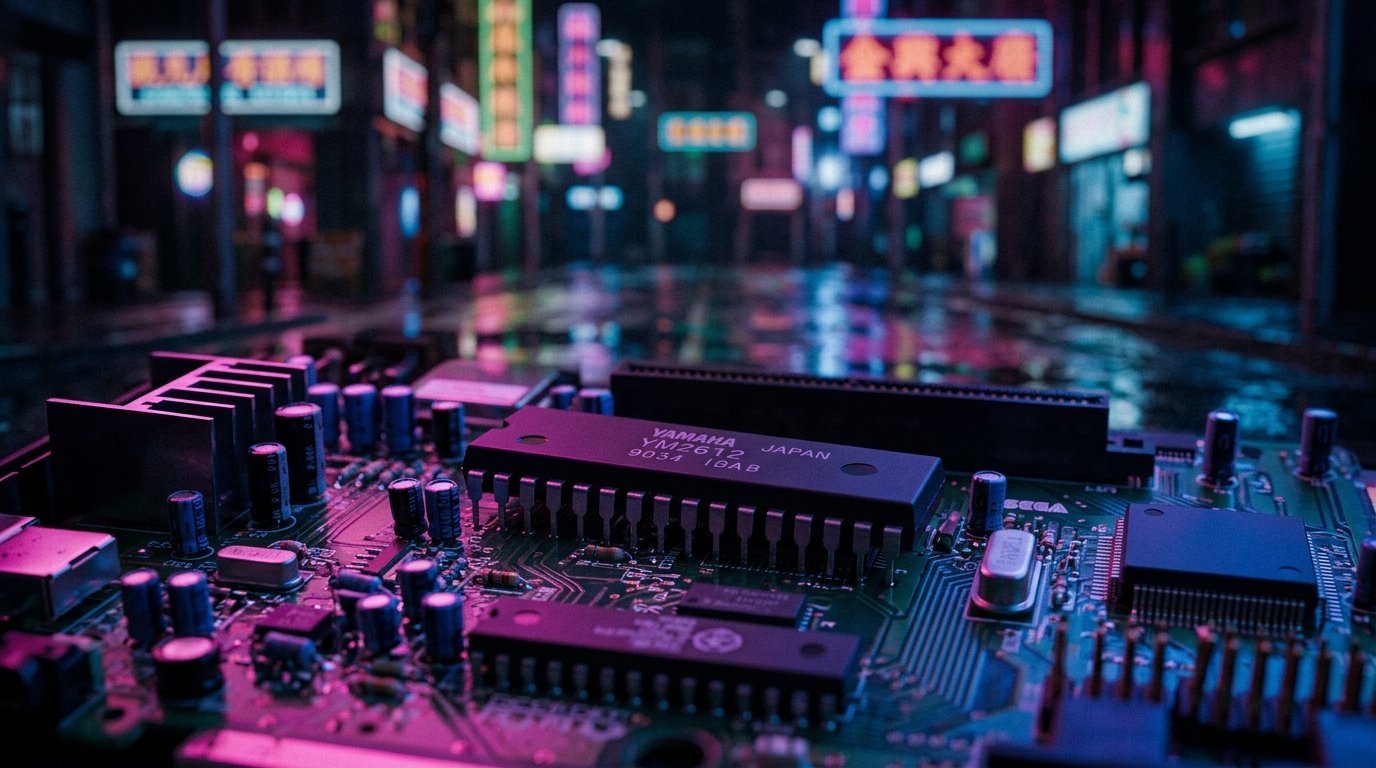
In 1992, the Sega Mega Drive had six FM synthesis channels, three square-wave voices and a secondary processor with 8 KB of RAM to run all of it. That was the budget Yuzo Koshiro and Motohiro Kawashima worked with on the ***Streets of Rage 2*** soundtrack, which still turns up on every serious list of the best video game music. More than three decades later, the case matters because it wasn't a miracle against the hardware. Koshiro realised early that Yamaha's chip could sound like a Tokyo club, and he wrote for that sound instead of trying to hide it.
## What Yamaha's Chip Actually Delivered
Start with the numbers, because the legend tends to inflate the drama. The Mega Drive's sound rested on four parts:
- **Yamaha YM2612:** six FM synthesis channels, four operators per channel.
- **Texas Instruments SN76489 (PSG):** three square-wave voices and one noise channel.
- **Zilog Z80:** a processor dedicated to sound, with its own 8 KB of RAM, while the Motorola 68000 ran the game.
- **8-bit DAC:** plays back sampled audio, but takes the place of the sixth FM channel. Every recorded kick drum costs you one synthesised channel.
The first useful comparison is with the direct competition. The Super Nintendo, released in Japan in 1990, took a different philosophy: a Sony sound chip with eight sample-based voices and 64 KB of memory. That gave it the timbres of real instruments, which is why so many soundtracks on that console sound "orchestral." The Mega Drive had no such luxury. It had FM synthesis, which is waves modulating each other, and it produces metallic, cutting, hard-to-tame timbres. Koshiro knew both machines: he scored *ActRaiser* on the Super Nintendo in 1990 while working for Sega in the same period. When he chose to write house and techno for the Mega Drive, it wasn't for lack of alternatives.
The second comparison is with his own past. In the Japanese computers of the 1980s, such as NEC's PC-88 line, composers worked with Yamaha chips from the same family, with fewer channels and far more freedom in timing. Koshiro arrived at the Mega Drive with years of practice sculpting FM timbres by hand, without a safety net of ready-made sound libraries. His Western counterparts generally relied on generic drivers. He wrote his own tools.
## From Tokyo to the Clubs: The Road to Bare Knuckle
Popular biographies often make a common mistake: treating *Streets of Rage* as Koshiro's first appearance. By 1991, when the game came out in Japan as *Bare Knuckle*, he already had a résumé. He had joined Nihon Falcom early, working on *Ys* alongside Mieko Ishikawa, and in 1989 he wrote the music for Sega's *The Revenge of Shinobi*. His ear for melody came from the JRPG and the Japanese computer-music school. What was missing was something else.
That something else came from the night. In several interviews, Koshiro has spoken about his connection to dance music, especially Chicago house and Detroit techno, and the time he spent in clubs. What he did in *Streets of Rage* was a translation, not an imitation. He heard music made with synthesisers and drum machines and realised that the FM chip, with its dry basses and electronic pads, was the natural instrument for it. At the time, the rest of the industry wrote game music as if composing for a piano or a stripped-down rock band reduced to bleeps.
His mother, Tomo Koshiro, presided over Ancient, the company he helped found and which became the base for his independent work. The detail sounds anecdotal, but it explains something practical: Koshiro had a structure of his own that let him keep his tools and his pace, instead of being at the mercy of a publisher's in-house team.
## A Kick Drum Without a Drum Kit: How the Sound Was Built
Writing dance music on an FM chip raises one concrete problem, and its name is drums. On an analog synth, a kick is made with an oscillator whose frequency drops very fast. On the YM2612 you can do something similar: an operator with a very quick pitch envelope produces a convincing thump, and another with modulated noise supplies the attack. But that burns FM channels, and there are only six, which also have to pay for the bass, the pads, the melody and the effects.
The alternative is the sample. The DAC lets you play back recorded sounds, which is why the snares and kicks in *Streets of Rage 2* have that grainy character, an attack that always sounds slightly dirty. The cost is double, though: you lose an FM channel, and the Z80 is busy feeding the DAC in tight loops, which limits what else the processor can do at the same moment. Koshiro had to decide, bar by bar, where that budget was worth spending. Hence the feeling that the tracks breathe: there are moments when the percussion comes in hard and others where it vanishes to let the bass work.
Anyone who listens to **"Go Straight,"** the first-stage theme of *Streets of Rage 2*, hears the consequences of those choices: a bass line that sounds like it came from a studio machine, short chords that push forward, and a kick that lands exactly where the body expects it. In **"Never Return Alive,"** the tension comes from little more than an insistent bass and filtered noise, which is club architecture compressed into half a dozen channels.
## What the Official Story Leaves Out
### The pattern: limits as method
A pattern recurs in Koshiro's career: instead of fighting the hardware, he treats it as part of the composition. In *Streets of Rage 3* (1994), he and Kawashima went further and used an automated composition tool, with elements of random generation, to produce harsher, more abstract techno tracks. The result divides opinion to this day, and that is exactly what makes it interesting: a composer using his own computer as a collaborator, in 1994, in a brawler for 16-bit consoles.
The pattern repeats later, on other platforms, with different results. Koshiro kept writing game music for decades, including the *Etrian Odyssey* series, and returned to *Streets of Rage* in 2020 for the fourth game, this time as one of several composers, alongside names such as Yoko Shimomura and Olivier Deriviere.
### My reading
In my assessment, the "genius despite the limitations" narrative is lazy. It assumes Koshiro wanted to sound like an orchestra and had to settle for bleeps, and that's wrong. What he did was choose an aesthetic, that of electronic dancefloor music, and see that the hardware at hand was the best possible fit for it. The chip's limits didn't take anything from him; they gave him a vocabulary.
What nobody is saying clearly is that this changes how we should look at game music today. A team now has access to audio streaming, orchestral libraries and human voices, and budget barely limits anything anymore. The result is soundtracks that are competent, big and often indistinct. When the limit disappears, so does one of the reasons to make radical decisions. The uncomfortable question is whether the best game music was the kind that had to be invented because there was no alternative.
## The Same Music, Three Different Consoles
There is a detail that rarely appears in celebratory texts and that any collector knows: the Mega Drive doesn't sound the same in every revision. The original Japanese model and the first Western model have a richer, warmer audio circuit. Later, cheaper revisions brought component changes that altered the sound, and some of them moved to an integrated version of Yamaha's chip. To an attentive listener, the bass and the brightness of the same track change from version to version.
This means Koshiro's music was, from the start, a work subject to the equipment it's heard on. Emulators try to reproduce the chip accurately, and Sega has re-released the game on mini-consoles and compilations, each with its own tuning. None of those versions is "the" version. Each person grew up with one, and that is the one they consider the original.
One question is left without an easy answer: if the most celebrated soundtrack of the 16-bit era depends this much on the circuit that plays it, what are we preserving when we listen on a phone, from a clean