Virtual Boy Headaches: What Nintendo Saw Coming in 1995
Oct 13th '26 7:53am:
Written by: GEmmo
<br>On February 17, 2026, Nintendo resurrected the Virtual Boy inside the Switch Online + Expansion Pack. What got people talking wasn't the plastic accessory (or the cardboard one, in the cheap version) that holds the Switch. It was the warning at the door: don't play more than 30 minutes at a time. More than three decades after the original launch, on July 21, 1995 in Japan and August 14 in North America, the red-and-black machine is still remembered for the reason that pulled it from the market within months: it gave people headaches. But the stock phrase hides a better question. What exactly was happening to the eyes and brain of someone leaning over that viewer? And how much of it did anyone actually measure?
## One Viewer, Two Red Screens and a Stand: The Spec Sheet That Explains the Pain
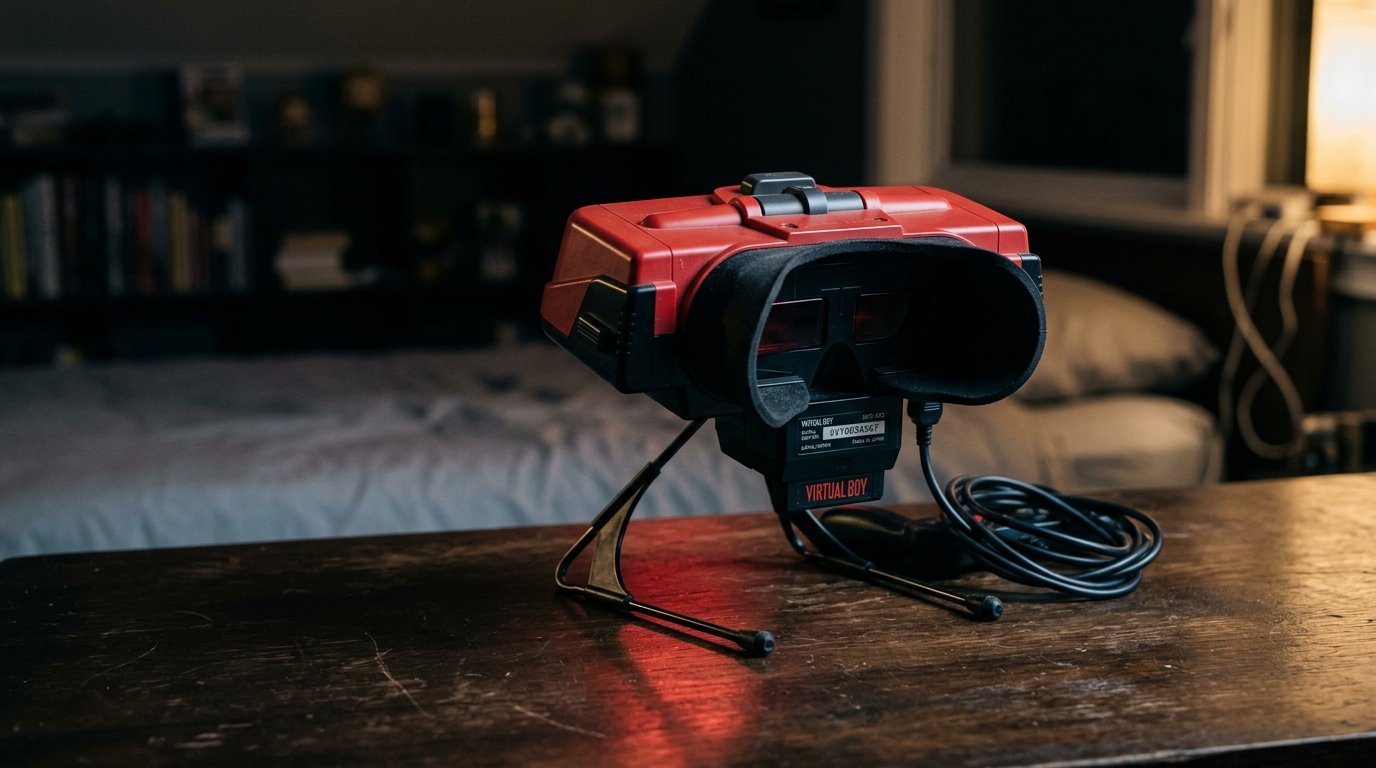
Before talking symptoms, look at the object, because almost everything that went wrong is in the spec sheet.
- **Displays:** two, one per eye, at 384 × 224 pixels each, in red LEDs on a black background. The technology came from Reflection Technology, a Massachusetts company.
- **Scanned image:** instead of a panel that lights up all at once, a row of LEDs was "swept" by oscillating mirrors, at 50 Hz.
- **Hardware adjustments:** interpupillary distance (IPD) and focus controls.
- **Mounting:** a tabletop stand included, and no head strap.
- **Safeguards:** optional auto-pause in games, a recommendation to take breaks, and an age guideline of 7 and up.
- **Market:** US$179.95 in the US, around 770,000 units sold, 22 games.
None of these points is absurd on its own. The problem is the sum. A 50 Hz scanned display, a few centimetres from the eyes, in a single saturated colour, for an hour of *Red Alarm* or *Teleroboxer*, looks like nothing the human visual system meets in normal life. The red wasn't chosen for aesthetics. The most repeated version is that red LEDs were the cheapest and brightest to produce at scale, and Nintendo wanted a price that wouldn't scare parents off.
The result was a machine with "true" 3D, real depth between planes, that delivered that depth in a way the body couldn't process without effort.
## Vergence, Accommodation and the Sum the Brain Can't Close
To look at something nearby, the eyes do two things at once: they turn toward each other (vergence) and the lens adjusts its curvature to focus (accommodation). In real life the two go together. In a stereoscopic viewer, they stop doing so.
The image sits on a fixed optical plane, so accommodation stays at that distance. The disparity between the two screens, which creates the illusion of depth, asks vergence to follow objects that seem nearer or farther. The brain receives two contradictory instructions. This mismatch has a name, **vergence-accommodation conflict**, and Hoffman, Girshick, Akeley and Banks described it in 2008, in the *Journal of Vision*, as a cause of visual fatigue in stereoscopic displays. The discomfort isn't a defect of the Virtual Boy in particular. It's a property of the family of technologies it belongs to.
What did the Virtual Boy add to that baseline?
There are at least two plausible hypotheses, and they should be treated as hypotheses. The first is the flicker of the 50 Hz scan, which can bother people very unevenly. The second is the intense monochrome field, which demands contour-reading effort without the help of colour. Neither has been demonstrated for this specific device.
There were also people who never had a problem, simply because they couldn't see 3D. People with strabismus, amblyopia or reduced stereo vision, a small but real slice of the population, looked at two flat overlapping images and wondered what the fuss was about. For them, the machine was just a very awkwardly placed red screen.
And one detail that only someone who has dug into the device will notice: the two hardware adjustments existed for a reason. The IPD dial aligns the lenses with the distance between your pupils, and a misalignment forces the eyes to compensate continuously. In my assessment, many people never touched it. Someone who picked up a Virtual Boy in a shop or at a friend's house would look in, find it strange, and move on. Part of the "gives you a headache" reputation may simply be that of a badly adjusted viewer.
## Neck, Posture and the Choice Not to Put It on Your Head
Period accounts don't only mention eyes. They mention necks. To fit your face into the viewer, you had to hunch over the table, and the more interesting the game, the longer you stayed that way. Neck pain after a half-hour session of *Galactic Pinball* is the kind of thing nobody puts on the box.
The decision to use a stand instead of a head strap was, as far as is known, also a safety choice. Nintendo avoided the weight of a head-mounted viewer and the disorientation of no longer seeing your surroundings. It's a curious irony: the solution designed to reduce one risk created another, more mundane and more constant.
## The Comparisons That Count: From 1993 to Today's Headsets
If we want to gauge the real weight of these complaints, it helps to look at what's known about similar devices, and two comparisons are useful.
**The first predates the Virtual Boy.** In 1993, Mon-Williams, Wann and Rushton published in *Ophthalmic and Physiological Optics* a study on binocular vision after using a head-mounted display, titled "Binocular vision in a virtual world". They measured transient changes in binocular function after relatively short use. It wasn't about the Virtual Boy, but it was exactly the kind of literature any toy company's legal department in 1995 would have had in front of it, and it helps explain the caution of the warnings.
**The second comes later.** In 2011, Nintendo returned to stereoscopy with the 3DS. The difference wasn't technological, it was about control: a depth slider beside the screen that let the player turn the 3D down or off, and a warning that children under 6 shouldn't use 3D mode. The Virtual Boy had no knob to reduce depth. It was all or nothing.
Today, age recommendations for virtual reality range from 10 to 13: Meta lowered the Quest's minimum age to 10 in 2023, Sony indicated 12 for PlayStation VR in 2016, and Apple recommends the Vision Pro only from 13. An entire industry has been quietly learning what Nintendo tried to head off in 1995 with a line in the manual.
## The Gap Nobody Mentions: Nobody Really Measured It
A piece is missing here. For thirty years, one machine has had a reputation for causing headaches. There are official warnings, personal accounts, and a vergence-accommodation conflict that's well documented in theory. As far as I know, there is no published, controlled clinical study of the effects of the Virtual Boy itself.
### The Pattern That Repeats
Every time new stereoscopic hardware arrives, the cycle is the same. There's a public alarm, little measurement, and a legal warning that takes the place of data. The warning protects the company, and the absence of data keeps the warning in place. The 2026 Virtual Boy's "30 minutes maximum" didn't come out of any trial of this device. It's inherited caution, the rule of thumb of an industry that knows some people feel ill and can't say exactly which ones, when, or why.
### My Reading
What I maintain is this. The complaints were real, but mostly transient in nature: eye fatigue, headache, dizziness, neck pain. Every source I consulted points that way, and I know of no published evidence of permanent injury caused by the Virtual Boy. The bigger damage was reputational. Nintendo was left with a machine people associated with discomfort before they ever tried it, and that weighed more on sales than any individual symptom.
And the story has another, less comfortable side: if a little more research had accompanied the launch, perhaps the conversation today would be about what the device did well, and not only about what it did badly.
## Closing
One question stays unanswered. In 1995, 30 minutes was a reasonable limit for a red-LED viewer at 50 Hz. In 2026, the same Nintendo repeats the same number on a cardboard accessory, with completely different screens, optics and software. Either the limit was right for reasons nobody explained, or it was never more than a phrase of caution that stuck. Which is it?