3DO: The $699 Console That Had Everything Except Customers
Oct 11th '26 6:10pm:
Written by:[jomifisi](https://comuniq.xyz/profile?u=jomifisi_17)
<br>In October 1993, the 3DO Interactive Multiplayer reached American stores at $699.99, roughly triple what a Mega Drive and a Super Nintendo cost combined. The usual explanation for what followed is that nobody pays that much for a console. It's right, but only halfway. Price wasn't 3DO's mistake. It was the consequence of a business model designed so that Trip Hawkins's company would never have to sell a single console itself, and a console that nobody is responsible for selling at a sensible price ends up exactly where this one did.
## What came in the $700 box
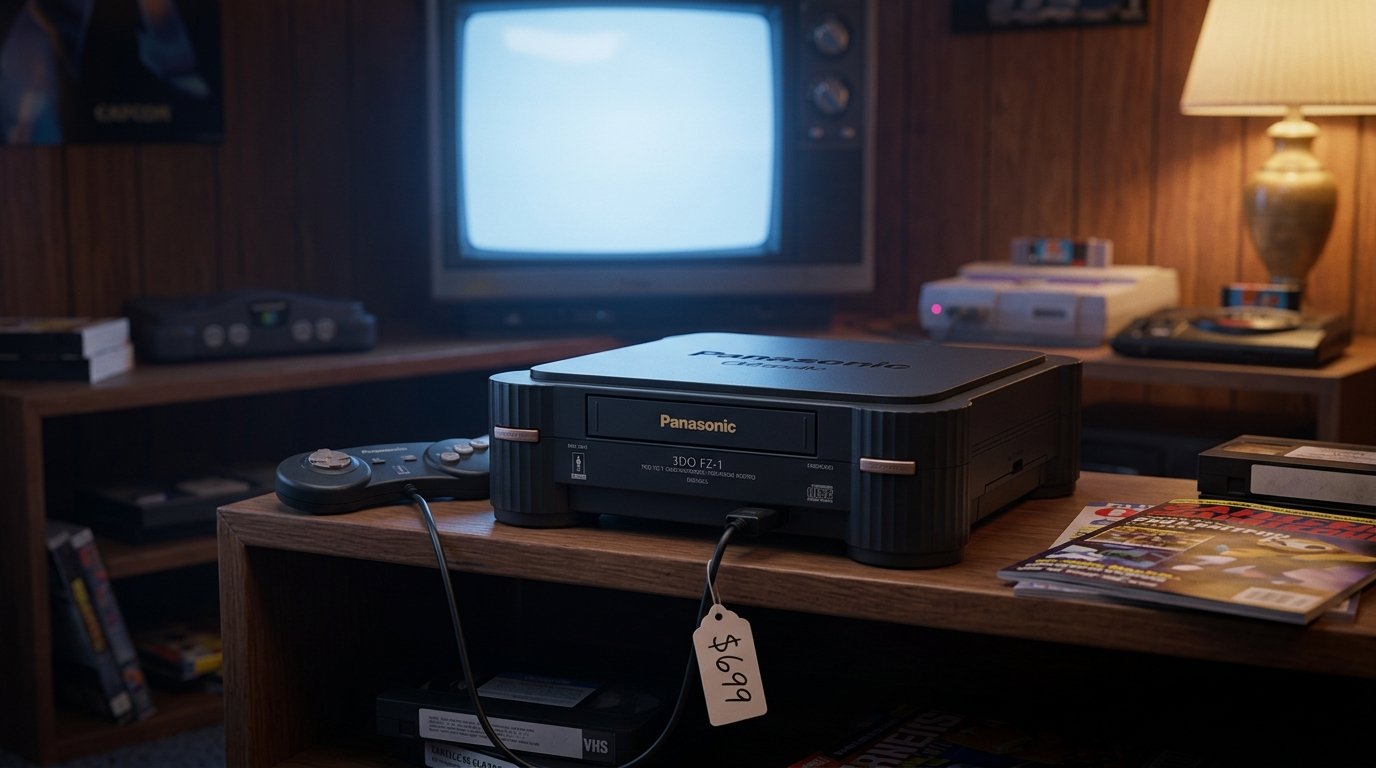
On paper, the machine frightened the competition. The first unit, the Panasonic FZ-1, shipped with this:
- **32-bit ARM60 processor at 12.5 MHz**, a member of the same family that now lives inside practically every smartphone
- **2 MB of RAM and 1 MB of video memory**
- **Double-speed CD-ROM drive**, in a market where cartridges were still the norm
- **Custom graphics chips** (the famous "Cel Engine") to stretch, rotate and warp textures without burdening the main processor
- **Launch price: $699.99**, with one game included, *Crash 'n Burn*
- **Hardware built by third parties**: Panasonic first, then Sanyo and Goldstar
Note the ARM. In 1993 it was an odd choice, cheap and efficient in a world proud of bits and megahertz, and it was part of what let 3DO promise so much with so little silicon. That the same architecture would end up powering half the planet is an irony I'll return to.
The most obvious comparison is with the neighbors. The Super Nintendo and the Mega Drive were selling at the time for roughly $100 and $150, and games cost between $50 and $70 each, cartridge included. Someone walking into a store with $700 could leave with both consoles, a handful of games, and still have change for ice cream. 3DO asked that same customer to believe in a promise.
The second comparison is more uncomfortable. In November 1993, a month later, Atari launched the Jaguar at $249.99, sold as a 64-bit machine (which was, let's be generous, debatable). 3DO lost to Atari on price and, as a result, lost the argument of "cutting-edge technology within reach." It sat in the middle of the map: too expensive for the average player, without enough games for the enthusiast.
One detail that only people who touched the machine remember: the controller had a headphone jack and a port for chaining a second controller to the first, daisy-chain style. It was a well-thought-out idea that nobody ever commented on, because almost nobody had a 3DO in the living room to need it.
## A business designed in the image of VHS
Trip Hawkins was no nobody. He founded Electronic Arts in 1982 and left in 1991 to create The 3DO Company, with money from heavyweights like Matsushita, Time Warner, AT&T and MCA. The idea was elegant: instead of manufacturing consoles, 3DO would license the technology to anyone who wanted to make hardware, the way it went with VHS, where JVC designed the format and half the world manufactured video recorders.
### Three dollars per disc
3DO charged publishers a license fee of around three dollars per disc sold, far below what Nintendo and Sega took from each cartridge. For studios used to paying a lot for every manufactured unit, the proposal was tempting. Discs were cheap to produce and game margins jumped overnight. Hawkins came from the publishing side, knew what they wanted to hear, and said it in so many words.
The problem is the other side of the scale. If the company that defines the platform earns three dollars per game and manufactures nothing, where does the money come from to subsidize the hardware? The answer is: nowhere.
### Who paid the difference
Sega and Nintendo sold consoles close to cost, or below it, because they made it all back on cartridge royalties. The hardware was the bait, the software was the business. Sony would repeat the recipe soon after, and far more aggressively.
3DO did the opposite. The manufacturers (Panasonic, Sanyo, Goldstar) had to make money on every console, because they earned nothing from the software. The result: the device went out at cost plus margin, and that price was $700, a barrier to entry that no marketing campaign can get around. When I first saw that number, in an old magazine chart, I thought it was a printing error. It wasn't.
The VHS model works when the central product, the video recorder, is useful without needing the initial ecosystem. A console without games is an expensive paperweight. The customer had to pay $700 for a library that didn't exist yet.
## A library with talent and no starting point
To be fair, the games weren't bad. 3DO had some of the best arcade conversions of the era, *Super Street Fighter II Turbo* courtesy of Panasonic, *Samurai Shodown*, and games that felt like the future, like *Road Rash* and the first *Need for Speed*, which EA released on the platform in 1994 before it became a giant franchise elsewhere. There was *Gex*, which Crystal Dynamics tried to promote as a mascot, and *Return Fire*, a game that still deserves conversation today. Time even named the device a product of the year for 1993, which says a lot about how easily the mainstream press was dazzled.
But there's a brutal difference between having good games and having the right games at the right moment. The mass market needed a big title to justify buying the machine, something like *Sonic* for Sega or *Mario* for Nintendo, and 3DO never had that game. What it had instead was a lot of moving video (FMV, which then seemed like the most modern thing in the world and today ages like milk), and games that impressed in demos and tired you out after half an hour.
The CD, which was the theoretical advantage, had its price. Load times were long, and double-speed reading helped little when the game engine had to fetch data constantly. The Mega Drive booted in two seconds. The 3DO booted in a ritual.
## When the price dropped, nobody was listening anymore
The manufacturers lowered the price in stages. By 1995 the console was near $300, and it was no longer an absurd proposition. But the market had changed targets.
Sega launched the Saturn in Japan in November 1994, Sony put the PlayStation on sale in December of that year, and in May 1995, at E3, the showdown was set: Sega announced the American Saturn at $399 with an immediate surprise launch, and Sony answered with a number that made the auditorium shudder, $299. It had more advanced 3D technology, a library from heavyweight publishers and a giant company absorbing the gap between cost and price. 3DO was no longer competing against the Super Nintendo. It was competing against Sony.
From there the story is one of slow agony. Sales stayed, according to the most-cited estimates, near two million units over the platform's life, a fraction of any of the big ones. Publishers drifted away, because three dollars per disc doesn't help when the installed base is small. And the installed base was small because the console was expensive. The cycle closed on itself.
## M2: the second bet
3DO tried to escape with a new machine, the M2, based on a PowerPC processor and planned to be considerably more powerful. In 1995, Matsushita paid around $100 million for the rights to exploit the technology, but the project ended up canceled and never reached stores as a console. The company then turned to software and games on other platforms, sold off what was left of the hardware (Samsung reportedly ended up with it, according to accounts at the time, for something on the order of $20 million) and lived on franchises like *Heroes of Might and Magic* and *Army Men*. In 2003 it filed for bankruptcy.
There's something cruel about a company that goes from "the future of video games" to making little green plastic soldiers in two decades.
## What this story usually leaves out
### Price was the one variable Hawkins didn't control
In my assessment, the summary "it was expensive and so it failed" is a comfortable way to file the matter away, because it suggests a price cut could have saved the project. Nothing of the sort. 3DO couldn't lower the price without convincing three different manufacturers to sacrifice margin on a product that gave them no profit elsewhere. Every decision went through partners with their own interests, and so the company that most needed to act was the one with the least access to the controls.
That's what the price narrative misses. Sony let $299 be a marketing number because it absorbed losses on hardware. Sega, despite the mistakes it made with the Saturn, did the same. 3DO had nobody to absorb anything. The high price was the visible form of an invisible structure.
### The right idea on the wrong platform
And here we return to ARM. Eighteen years after 3DO's founding, in 2008, Apple opened the App Store and Google launched Android. Both models rest on an idea Hawkins sketched in 1991: an open platform, hardware made by many hands, light software licensing, and money flowing from programs instead of machines. The difference is that the phone already justified its purchase without any game, because it made calls. It was a useful device in itself, and the app store came on top, as a bonus.
3DO wanted the player to pay first for the promise and only then, maybe, for the content. The model was right and the starting point was wrong. Hawkins was right about the future and wrong by almost fifteen years about the calendar, which in technology amounts to being wrong.
One question remains that I can't file away: if 3DO had launched with a partner willing to lose money on every console sold, would the model have worked, or was the problem the format itself, a platform with nobody behind it to whom the loss would hurt?