Resident Evil: Fixed Cameras, Design Choice or Limitation?
Oct 10th '26 5:49pm:
Written by: [jomifisi](https://comuniq.xyz/profile?u=jomifisi_17)
<br>Resident Evil came out in Japan on March 22, 1996, under the name Biohazard, and asked players for something almost no big-budget game would ask today. Accept that you can't see what's two meters away. Press "up" to walk in whatever direction the character is facing, even when the screen switched angles mid-step. Thirty years later, the question keeps coming up in forums, videos and comment sections with the regularity of a ritual. Were fixed cameras and tank controls a design decision, or the patch job of a team doing what it could on a console with 2 MB of RAM? The honest answer is uncomfortable for both sides of the argument, because both are right and neither has the whole story.
## What the PlayStation Could Draw in 1996
Start with what can be measured, because that's where the "it was all limitation" thesis gets its strength. The PlayStation had a processor running at about 33.9 MHz, 2 MB of main memory and 1 MB of video memory. It drew polygons quickly, but without perspective correction on textures, so real-time 3D environments of the era wobbled. Edges swam, and textures stretched in odd ways when the camera got close. A mansion with wood paneling, heavy rugs and chandeliers, rendered in real time on that machine, would have looked like a scale model coming apart.
Capcom's solution was to draw the sets beforehand, on a computer vastly more powerful than any console, and store them on the disc as still images. Only the characters and interactive objects were polygons, layered on top with depth masks so Jill could walk behind a table without clipping through it. The result was a mansion with a visual quality no real-time game could reach on that hardware. The price was well known: if the set is a photograph, the camera can't move freely, because the photograph is only valid from that angle.
But stop here before closing the case. The grammar wasn't born on the PlayStation. In 1992, Infogrames' Alone in the Dark, with Frédérick Raynal at the helm, already used fixed cameras with polygonal characters and movement that rotated the character instead of moving it across the screen. And before that came Sweet Home, which Capcom released in 1989 on the Famicom, inspired by Kiyoshi Kurosawa's film, with a haunted house, tight item management and doors as the border between danger zones. It has been widely reported that Shinji Mikami's project began as a kind of reimagining of that game. In other words, the team didn't choose the formula from scratch. It inherited it and saw that the hardware favored it.
There's also a detail that shows how a limitation disguises itself as rhythm. The CD-ROM couldn't load the next room instantly, and the door-opening animation, with its creak, its silence and its nearly frozen screen, exists to hide that loading. Nobody had to plan it as a tense moment. Players simply came to treat it as one. Those seconds before you see what's on the other side are part of the game's emotional memory.
## Tank Controls: The Logic Almost Nobody Explains
The most repeated complaint is about the controls. Pressing up makes the character move forward in the direction they're facing, left and right rotate them on the spot, and there's no way to sidestep or turn instantly. Today it feels rigid. But there's a technical reason behind it that rarely comes up in these discussions, and I find it more interesting than the folklore.
Imagine the game used screen-relative controls, like almost every modern game. You hold "up" and the character goes up the screen. Now the camera changes, because you've crossed a door, and the new angle is almost the opposite of the old one. If you keep holding "up," you suddenly walk the other way, back toward where you came from, and the character turns around on their own. In fixed-camera games, that's one of the classic problems of screen-relative control. With tank controls, "up" is always "toward the front of the character." Even if the camera jumps to a new angle, anyone holding the button keeps walking in the direction they were already going. The scheme that feels clumsy is, at bottom, the only stable one when the camera changes angle from one second to the next.
The cost, of course, is sluggishness. Turning 180 degrees takes time, and anyone who's been caught by a zombie while trying to turn and flee knows exactly how much. Only in Resident Evil 3, in 1999, did Capcom add the quick turn, almost admitting the problem existed.
Here's the point the "it was just a limitation" narrative ignores. The rest of the game is calibrated around that sluggishness. Zombies advance slowly because the player rotates slowly. Ammo is scarce, the inventory holds six items with Chris and eight with Jill, and saving requires ink ribbons that get used up. The storage boxes force you to decide what to leave behind. None of these pieces comes from a hardware restriction. They were choices that fit together, and the whole produces a player who never feels comfortable. The camera hid the danger, the controls made escape expensive, the inventory made preparation hard, and the ink ribbons put a price on every save.
## When the Hardware Stopped Being an Excuse
There's a simple test for separating choice from limitation. If the formula only existed because the hardware forced it, it should have disappeared once the hardware stopped forcing it. It didn't.
Resident Evil Code: Veronica, released in Japan in February 2000 on the Dreamcast, abandoned pre-rendered sets. The environments became real-time 3D, and the camera gained the freedom to move, follow the character and change framing fluidly. The tank controls stayed. In 2002, Capcom remade the first game on the GameCube, with pre-rendered backdrops far more detailed than the original's, on a console that could have allowed a different approach, and kept fixed cameras and tank controls. Resident Evil Zero, the same year, did the same. None of those machines required any of this.
The break only came with Resident Evil 4, in January 2005. The story here is a curious one, because the game went through several prototypes. One of the earliest versions, directed by Hideki Kamiya, drifted so far from the series' spirit that it became a project of its own and gave birth to Devil May Cry. The final version swapped fixed cameras for an over-the-shoulder view, but kept a rule that strikes me as the most revealing of all. You can't walk while aiming. You stop, aim, fire, and during that time you're exposed. Capcom threw away the fixed camera and kept the vulnerability. It's hard to imagine clearer proof of what the team considered essential and what it considered incidental.
## The Fear the Camera Hid
What remains is to see what the fixed camera actually did to the fear, and here the debate about intent matters less.
### What a Chosen Angle Does to a Hallway
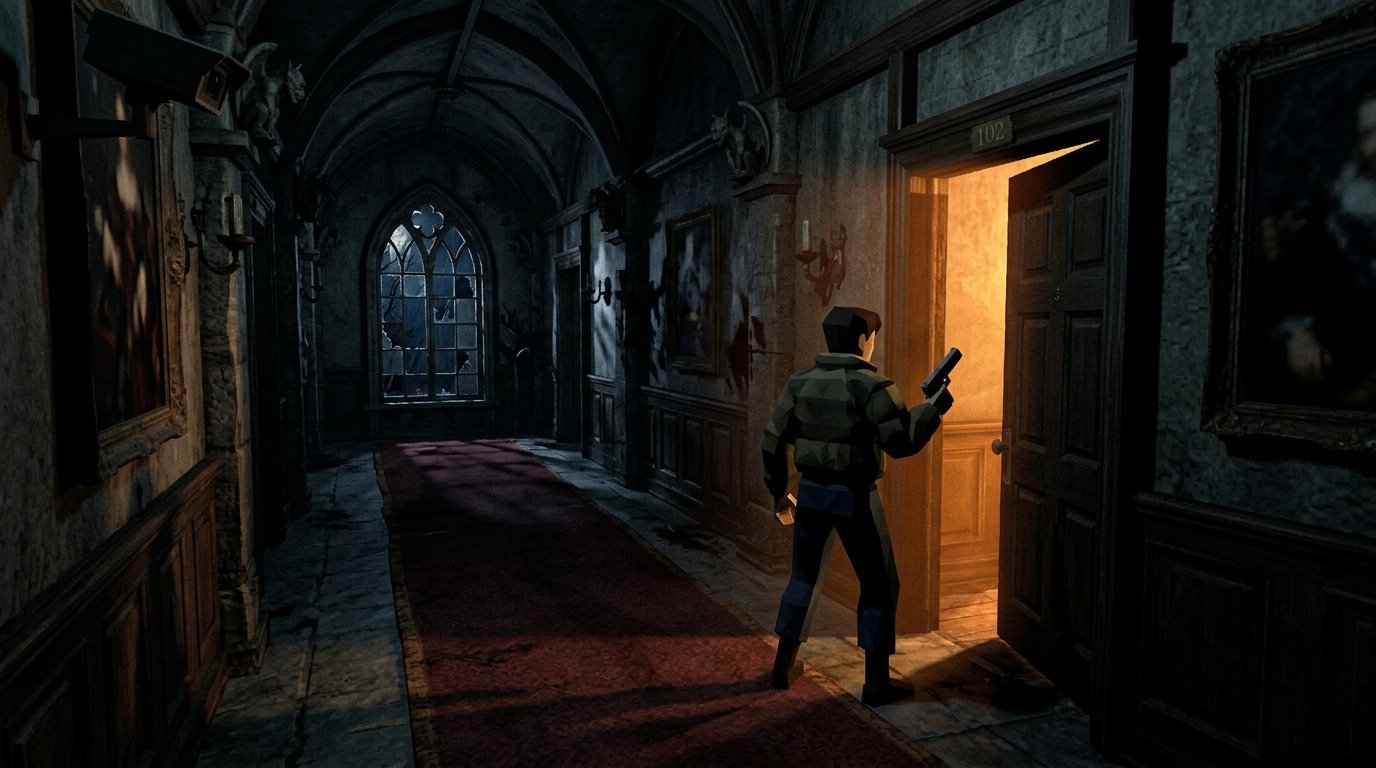
A fixed camera is a directed camera. Every room in the mansion has framings designed by someone, like shots in a film, and the player can't correct them. Think of the second-floor hallway where the dogs burst through the window. There's no way to look around before entering, or to rotate the camera to peek around the corner. The space shows what the framing chose to show, and the rest is left to sound, to footsteps off-frame, to a shadow that enters the screen before the body that casts it.
With a free camera, the player decides where to look, and tension comes to depend on how well the game can force the player's gaze. With a fixed camera, the game keeps that control. Much of the imagery the series left in players' heads came from zombies you hear groaning without seeing, from framings where the door fills half the screen and nothing of what's behind it appears. That isn't just atmosphere. It's the management of information, which is what horror does best.
### Where Choice Ends and Bad Luck Begins
Here's my position. In 1996, the fixed camera was a limitation handled with talent, which is very different from pure choice. Capcom didn't pick the PlayStation because of the camera, and if it could have drawn photorealistic mansions in real time in 1996, it probably would have. But the team didn't just tolerate the constraint. It used it to build tension and then made it the norm. The proof is what came after, with the 2000 and 2002 games repeating the formula without need. When a restriction outlives its own cause, it has gone from accident to preference.
And yet, not everything was genius. The repeated walks between rooms, the inventory that forces you back to a storage box, the voice acting of the original, with Barry's infamous "Jill sandwich" line, are signs of an industry still learning how to do this. Admitting that the game is clumsy and that the camera is brilliant at the same time isn't a contradiction. They're different layers of the same work.
## What the Genre Learned and What It Dropped
The pattern repeats elsewhere. Konami's Silent Hill, in 1999, used dense fog to hide the PlayStation's limited draw distance, and that fog became so central to the game's identity that Konami never fully abandoned it. It's the same logic as Capcom's camera, with the hardware pushing the aesthetic and the aesthetic becoming a trademark.
Even more interesting is what happened afterward. The 2019 Resident Evil 2, remade with a free camera, taught something else: fear can come from pursuit instead of concealment. Mr. X, following the player through the police station corridors, replaced the angle that hides with the footstep that approaches. It works, and it works well, but it's a different kind of fear, more physical and louder, less like the surveillance of the original.
And then there's the deliberate return. Games like Signalis, from 2022, and Crow Country, from 2024, went and fetched the grammar of fixed cameras with no hardware forcing them to. They chose it because it works, and because people who grew up with it want someone to use it again. That may be the clearest answer the original question can have. A limitation only becomes a language when someone, later and with every option available, goes back and picks it up on purpose.
One doubt remains that I can't resolve, and I'd rather leave it open than pretend I have the answer. If Capcom had had the freedom in 1996 to show everything, would the game have been less scary? Or would it simply have been a different game, and would nobody be writing thirty years later about its cameras?