Hellraiser: Revival Hits PS5 and Divides Early Reviews
Oct 8th '26 4:27pm:
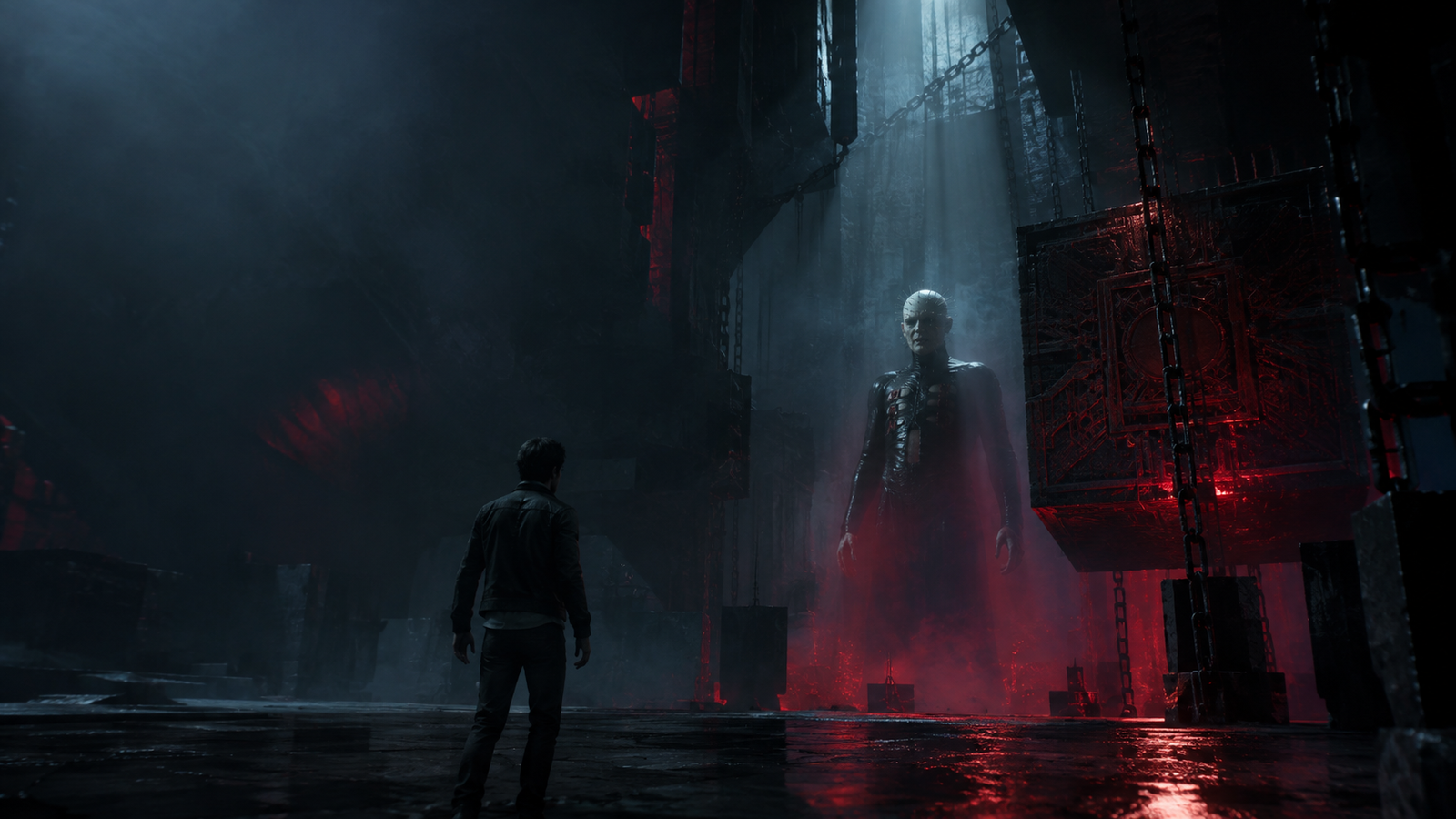
*Clive Barker’s Hellraiser: Revival* arrived on PlayStation 5 this Thursday, October 8, accompanied by a situation that is not as simple as calling it a good or bad reception: the first reviews are deeply divided. Saber Interactive’s game attempts to turn Clive Barker’s universe into a first-person survival horror experience, with Aidan Lynch searching for his girlfriend Sunny after she is taken into the Labyrinth by the Cenobites. But the execution has produced very different reactions from critics. Some reviews praise exactly what fans were hoping for, including the atmosphere, graphic violence, Doug Bradley’s return as Pinhead and the game’s faithfulness to the source material. Others point to bugs, uneven combat and design decisions capable of completely breaking the rhythm of the experience.
## The game arrived with a very clear identity
There is one thing *Hellraiser: Revival* does not seem to have done halfway: **being a Hellraiser game**.
That may sound obvious, but it is not. Adapting a property created by Clive Barker into a video game is particularly difficult because the Cenobites do not work exactly like traditional survival horror monsters.
They are not simply creatures that chase the player through dark corridors. The *Hellraiser* mythology has always been connected to desire, pain, pleasure, curiosity and transformation. The Labyrinth is not simply a scary setting either. It represents its own strange, almost ritualistic logic, and it needs to feel unfamiliar even after the player begins to understand its rules.
*Revival* starts from exactly that material.
The player controls **Aidan**, who must try to recover Sunny after she is dragged into the Labyrinth. To do so, he eventually makes a deal with Pinhead and uses the **Genesis Configuration**, a new puzzle box connected to the Cenobite mythology. The game combines exploration, first-person combat, weapons, stealth, puzzles and abilities associated with the box.
That is an ambitious combination for a franchise that has spent decades being primarily associated with cinema.
Saber itself says the team worked for more than four years to bring Barker's particular style of horror into the game. Game director Emil Esov described the project as an attempt to reproduce the uncomfortable and unusual nature of the *Hellraiser* universe, precisely because the Cenobites do not fit easily into the conventional division between hero and villain.
And this is where the reception begins to diverge.
### What works when the game simply lets Hellraiser be Hellraiser
Some of the strongest reviews seem to agree on one thing: when *Revival* abandons the need to function like a conventional action game and simply explores Barker's universe, it finds its best version.
TheSixthAxis gave it **9/10** and praised the atmosphere, visceral combat, puzzles and faithfulness to the source material. The review also highlighted the Labyrinth, sound design and Doug Bradley’s return as the Hell Priest, the name by which Pinhead is known within the mythology.
Giant Bomb also gave the game **4 out of 5 stars**, describing the experience as uncomfortable, grotesque and capable of combining fear with fascination.
The difference becomes even more obvious when looking at the other side.
Game Informer gave the game **4.5/10**. The publication praised the dark visual presentation and the franchise's commitment to gore, but reported a series of technical problems, including a healing animation that froze during combat and a sequence in which the game failed to properly recognize that all enemies had been defeated, forcing the reviewer to reload a save.
This is not simply a case of critics disagreeing about their taste in horror.
They are describing **different gameplay experiences**.
## The early scores explain why Metacritic has become a search term
The behavior shown in the Google Trends screenshot you captured makes a lot of sense given this reception.
Among the top searches over the previous four hours were **“hellraiser game,” “hellraiser revival metacritic”** and **“clive barker's hellraiser revival.”** The search for “hellraiser revival metacritic,” in particular, was showing a 50% increase at the time of the screenshot.
That happens because someone who has just discovered the release has a very specific question: **is this game actually good?**
The early reviews do not offer a comfortable answer.
OpenCritic had already collected dozens of reviews at the time of publication and classified the overall reception as **“Strong,”** while aggregators and review compilations showed considerable variation between individual scores.
One compilation of the early reviews, for example, listed high scores such as **9/10 from TheSixthAxis** and **9/10 from Insider Gaming**, while IGN appeared with **6/10** and Game Informer with **4/10** in one review roundup.
The most interesting part is not deciding which score is “right.”
It is understanding **why they can coexist**.
Insider Gaming described *Revival* as a very positive surprise, highlighting its journey through pain and pleasure and the game's ability to immerse itself in *Hellraiser's* identity.
Slant Magazine, however, found almost the opposite problem: beneath the franchise's visual personality, the game is trapped inside familiar survival horror structures, including crafting and systems that reduce some of the strangeness that should be its greatest advantage.
That difference says a lot about the project.
## The problem with turning the Labyrinth into a traditional video game
There is an interesting contradiction at the heart of *Hellraiser: Revival*.
The franchise works best when it feels like **nobody quite knows what the rules of that place are**. The player, however, needs rules.
They need to know where they can go, when they can attack, which resources to save, how to solve a puzzle, when to run and when to fight. They need to recognize patterns. They need to learn systems.
That is where a *Hellraiser* adaptation inevitably starts to lose something.
*Resident Evil*, for example, turned resource management, exploration and combat into fundamental parts of its identity. The problem emerges when the player notices the system before noticing the world.
In *Hellraiser*, that can be particularly damaging.
If I am entering the Labyrinth and thinking about how much ammunition I have, how much material I need to craft a particular item or what the next inventory upgrade will be, I am playing a survival horror game.
If I am entering the Labyrinth and thinking **“what the hell is this place?”**, the adaptation is doing something much more difficult.
The strongest reviews suggest that *Revival* reaches that second state at certain points. The harsher reviews suggest that it returns too quickly to the first.
## Pinhead may be the easiest part to get right
There is a huge advantage *Hellraiser: Revival* has that few licensed games can claim: **Doug Bradley is back as Pinhead**.
Game Informer specifically praised Bradley's performance, even while being extremely critical of the rest of the experience.
That helps explain why reactions to the game's atmosphere are much more consistent than reactions to its gameplay.
Pinhead does not need to be reinvented.
The character already carries an instantly recognizable visual and vocal presence. The same applies to the Cenobites, the Labyrinth, the chains, hooks and entire industrial aesthetic of flesh, metal and suffering.
The team had a very strong starting point.
The real challenge was figuring out what the player should actually **do** for several hours inside that universe.
That distinction is crucial.
A film can put Pinhead in a room for a few minutes and turn his presence into an event. A game needs to build encounters, enemies, objectives and systems to sustain that experience for hours.
That is where the reviews begin to diverge.
## The PS5 also becomes part of the discussion
On PlayStation 5, *Hellraiser: Revival* is presented as a single-player horror game with DualSense support, including vibration and adaptive trigger effects. The standard edition is listed at **$39.99**, while the Deluxe Edition costs $49.99 on the US PlayStation Store. The Portuguese PlayStation Store lists the standard edition at **€39.99**.
That price also changes how the game should be evaluated.
This is not a production that needs to compete directly with every major AAA release of the year in scale, length and budget.
What consumers are buying is a focused horror experience based on a very specific franchise.
That should work in *Revival's* favor.
A roughly ten-hour game focused on atmosphere, violence and exploring a property like *Hellraiser* can be more interesting than a massive adventure that dilutes its identity over dozens of hours.
Some reviews genuinely seem to see that advantage. One review compilation praised the narrative, creature design, Doug Bradley's presence and relatively short runtime, while also pointing to combat problems and glitches.
The problem is that bugs are particularly dangerous in a horror game.
A bug in an RPG can be annoying.
A bug during a sequence carefully designed to create fear can completely destroy the effect.
If an animation freezes during combat, as reported by Game Informer, the threat stops being the Cenobite. It becomes the game itself.
That difference may seem small on paper, but it is enormous in practice.
## The interesting part is that positive reviews do not ignore the problems
The divided reception does not appear to follow a simple split between “people who like Hellraiser” and “people who don't.”
That would be the easy explanation.
There are highly positive reviews that acknowledge limitations, while some negative reviews admit that the game contains genuinely strong moments.
Game Informer itself, despite its low score, acknowledged that when *Revival* is not dealing with a technical or design problem, there is a reasonably competent *Hellraiser* adaptation underneath it.
That is more interesting than a complete rejection.
It means the discussion surrounding the game probably will not be “Hellraiser: Revival is a failure.”
The discussion will be more uncomfortable: **how much of a good game needs to exist before technical problems stop being acceptable?**
And that is a particularly relevant question for anyone following licensed horror games.
Because *Revival* demonstrates that there is room for this kind of project.
The market does not necessarily need another adaptation of a famous franchise made simply to capitalize on the name. What some of these reviews suggest is that there is an audience for stranger, more violent experiences that are less interested in softening the identity of their source material.
The problem is delivering that experience with enough consistency.
## What nobody should do with these early scores
I would be careful with a common reaction that appears whenever a game receives such wildly different reviews: take the lowest score and declare that the game is bad, or take the highest and say the other critics simply “didn't get it.”
Both readings are lazy.
The best way to interpret *Hellraiser: Revival* right now is to separate **the adaptation** from **the video game**.
As a *Hellraiser* adaptation, there are strong signs that the team understood the material. Doug Bradley's presence, the Labyrinth, the grotesque aesthetic and the willingness to avoid turning the Cenobites into generic monsters appear repeatedly among the praise.
As a video game, the situation is less settled.
Combat, puzzles, exploration, crafting, stealth and technical stability are precisely the elements that appear in negative reviews or among the reservations in several analyses.
That difference is probably the best explanation for what is happening across Metacritic and OpenCritic.
And it also explains why **“Hellraiser Revival Metacritic”** has started appearing in searches.
People are not simply looking for the game's review aggregate.
They are trying to figure out which of these two versions of *Revival* is closer to reality.
## The opportunity for Saber comes after launch
There is still one variable the early reviews cannot fully answer: **what happens after the first patch**.
If a significant portion of the negative criticism is tied to bugs, performance problems and broken behaviors, there is a difference between a structurally poor game and a game released in a technical state below what it should have been.
That is not an automatic excuse.
Technical problems are still problems, especially for someone buying the game on day one.
But the situation is different when the core experience receives praise from several sources and the biggest complaints are concentrated around execution.
It is too early to say how much Saber will be able to fix. What can already be said is that *Revival* has not faced a uniform rejection.
Quite the opposite.
The difference between a 4.5/10 review and a 9/10 review is too large to be explained simply by personal preference. It reveals a game with **very specific strengths and equally specific weaknesses**.
That may be the most interesting part of the launch.
*Hellraiser: Revival* is not being discussed because nobody liked it.
It is being discussed because some people have found exactly the *Hellraiser* game they have wanted for decades, while others have found a technically troubled survival horror game trying to reach that same idea.
And looking at the search trend you captured, players are beginning to notice precisely that contradiction.
The box has been opened.
Now the question is whether what is inside is the Labyrinth fans wanted, or simply another horror game trying to survive its own mechanics.