Street Fighter II: Casual Arcade Play vs. Tournament Play
Oct 8th '26 12:18pm:
Written by: [jomifisi](https://comuniq.xyz/profile?u=jomifisi_17)
In 1992, Capcom released two revisions of Street Fighter II within a few months of each other. The second one came out in a hurry because bootleg boards, with characters faster than the company's own, were already circulating in arcades. **Champion Edition** arrived that spring and finally let you pick Balrog, Vega, Sagat and M. Bison, and fight mirror matches on top of that. **Hyper Fighting** followed at the end of the year, faster and with new moves, partly as a response to the unofficial versions (the most famous was called Rainbow Edition). The question of how the game was balanced between tournament play and casual play has an uncomfortable answer: nobody balanced anything, at least not on purpose. What existed was a permanent negotiation between the manufacturer, the arcade owner and a community that figured out the game faster than Capcom could change it.
## What was baked into the cabinet before any player showed up
Start with the hardware, because it decided more than we usually admit. The first Street Fighter, from 1987, used two pressure-sensitive pads: the harder you hit, the harder the move landed. It was a charming idea and a torture for both your hand and the machine's owner, who watched the pads break. In 1991, Street Fighter II swapped them for six ordinary buttons, three punches and three kicks, at fixed strengths. The change looks like ergonomics, but it is the game's first balance decision: the controls became **repeatable**. Two players could do exactly the same thing twice, and only then does practice exist, and only with practice does competition exist.
Then there is the service menu, which almost nobody remembers. The operator could adjust the difficulty of the single-player mode on a scale from 1 to 8, with the factory default somewhere in the middle (I'm citing this from memory of the operator manuals, so check it before publishing). Later versions also let you change the speed. In other words, the same ROM behaved like different games depending on who bought the cabinet and what he thought filled the cash box fastest. A greedy owner who set the solo mode too cruel scared off beginners. An owner who was too nice watched matches drag on and the line shrink.
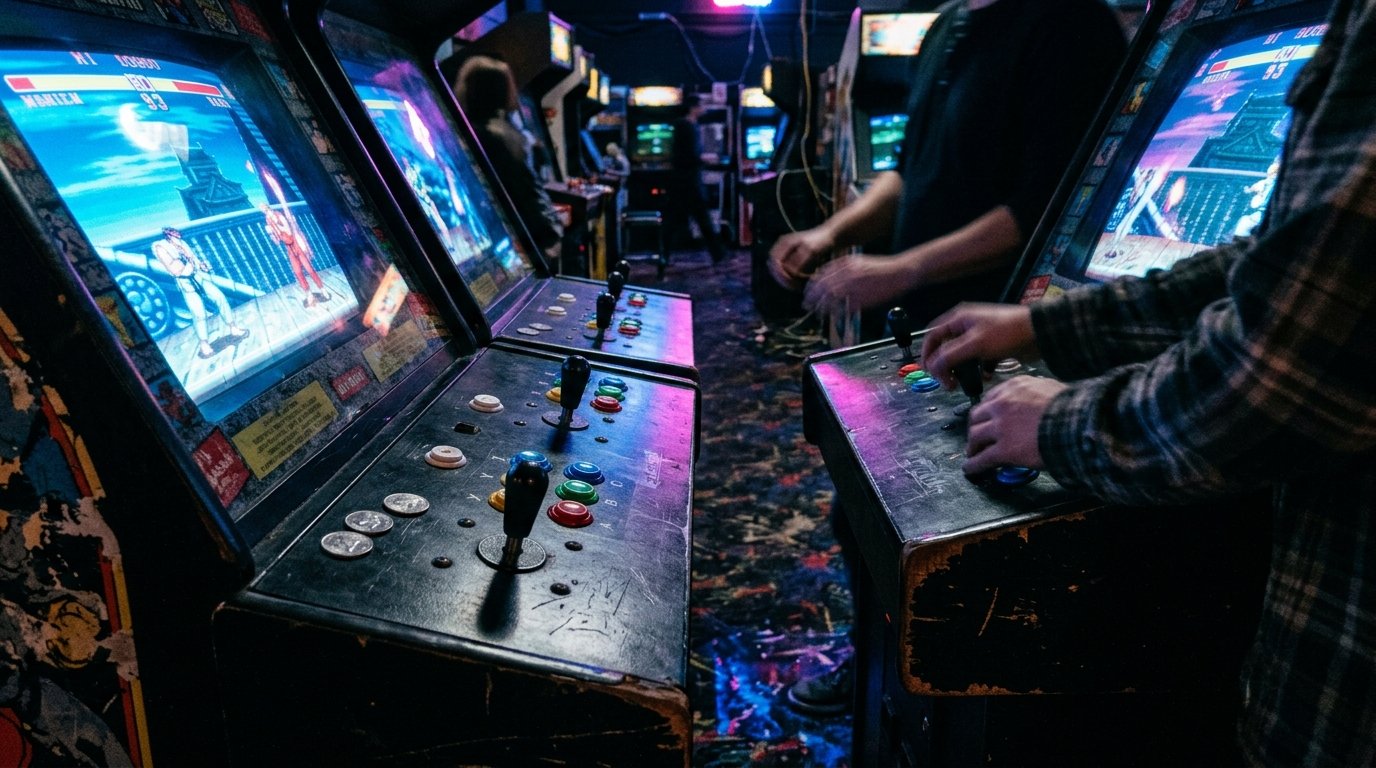
And there was the second player's start button. If someone was playing against the machine and another person dropped in a coin, the solo game was interrupted and the two faced each other. That cheap mechanic created the versus mode the game effectively became. Capcom didn't write a tournament rule, but it left installed the infrastructure of a public challenge: you lose, you step aside, and if you want to keep playing you pay again.
## The coin as a yardstick: who paid for the match
A quarter in the United States, a hundred yen in Japan. It's hard to overstate how much that price shaped the choices. Every solo run had to convince the player, in two or three minutes, that it was worth paying for another one. That's why the first opponents in Street Fighter II are generous and the last ones, M. Bison especially, earned a reputation as cheaters among players. The solo difficulty curve works as a billing machine: easy enough to hook you, hard enough in the final stretch to make you feed in another coin.
Here is the first layer of casual balance, and it has nothing to do with characters. It was a question of **learning time**. A newcomer who couldn't pull off a special move in two minutes walked away and never came back. The game had to reward someone mashing buttons without understanding anything while keeping its depth for those who stayed. The special moves with joystick motions, the quarter circle and the rising dragon, worked in both worlds. For the beginner, a fireball was a magic trick. For the veteran, it was a spacing tool you could block, jump over or punish.
The versus mode solved the owner's other problem: matches between humans, paid for by whoever lost. The winner stayed, the loser paid again. A machine full of people wanting a rematch earned more than a machine with one lonely player losing to the CPU. The operator's commercial interest and the community's competitive interest ended up pointing the same way without anyone arranging it.
## What slipped out of control: combos, mirrors and strength lists
There's a story told in interviews with the original team, and I'm somewhat suspicious that it grows into legend with every retelling. According to those accounts, Street Fighter II's combos, chained moves where the next one lands before the opponent recovers, showed up almost by accident during testing. They noticed the effect, decided not to fix it, and the rest became the grammar of the series. Even if the details change depending on who's telling it, the structural point holds: the most competitive layer of the game, the one that separates the tournament from the bar game, **wasn't designed**. It was found.
Champion Edition is the most underrated revision in this story. Being able to pick the bosses and fight the same character on both sides sounds like a minor concession, but it is exactly what a tournament needs. Without mirror matches, if two players want the best character, one of them is forced to use the second best, and that decides the match before it begins. The bosses themselves were unbalanced on purpose, since they had been conceived as CPU obstacles, not fair picks.
As for strength lists, what really existed was a culture of arguing about who was strong, fed by specialist magazines and by the talk around the cabinet. Characters with easy-to-control fireballs and long-range moves were seen as problems by anyone playing seriously. Others, slower or dependent on proximity, were at a disadvantage. Nobody at Capcom signed a table like that. The community wrote it, and almost always with more rigor than the manufacturer would have had the time or interest to apply.
## Turbo, Super, Super Turbo: a patch dressed as hardware
Think about the sequence: World Warrior in 1991, Champion Edition and Hyper Fighting in 1992, Super Street Fighter II in 1993, Super Turbo in 1994. Each worked as a balance patch, except that it was delivered as a board upgrade kit the operator had to buy and physically install. That changes everything. A modern fighting game gets numerical tweaks in weeks and the community reacts in days. Back then the cycle ran from months to a year, and every fix cost money to arcade owners who had no obligation to adopt it.
That slowness, in my judgment, was a virtue in disguise. Because Capcom could only touch the game now and then, the community had **time to learn each version to the bottom**. When a trick was discovered, it stayed alive in arcades for months before the next revision arrived. The revisions also kept squeezing both ends at once. Hyper Fighting's higher speed pleased the veteran and scared the newcomer, who got the option to play slower. The super meter that arrived in Super Turbo gave the player who was losing a dramatic way out, good for the casual crowd, and at the same time created a new layer of resource management for the competitive one.
### The hidden Akuma and the rule the community wrote
The clearest example of outsourced balance is Akuma. In Super Turbo, the character appeared through a secret input sequence, and he was too strong for a clean match. Capcom hid him and walked away. Who decided whether he was allowed in a tournament was each organizer, and depending on the event he was allowed or banned. Some places also accepted the rule "he's in only if both players agree." The community wrote that rulebook with no manual, and one version of the rule eventually became custom.
## The Japanese arcade layout: balance by architecture
In Japan's arcades, the layout of the space was part of the balancing. Over time the back-to-back cabinet arrangement became popular, with the two players on opposite sides, unable to see each other. It prevented trouble between strangers who had just won and lost, and it created a culture of almost anonymous rivalry, where reputation came from what you did on screen and not from who you were. Who queued to challenge and who held the machine all sorted itself out inside the physical space. That layout detail may have done more for the coexistence of casual and competitive play than any change to a move.
On the other side of the world the setting was different. An American mall arcade was loud, open, a place of passage. The same machine, the same ROM and the same version produced a different society around it, with different rules of coexistence. The word "balance" here no longer describes the game. It describes the place.
## My reading: the balance was legibility, not fairness
There's a comfortable consensus that Street Fighter II was "perfectly balanced." I disagree. There were clearly better characters, quite uneven matchups, and a version that had to be fixed, then another, then another. What the game really had was something different and, to me, more important: **legibility**. Anyone who walked up to the cabinet understood what was happening. There were health bars, a clock, moves that matched visually what they did, and a fireball was a fireball. The beginner lost and knew why he lost. The veteran watched the beginner make the same mistake he had made a year earlier. In a way, the two were in the same game.
That, I think, is why the split between "casual" and "tournament" is less sharp than the modern debate makes it seem. The same person could be both, depending on the hour, the line and who stood on the other side. Nobody declared "now I'm competitive." You simply lost three times in a row to the same guy and started paying attention to what he was doing.
What bothers me is the question that remains. Today a developer can fix a character in days, measure win rates in real time and ship the adjustment to everyone at once. It sounds like the dream of any balance designer. But if Street Fighter II's best balance only existed because nobody could fix it quickly, what exactly did we gain by being able to fix everything?