Valor Mortis: Can Ghostrunner's Speed Survive a Soulslike?
Oct 7th '26 12:19pm:
Written by:[jomifisi](https://comuniq.xyz/profile?u=jomifisi_17)
<br>Valor Mortis, the first-person soulslike from the studio behind Ghostrunner, launches October 13 on PC, PlayStation 5 and Xbox Series X|S for $39.99 / €39.99, and it arrives on Game Pass for PC and Xbox on day one. That price and date are the business story. The design story is stranger. One More Level built its reputation on a game where you die in a single hit and respawn a second later. Now it is asking players to live with stamina bars, attrition and the slow punishment of the genre it is borrowing from. Those two philosophies have almost nothing in common, and whether they can share a skull is the real question hanging over this launch.
## The launch package: October 13, $39.99, and no pre-orders
The details first, because they shape everything else.
- **Release date:** October 13, 2026, moved from the original September 24
- **Platforms:** PC (Steam), PS5, Xbox Series X|S
- **Price:** $39.99 / €39.99 / 149.99 zł for the standard edition
- **Deluxe Edition:** $59.99 / €59.99, including a major story expansion planned for 2027
- **Game Pass:** day one on PC and Xbox
- **Pre-orders:** none, so the first chance to buy is launch day
- **Demo:** available on Steam since early June
- **Voice cast:** Vincent Cassel plays Napoleon Bonaparte
The delay deserves more attention than it got. The September 24 date was announced during the Xbox Games Showcase on June 7, and it was gone four days later. Blake Rochkind, who runs publisher Lyrical Games, told Game File that the slot had looked clean until Remedy's Control picked the same day at a PlayStation showcase on June 2. After that, he said, moving was the only option. Game Informer's list of what September was holding includes The Blood of Dawnwalker, Marvel's Wolverine, Fire Emblem: Fortune's Weave, Silent Hill: Townfall and Onimusha: Way of the Sword. A new IP from a mid-sized studio would have been flattened.
October is not empty either, but it is survivable. The studio's own message, in its tone more than its words, framed the move as giving the game and the player's wallet room to breathe.
Then there is the price. By the studio's own account it spent the better part of a year arguing about it. Forty dollars sits well below the $70 mark many big releases occupy, and skipping pre-orders pushes the same message: judge the finished game, not the trailer. It reads as a studio that knows it cannot win a marketing war and is trying to win an argument about value instead.
## Ghostrunner's contract with the player: die instantly, return instantly
To see what One More Level is risking, you have to remember what Ghostrunner actually was. Released in 2020, with a sequel in October 2023, it was a first-person slasher built around a cruel, elegant rule: almost everything kills you in one hit, and almost everything dies in one hit from you. You wall-run, dash, grapple and slow time mid-air, and a mistake costs you about a second before you are back at the checkpoint.
That respawn speed is the hidden engine of the whole game. Death in Ghostrunner has no weight, so the game can be merciless. You are never punished, only corrected. The loop works like a rhythm game: attempt, fail, retry, and the retry is so fast that frustration never has time to set.
Soulslikes run on the opposite contract. Since Demon's Souls in 2009 and Dark Souls in 2011, the genre has been built on consequence. Stamina limits every swing and roll, so every action is a loan against your next one. Dying costs you something real, usually currency left where you fell, to be recovered if you survive the trip back. Tension comes from what you stand to lose.
So here is the problem in one sentence: Ghostrunner makes dying free so it can ask for speed, and a soulslike makes dying expensive so it can ask for caution. A game that wants both has to decide which one it believes in. The studio's own pitch hints at the compromise: a soulslike built around skill, stamina and high-mobility combat, with brutal, methodical fights and Metroidvania-inspired levels. Mobility and stamina are the two ideas most likely to fight each other.
## What a first-person camera does to stamina combat
First-person soulslikes are not unprecedented. FromSoftware's King's Field, released in 1994, is a distant ancestor of the whole genre and played from the character's eyes. But when the genre standardized, it did so in third person, and there is a practical reason.
Stamina combat is a spacing game. You read an enemy's wind-up, judge distance, and commit to a dodge or a swing. A third-person camera gives you the whole body of the enemy, your own animation, and the flanking enemy at the edge of the frame. First person takes most of that away. You lose peripheral awareness, you lose a clear read on your own character's position, and depth perception becomes unreliable when an enemy's weapon is swinging toward the lens.
That is why the shift is a redesign of readability, not a camera swap. Enemy attacks need exaggerated telegraphs. Hit feedback has to come through sound, screen shake and controller response, because you cannot see your own character flinch. And dodging, which in third person is a visible roll with clear invincibility frames, has to feel trustworthy when all you see is the world lurching sideways.
One More Level has a real advantage here. Ghostrunner is a first-person melee game with fast, precise feedback, and the studio has spent years learning how to make sword contact legible through a single pair of eyes. Few developers could say the same.
The demo's reception, though, suggests the translation is not seamless. In June, SteamDB figures showed player reviews at 60 to 70 percent positive, with a demo peak of about 1,900 concurrent players. That is mixed, not fatal, and demos tend to punish games whose systems need hours to click. Game Informer's hands-on preview was clearly more enthusiastic than the Steam crowd. The studio, for its part, said the delay would give it time to act on the feedback. Whether that meant tuning or something deeper, we will only know from the final build.
## A Napoleonic plague story is doing more work than it looks
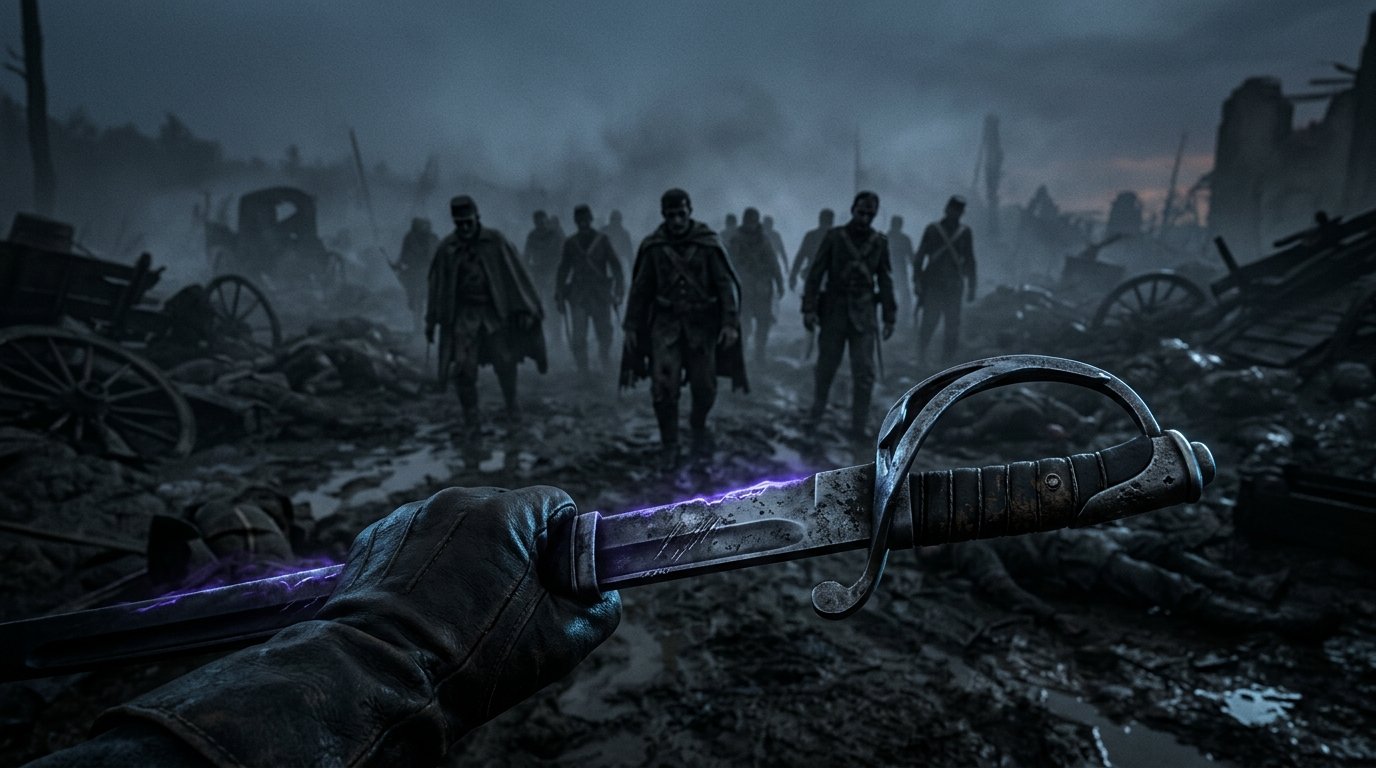
Setting is usually an afterthought in a soulslike preview, but here it may be the cleverest structural decision. The game follows William, a French soldier of the Grande Armée who is brought back from death by a substance called Nephtoglobin, the same substance that turns other fallen soldiers into abominations. He fights with Napoleonic-era weaponry and supernatural abilities in an alternate nineteenth-century Europe, and Vincent Cassel's Napoleon warns him about what he has become and asks what he would sacrifice for power.
Strip away the costume and look at the mechanical implications. A resurrected soldier with supernatural powers is the perfect justification for movement abilities that a grounded knight could never have. In my reading, the powers are the hinge: they are how Ghostrunner's verticality and speed get smuggled into a genre that normally prizes heavy, deliberate bodies. Muskets and sabers give the combat a historical texture that fantasy swords lack, and a plague-ridden battlefield gives the enemy design a visual language of rot and desperation that fits the genre's mood.
Whether the powers are tuned well enough to carry that weight is another matter. A fiction can justify a mechanic. It cannot make it fun.
## How genre crossovers usually succeed or fail
### The pattern: one twist, executed obsessively
The soulslikes that broke through did not try to remake the formula. They added one strong idea and built everything around it. Nioh, in 2017, took the structure and added stance switching and a rhythm of recovering stamina mid-fight. Sekiro, in 2019, replaced the shield-and-roll approach with posture and parry, then gave the player a grappling hook so the combat could be vertical. Lies of P, in 2023, leaned on a parry system tight enough to define the whole game.
Each of those games kept the core consequence loop intact and bent one pillar. They did not ask the player to unlearn the genre. That is the template Valor Mortis has to match: one clear twist, the first-person view and the movement, that reshapes combat without breaking the contract of risk and recovery.
### Where I think Valor Mortis can break
The risk is not that the game is too fast or too slow. It is that it never decides what stamina is for. If stamina is a hard limiter on movement, the Ghostrunner fans will feel strangled. If it only governs attacks while movement is free, the soulslike fans will feel the tension drain out, because a player who can always run away has no stakes.
The second risk is the one the price hints at. A $40 game from a mid-sized studio cannot afford the boss-per-hour density of a FromSoftware release, and the soulslike audience is trained to judge a game by its bosses. Day-one Game Pass access softens that, since players can try it without the commitment, but it also means the first week's verdict will be made quickly, by a lot of people who did not choose to pay.
The third risk is the quietest. Soulslikes live on word of mouth, on shared discoveries and arguments about builds. That works best when a game is still dense with secrets after the first thirty hours. A new IP launching in a crowded autumn has about two weeks to show it has that depth before the next release takes the conversation.
None of that makes the game a bad bet. I think the instinct to put Ghostrunner's design intelligence inside a genre that rewards patience is a smart one, and it is rarer than it sounds.
## What the demo cannot tell us
A demo can show you how a sword feels in your hands. It cannot show you what hour twelve feels like, when the movement is second nature and the question shifts from "can I do this?" to "does the game keep surprising me?" Ghostrunner never had to answer what happens to a player's momentum when the stamina bar runs dry. On October 13 we find out whether Valor Mortis has an answer, or only a very good premise.