Pocket Cat Desktop: The Cat That Judges Your Doomscrolling
Oct 4th '26 11:43am:
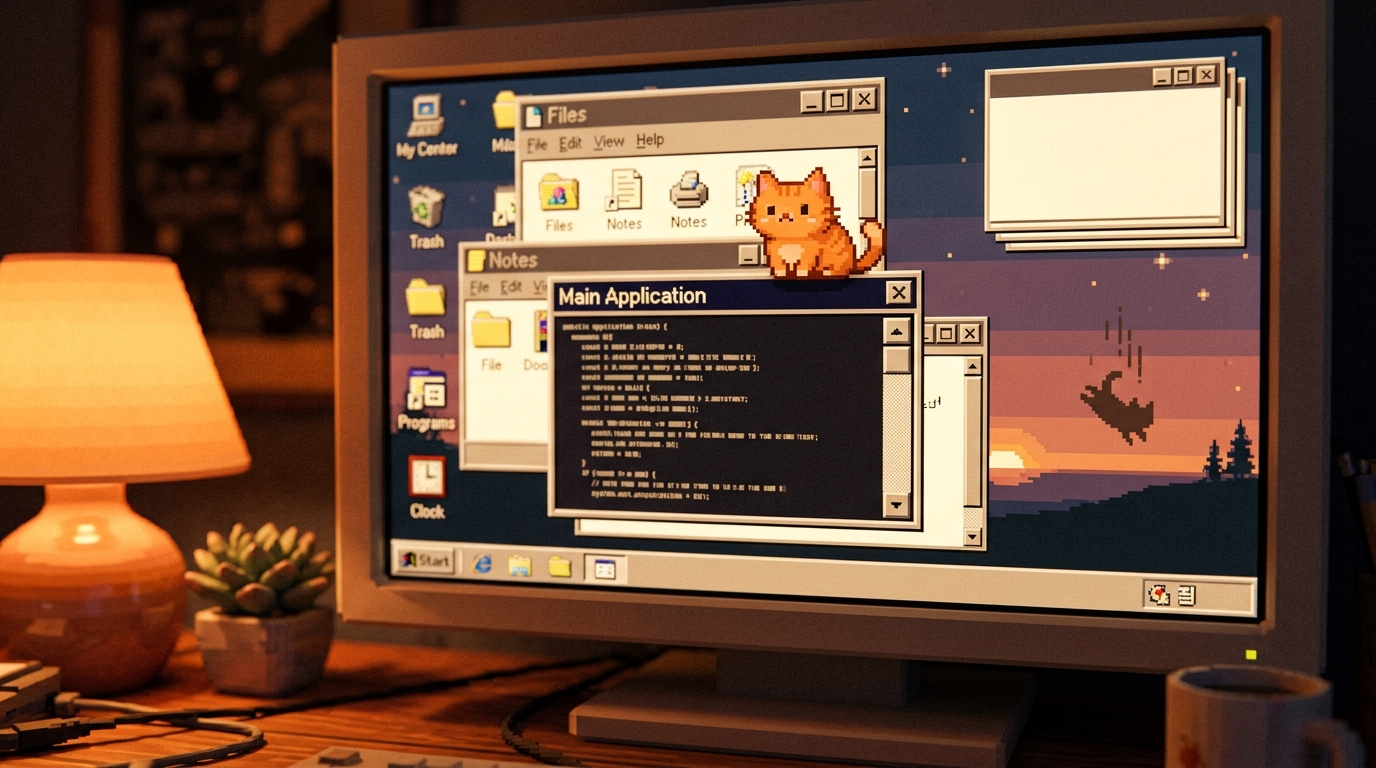
**Pocket Cat Desktop**, a game in which a tiny pixel-art cat lives on top of your Windows windows, already has a Steam page, but no release date and no price yet. It's the work of a single developer, Andrei Apanasik, and the idea is easy to explain and hard to shake. The cat walks along the edges of your open windows, climbs from one to another, curls up in a corner while you work, and falls when you close the window it was sleeping on. At night, it writes a diary. Under the joke there's a rare motive for this genre: Apanasik says he is making it in memory of his cat, Sonya, and that he can't have pets in the apartment where he lives.
## What Steam confirms (and what it leaves blank)
Before interpreting anything, it's worth separating what's written from what's assumed. The game's page says the following:
- **Who makes it:** Andrei Apanasik, who is also the publisher. No studio or team has been announced.
- **Status:** "Coming soon," with no date and no price published.
- **Requirements:** a dual-core 2.0 GHz processor, 1 GB of RAM, a DirectX 11-compatible GPU and 500 MB of disk space. The recommended spec raises the memory to 2 GB.
- **The cat's three meters:** Hunger, Energy and Mood.
- **Diary:** the cat records every day what happened to it, whether that's the butterfly it chased, the nap on your spreadsheet, or the day nobody fed it.
- **Soundtrack:** a built-in lo-fi/ASMR player.
- **Steam features:** Achievements, Workshop, Cloud and Family Sharing.
- **Languages:** eleven, including Brazilian Portuguese.
- **Tags:** Idler, Desktop Companion, Cozy, Life Sim, Time Management, Resource Management, Memes.
There are two oddities in the listing. The first is that the minimum and recommended operating system both appear as "Windows XP," which is almost certainly a leftover from the form. The page itself carries a note saying the Steam client has only supported Windows 10 and later since January 1, 2024. The second is that the game ticks full audio in all eleven languages. For a game whose protagonist doesn't speak, that reads like a form filled in a hurry, or else there's a lot of localized meowing. Neither is serious, but anyone writing about a game with no release date should note what's still raw.
The point I find most interesting is the Workshop checkbox. In a screen-cat game, that only makes sense if the community can create things: skins, backdrops, maybe diary entries. The page says nothing about it, and what the Workshop ends up meaning here will help decide whether the game has a life past its first week.
## Windows as floor: the one idea that isn't decoration
Anyone can draw a pixel-art cat. The decision holding this game up is a different one: treating system windows as terrain. The rooftops are title bars, the floors are stacked windows, and gravity responds to what you do. Close the browser where it was sleeping and it falls. It's a small idea with big consequences, because it turns your normal behavior (opening, closing, dragging, minimizing) into input for a game without you having to learn anything.
Technically, the game presumably reads window positions through Windows' own interfaces, which is how these programs usually work. The page doesn't explain it, and it doesn't have to. What matters is the effect: the desktop stops being a backdrop and becomes a level. A cat walking over an Excel window has a specific charm, that of an animal occupying a space made for something else.
There's a tension here that the author seems to have noticed. A creature that gets between you and your work can be delightful in the first hour and unbearable by the fifth. The game's text insists that the cat settles in, reads along with you, and watches you type. The design aims at companionship, not interruption. Whether that holds up over eight hours of use is the question a demo, when one exists, will have to answer.
## Four decades of screen creatures, and where this one parts ways
The idea of an animal wandering around your desktop isn't new. The cats that chase your cursor, the *Neko*-style programs, go back to the 1980s. The sheep and little characters that walk along window edges (eSheep, the Shimeji) were already doing much of what Pocket Cat Desktop promises in the 1990s and 2000s. More recently, *Desktop Goose*, from 2020, gave everyone the opposite experience: a goose that ruins your afternoon on purpose. And Bongo Cat became the involuntary mascot of people who stream.
That forces an honest question: what does Pocket Cat Desktop do that its predecessors didn't? In my reading, three things.
The first is **memory**. The Shimeji were toys with no past, while this creature writes a diary and has states that carry over from one day to the next. The second is **consequence**: if you don't feed it, the game registers it, and the page doesn't hide that the cat gets annoyed. The third is **tone**. Where Desktop Goose is malicious and Neko is a reflex, this cat is a difficult coworker, one who demands attention and then pretends to be indifferent.
None of the three is unprecedented on its own. The combination, delivered by one developer with visible care in the writing, is what sets it apart from yet another desk toy.
## The market is already full of cats
A good concept shouldn't be mistaken for an empty space. *Desktop Cat*, by Kang Huitae, offers twelve pixel-art breeds and coats, lets you have up to fifteen cats at once, keeps the first one free forever, and runs on macOS and Windows (the latter via the Microsoft Store). On Mac, the cats even chase and groom each other and fetch your notifications. On Android, *My Desktop Cat* does an overlay version, with a free orange cat and paid variants.
In other words, anyone who just wants a pixelated cat on their screen already has one, and for free. Pocket Cat Desktop will only justify a price, once it has one, if it sells something those don't: **personality with continuity**. The cat that knows you. The one that writes about you. The game competes less with other screen cats than with idle games and small life sims, which is where its tags place it.
There's also the most commercial question of all: how much will it cost? Free screen cats exist in abundance. A cat with a diary, meters and a Workshop might cost the price of a coffee or a small indie game, and the gap between those two is where the conversation is won or lost.
## What Pocket Cat Desktop inherits from Sonya
### The pattern: games born from an absence
In his ModDB post, Apanasik says he wants to capture a bit of what it feels like to have a cat nearby: quiet company one moment, urgent demands for attention the next. He also says that since he can't keep pets at home, building this companion means a great deal to him. That matters more than it seems.
The virtual-pet genre was born, in large part, from this logic. The Tamagotchi, from 1996, is usually told as a response to dense cities where real animals didn't fit. *Neko Atsume*, which lined cats up on phones, and *Stray*, which made a cat the protagonist of an entire game, show how many people will accept a substitute, as long as it respects the essentials of the animal: the indifference, the caprice, the warmth. Games like these win or lose on fidelity to a memory, and that fidelity shows. It's easier to get the pose of a cat asleep on a keyboard right when you've lived with one.
None of this guarantees the game is good. But it explains why the store text doesn't read like agency copy, and on a Steam page that's already a sign.
### The critique: the diary is the bet and the risk
The diary is the most original idea in the package and also the most fragile. It works if the writing is good and varied, and it dies by day three if entries repeat. A game like this lives on writing, and producing hundreds of credible entries with humor, without sounding like an automatic generator, is months of work. For a solo developer, it's probably the project's biggest risk, bigger than the technical side.
The three meters (Hunger, Energy, Mood) bring the opposite problem. A resource-management game overlaid on your screen risks becoming one more task on the list, and the page seems to know it: it promises the cat will tolerate your indifference, yet "don't you dare ignore them" is right there in writing. Between obligation and companionship there's a thin line, and that's where the game will be decided. A creature that makes you feel guilty for working in peace risks ending up uninstalled.
## What a cat that watches you has to explain
The page claims the cat reacts to what you do: it settles down when you read a long article, watches when you type, and judges you when you doomscroll too much. It's the game's strongest marketing line and, for that very reason, the one that's least explained.
How does the cat know you're reading, typing or scrolling? It could be the active window's title, the program in the foreground, the rhythm of your keyboard and mouse, or something else. The page doesn't say, and the difference matters. A program that observes open windows on a work computer rightly raises privacy questions: what it reads, what it stores, whether anything leaves the machine. The author should answer this before launch, in a simple, visible text rather than a buried policy. With Steam Cloud announced, the question of what gets saved and where is even more natural.
This is, in my assessment, the gap almost nobody is commenting on. The game's charm depends on a program looking at what you do. For the player, that surveillance is only acceptable if it's small, local and explained.
## No console gets here
For anyone following the game from the console world, it's worth stating the obvious: this doesn't exist there. The premise depends on an open window system, where one program can see and walk over others. No console allows that, and PlayStation in particular is the opposite of this philosophy. On PC handhelds, the Steam Deck has a Desktop mode, but it runs Linux, and the Pocket Cat Desktop page lists Windows only.
It's one of the reasons these games remain a PC thing. The computer is both the place where you work and the place where you play, and it's that mix, a small creature walking between the spreadsheet and the email, that gives the genre its charm. In the living room, connected to the TV, a cat like this would just be an animation.
## What's still missing
The list of unknowns is long and honest. There's no date, no price, no demo. We don't know what the Workshop will allow, or how the cat behaves when you open a fullscreen game or take a video call. We don't know whether the idea survives a week of real use, or how it reacts to someone with three monitors.
What we do know is little, and it's good: a clear design idea, an author who explains where it comes from, and a community that found it before there was a game. Apanasik's Telegram channel, incidentally, is called *gamedev_suffering*, which says something about the size of the project and the honesty of the person making it.
One question remains that doesn't fit on a Steam page. When the cat judges your scrolling at eleven at night, will you feel accompanied or watched?