Beyond Kanji: The Lost Heritage of Visual Novels the Western Market Never Played
Sep 27th '26 8:15pm:
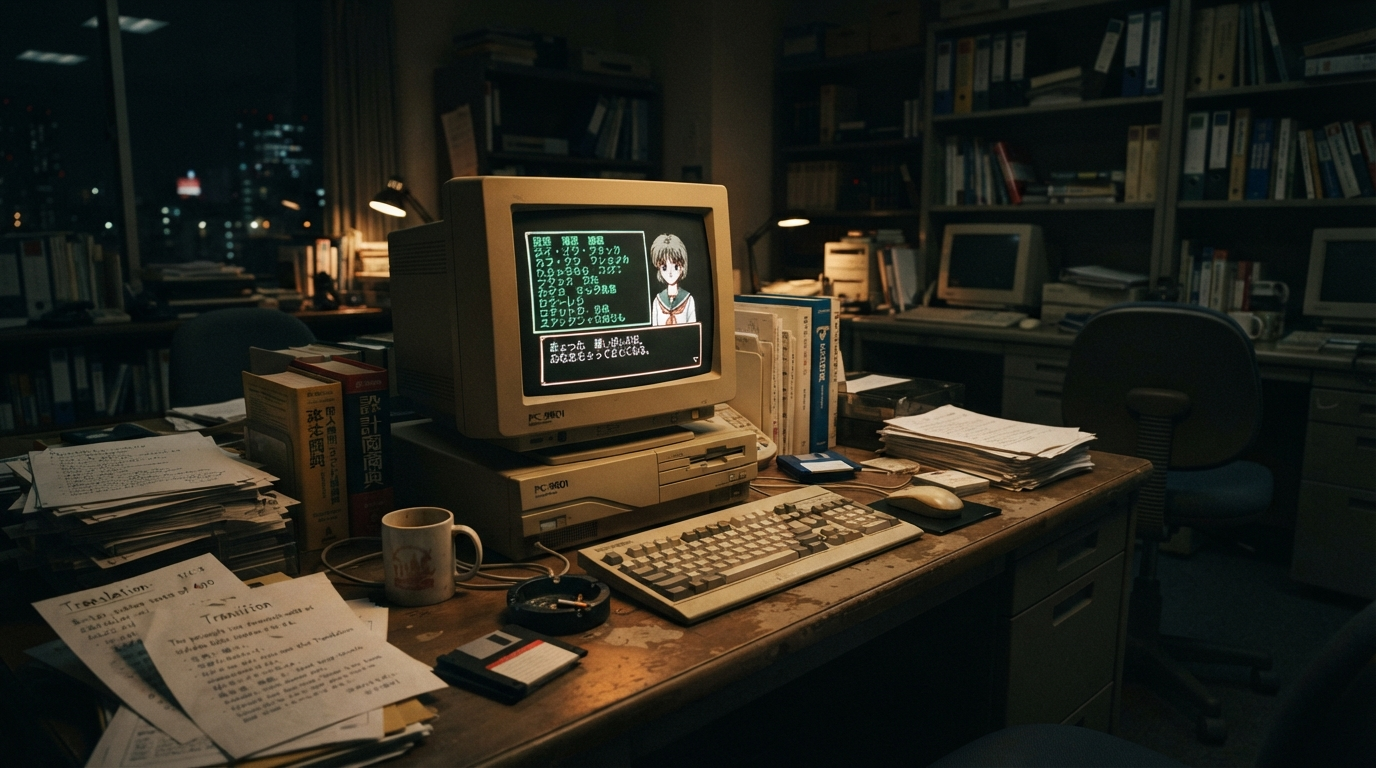
### The Text Cemetery That Secretly Shaped the Industry
A vast and silent cemetery of interactive stories has never earned an import stamp at Western ports. While the global market celebrated the transition from 16-bit to 32-bit systems in the 1990s with fanfare and multimillion-dollar translations of iconic JRPGs, an entire branch of Japanese creativity remained docked locally, restricted to obscure platforms like the PC-9801, FM Towns, and very limited physical home releases. We are not talking about mere fringe curiosities, but structural masterpieces that defined the grammar of psychological suspense, atmospheric horror, and modern romantic drama. The West consumed the stylized shell of these creations—through spiritual successors and belated adaptations—without ever suspecting the density of the original archive buried beneath layers of reverse engineering, technical complexity, and, above all, absolute corporate indifference to markets outside the archipelago.
### The Exclusionary Architecture of the PC-98 and the Floppy Disk Era
To understand why tons of fundamental interactive narratives never saw the light of day outside Japan, we must look at the infrastructure of domestic computing in the 1980s and early 1990s. While the United States and Europe standardized the IBM PC compatible ecosystem with Western architecture, Japan lived in a parallel universe dominated by proprietary hardware, most notably NEC's PC-98 line. These computers operated with peculiar text resolutions, hardware-embedded font management, and sound chips that allowed for highly sophisticated FM soundtracks for the time.
Visual novel developers were born precisely within this highly specific technical niche. Programming for the PC-98 meant writing code routines deeply tied to NEC's silicon. When the Western market began looking to Japan for content to license, the primary obstacle wasn't the language barrier—which in itself required bilingual translators with deep cultural knowledge—but the physical impossibility of running the code without completely rewriting the game from scratch.
The industry at the time operated under a strictly territorial logic. The porting costs for global Windows 95 or Western home consoles seemed prohibitive for genres that essentially relied on prolonged reading. The result was a historical fissure: while Western audiences learned to love the genre through isolated pioneers who achieved the feat of an official translation, hundreds of foundational titles remained confined to stacks of 3.5-inch floppy disks, rotting away in dusty Tokyo warehouses or circulating in extremely restricted auction communities.
### The Illusion of Digital Preservation and the Myth of Universal Access
Contemporary discourse loves to preach the fallacy that we live in an era of digital abundance, where any work from the past can be rescued with a few clicks. In practice, the history of lost visual novels disproves this comforting narrative with startling methodological violence. The preservation of these artifacts never depended on large corporations or public policies for technological curation; it survived thanks to the almost quixotic obstinacy of small groups of amateur translators and reverse engineers operating in the gray zone of international legality.
What mainstream media often ignores is that translating a visual novel is not the same as translating an instruction manual or even a traditional RPG script. The text in these works functions as a complex mechanical gear. Often, scripts were stored in proprietary data structures, compressed by rudimentary algorithms created by lonely programmers who did not even document their processes. Altering a single line of dialogue required rewriting memory pointers to prevent the game engine from collapsing when rendering an incorrect line break on screen.
When these fan teams—often working anonymously for years on end—finally managed to extract the text files, the cultural barrier imposed its second round of natural selection. The vocabulary of these narratives frequently resorted to untranslatable puns with archaic kanji, Tokyo subcultural slang from the 1980s, and deep literary references that defy any attempt at direct transposition into English. The result is that the portion of video game history that survived the test of time in the West is a distorted fraction, filtered through what was commercially viable or technically accessible to translate by volunteer enthusiasts, leaving in the dark works that shaped the creative thinking of legendary authors in the medium.
### The Silent Echo in the Modern Industry
The most fascinating—and melancholy—aspect of this historical gap is how it continues to shape current game design in invisible ways. Renowned creative directors in independent studios and major Japanese publishers frequently cite obscure references from the PC-98 golden age as direct inspiration for their narrative structures. However, when Western players consume these new products, they applaud the supposed originality of concepts that, in reality, had already been explored to exhaustion in titles that never left Japanese soil.
This geographic collective amnesia creates a dangerous distortion in the way we understand the evolution of interactive mediums. We treat narrative in games as a recent linear phenomenon, driven by Western blockbusters focused on cinematography, when in fact the conceptual foundation of branched writing and the psychological impact of textual choices was sedimented on obsolete Japanese microcomputers over thirty years ago.
The consequences of this invisibility go far beyond mere collector nostalgia. They impoverish critical debate about the medium. We discuss market trends and mechanical innovations while ignoring the entire trunk of the family tree from which these fruits fell. As long as binary files continue to corrupt on deteriorating physical media and original rights holders ignore the patrimonial value of these works, the video game canon will continue to be half-told—a brilliant official history built on foundations that the vast majority of the planet will never have the privilege of knowing.