14 Years Without a New Dimension: What the Sift Reveals About Minecraft's Future
Sep 26th '26 9:09pm:
Written by: jomifisi
<br>Mojang Studios revealed, during the September 2026 edition of Minecraft Live, that the Sift will be the fourth dimension in Minecraft's history — the first since the End was added in 2011 — and that it will arrive first inside **Minecraft Dungeons II**, which launches September 29, before eventually landing in the Java and Bedrock versions of the main game "next year." It's a big announcement delivered in a strangely cautious way, and that choice says more about the franchise's current moment than any trailer could.
## What Was Announced at the Live: The Full List
Before getting into the part that actually matters, it's worth separating fact from spectacle — Minecraft Live has a habit of wrapping technical announcements in jokes and inside references, and that sometimes gets in the way of anyone who just wants to know what's changing in the game. The concrete points from the broadcast were:
- **The Sift**, Minecraft's fourth dimension, debuts inside Dungeons II on September 29, 2026, and arrives in Java & Bedrock sometime in 2027, with no fixed date.
- **Minecraft Dungeons II** officially launches September 29, 2026, with an interconnected world structure (instead of isolated level-based missions like the first game) and a jumping mechanic new to the series.
- **Minecraft World**, a physical theme park inside the Chessington World of Adventures Resort in London, opens in 2027, with a themed hotel and the Escape the Nether roller coaster.
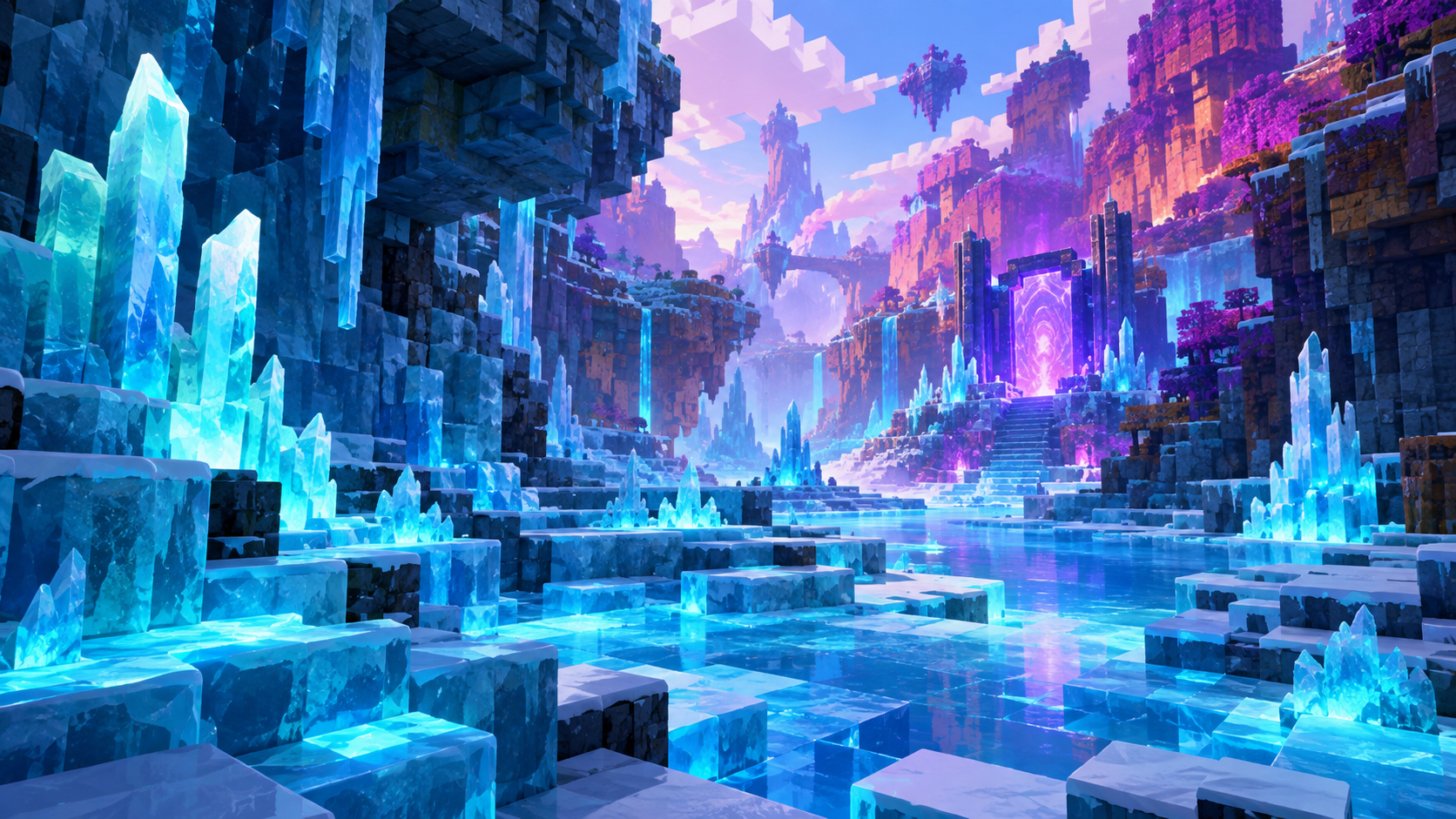
- A new **game drop** brings frozen cave biomes, with calcite blocks, ice stalactites and stalagmites, plus a frozen zombie variant still without an official name.
- **Sound effects packs** are coming to the Marketplace.
- Minecraft arrives on **Nintendo Switch 2** on October 27, 2026.
- **Minecraft Education** turns 10 years old.
- A **community challenge** proposes placing 50 million straw beds and 200 million cushions across the Overworld.
Notice that the Sift occupies two fronts at once: it's content from a paid game launching in two days, and it's also a promise for the game that is, by nature, free-after-purchase (anyone who already owns Minecraft doesn't pay again for updates) only some months from now. That split isn't a calendar accident — it's an editorial decision by Mojang, and that's where the analysis needs to focus.
## Two Comparisons That Put the Sift in Perspective
**Against the franchise's own history**, the gap matters: the End was incorporated into Minecraft in version 1.0.0, released on November 18, 2011, during that year's MINECON. Since then, the game has received dozens of updates — biomes, mobs, redstone mechanics, even a dimension undergoing a full overhaul in 2021 — but no genuinely new territory. Fifteen years is enough time for an entire generation of players to grow up without ever seeing a dimension "debut." The Sift breaks a drought that much of the player base didn't even know existed, because they simply never lived through the wait.
**Against the performance of the first Dungeons game**, the comparison is more uncomfortable for Mojang. The original Minecraft Dungeons, released May 26, 2020, received a lukewarm reception — 71 out of 100 on Metacritic, with critics pointing to a lack of the depth typical of the dungeon-crawler genre, even while praising its visual charm. It wasn't a commercial failure (the Minecraft label carries its own weight), but it also never became a pillar of the franchise the way Mojang seemed to hope back in 2018, when the game was announced with direct comparisons to Diablo. Placing the debut of a brand-new dimension inside the sequel to that game is, in practice, a bet that Dungeons II needs a stronger hook than the first game had — and the Sift is that hook.
## The Pattern No One Named During the Live
One detail slipped by in the recap's lighthearted tone: Mojang is increasingly using the franchise's satellite products — spin-offs, theme parks, console ports — as a testing showcase for ideas that later migrate, with adjustments, into the main game. This isn't the first time this movement has been noticeable; the logic of "prove the concept outside the core before committing the core" has been showing up more and more in the company's communications in recent years, and the Sift is the most explicit example yet, because it involves an entire dimension, not a mob or a block.
From a product standpoint, this makes sense: launching the Sift first in Dungeons II gives Mojang months of real data — telemetry from players, feedback from content creators, balance adjustments — before exposing the dimension to the much larger, much more vocal Java & Bedrock audience. A design mistake in a niche spin-off generates far less noise than one spread across a base of tens of millions of active players.
### What This Costs Players Who Just Play "Regular" Minecraft
The most generous reading is that of a controlled test. The more skeptical reading is that Mojang is conditioning early access to a piece of base-game content — which, technically, everyone who already bought Minecraft is entitled to receive for free — on the purchase of a separate game. No one is required to buy Dungeons II to eventually play with the Sift, that's true. But anyone who wants to see the dimension sooner, understand its mechanics ahead of the crowd, or simply satisfy the curiosity the live itself planted, needs to pay for another product. That's neither illegal nor unusual in the games-as-a-service market — it's practically the playbook Epic uses for Fortnite crossovers, for instance — but it sounds a little different coming from a franchise whose identity has always been sold as "one world, one purchase, updates forever."
It's also worth noting that the official recap itself, written in an almost stand-up-comedy tone, avoids any mention of this tension. The Sift is presented as a double gift — "you can already see it in Dungeons II" — leaving no room for the obvious question from anyone who only owns the original game: and what about me, who has no plans to buy the spin-off — exactly how long do I wait?
## The Frozen Game Drop Has Less Hype, But Maybe More Practical Relevance
While the Sift dominated the conversation, the next game drop for "classic" Minecraft brought something quieter, but with immediate relevance to everyone already playing today: a new frozen cave biome, with calcite blocks and ice crystals that emit their own light, plus a zombie variant that applies a freezing effect and, in some cases, throws ice balls. Game director Agnes Larsson reinforced that the studio's long-term vision keeps betting on "adventure" challenges as the central axis of updates — which, read alongside the Sift's arrival, suggests an entire season oriented around hostile environments and vertical navigation, not peaceful building.
It's a contrast worth underlining: the frozen cave arrives for everyone, for free, within the normal update cycle — no paid intermediary, no waiting for "next year." If anyone wants to gauge Mojang's real commitment to the player base that only owns the main game, this biome is the more honest thermometer from the live, even if it didn't get the same round of applause.
## The London Park and the Switch 2 Show the Same Logic, at a Different Scale
Minecraft World, the physical park inside the Chessington World of Adventures Resort, and the arrival on Nintendo Switch 2 on October 27 aren't, strictly speaking, game content — they're brand-surface expansion. But they fit the same reasoning: every announcement from the September live reinforces the idea of Minecraft as an ecosystem of entry points, not a single product receiving vertical updates. A theme park captures an audience that has never touched a controller. A console port captures people who already own the hardware but never installed the game. And the Sift, debuting in a spin-off, captures people who may have abandoned the original Dungeons back in 2020 and needed a concrete reason to come back.
Taken individually, none of these moves is surprising — most big game franchises operate this way today. Taken together, in a single broadcast running a little over an hour, they expose just how little room is left, within official communications, to treat the original game as a standalone priority. It's one piece among several, and it may no longer even be the piece that gets the most anticipated news first.
## What's Left Unanswered
At no point during the live did Mojang say whether the version of the Sift arriving in Java & Bedrock in 2027 will be identical to the one in Dungeons II or whether it will undergo adjustments — and there's no guarantee that "next year" means early, mid, or late 2027. It also wasn't made clear whether the pace of launching structurally important content first in paid products will become standard for the game's next dimensions, updates, or core mechanics, or whether the Sift was an isolated case, justified by the calendar coinciding with Dungeons II's launch. Until that gets resolved, anyone who only plays the free version — or rather, the version they already paid for once, years ago, and never had to pay for again — will keep watching from the outside as a piece of their own game is born somewhere else.
<br>Source: https://www.minecraft.net/en-us/article/mclive_sept2026_recap