The history of horror games nobody tells right
Sep 23rd '26 6:23am:
Written by: jomifisi
<br>In 1989, a Japanese game called *Sweet Home* placed five characters inside a haunted mansion, with no real weapons, using a limited inventory system that forced the player to choose between carrying a key or a healing item. There was no scripted jump scare there — there was scarcity, and scarcity, used well, is more terrifying than any figure leaping out of a closet. Seven years later, the same team at Capcom reused much of that logic to release *Resident Evil*, and the survival horror genre was officially born. What happened over the following three decades wasn't a linear evolution toward "better" or "scarier" games — it was a rivalry, almost never openly acknowledged by the industry, between two fear philosophies competing for the same audience and the same development budget.
## The lazy consensus about horror's "evolution"
Ask someone who's covered games for a while, and the answer usually comes pre-packaged: horror started "psychological and slow" and grew "more intense and immediate" as technology allowed better graphics and more realistic sound effects. It's a comfortable narrative because it looks like natural progression — as if *Alone in the Dark*, from 1992, were simply a rougher version of *Outlast*, from 2013, rather than a game with completely different design goals.
That reading ignores an inconvenient detail: the two models always coexisted, often within the same studio and the same year. In 1999, Konami released *Silent Hill*, a game built almost entirely around ambiguity — the fog covering the fictional town of Silent Hill wasn't just a technical limitation of the original PlayStation dressed up as an artistic choice (though it was partly that too); it was a narrative device that left the player unsure of what they were actually seeing. In that same period, smaller developers were already experimenting with timed scares and enemies that appeared suddenly in corridors, a technique that would, decades later, get the name everybody now uses without a second thought.
The idea that one model "won" over the other on creative merit also doesn't survive a simple comparison of sales numbers. *Five Nights at Freddy's*, released by Scott Cawthon alone in 2014, on a budget the creator himself has publicly described as almost nonexistent, sold millions of copies built entirely on the sudden-scare mechanic — the player sits still, checks cameras, and the game punishes any distraction with a high-contrast visual and audio jump scare. There's no ambiguity there at all. And it worked, commercially, overwhelmingly.
## What the actual timeline dismantles
Comparing *F.E.A.R.*, from 2005, with *Amnesia: The Dark Descent*, from 2010, helps show why the "progression" narrative simply doesn't add up. *F.E.A.R.* is technically more advanced, arrived five years earlier, and still relies heavily on the sudden appearance of a child-like figure in corridors — a device that today would be called, without ceremony, a classic jump scare. *Amnesia*, five years later, with far smaller technical resources (Frictional Games was a small Swedish studio, without the budget of a publisher like Warner Bros., which released *F.E.A.R.*), chose to remove the player's ability to fight at all. With no weapons, no possible defense, the only option is to run and hide, and the fear comes from helplessness, not surprise.
The second comparison that matters is with the adjacent film horror market, because the two mediums influenced each other more directly than the industry usually admits. The success of *Paranormal Activity* in 2007 — a film made on a budget estimated at 15,000 dollars that grossed more than 190 million globally — proved to an entire market that cheap, well-timed scares generate disproportionate returns on investment. It's no coincidence that, in the following years, a wave of independent horror games with equally modest budgets adopted exactly the same logic: *Outlast*, from Red Barrels, a Canadian studio founded by former Ubisoft employees who left specifically to escape slow corporate processes, released in 2013 a nearly combat-free game built around chases and sudden appearances inside an abandoned asylum.
## The pattern that repeats every time the genre resurfaces
There's a cycle that has repeated since I started closely following horror releases, and it's rarely named as a cycle: every time the market gets saturated with jump scares — and it always does, because the effect loses power with repetition — a title comes along that hands credibility back to the psychological side, usually from a creator with a public track record of frustration with the dominant formula.
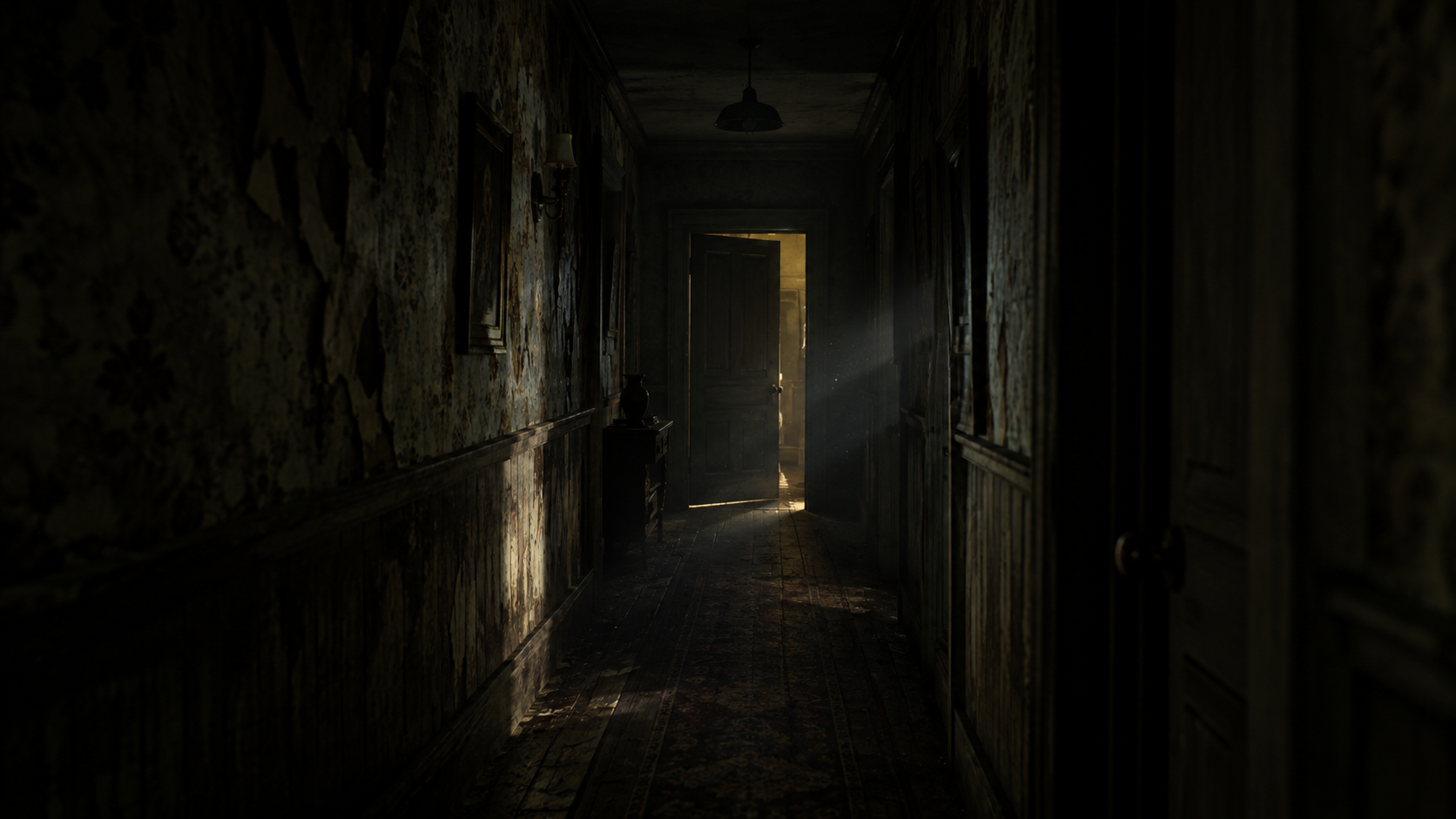
That's what happened with Hideo Kojima and Guillermo del Toro in 2014, when they released *P.T.*, a playable demo disguised as an indie game, distributed as a surprise on the PlayStation Store with no prior notice that it was actually a teaser for *Silent Hills*. *P.T.* had no enemies in the traditional sense. It had a hallway that repeated, tiny, almost imperceptible changes on each loop, and a radio sound that grew more disturbing over time. It became one of the most talked-about games of that year — and the full project ended up cancelled in 2015, after the falling-out between Konami and Kojima, an episode that still fuels debate today over how much "real" horror the industry is actually willing to fund when it doesn't come with a cheap, replicable formula attached.
Three years later, Capcom brought the *Resident Evil* series back to its claustrophobic-tension roots with *Resident Evil 7: Biohazard*, in 2017, including full virtual reality support — a decision that, according to figures Capcom itself disclosed in financial reports, helped sell more PlayStation VR units than any other single title up to that point. The pattern closes the loop: the psychological side tends to reclaim critical credibility, the jump scare tends to keep mass-market sales volume up, and it's rare for the same team to define both waves twice in a row.
### The critique the industry avoids making about the streaming era
Here's the angle almost nobody spells out directly: starting in the mid-2010s, the criterion that most shaped horror game design stopped being purely artistic and became algorithmic. Twitch and YouTube turned the streamer's physical reaction — the scream, the jump out of the chair, the face-cam capturing the fright in real time — into a free, viral marketing asset. A game that produces a fifteen-second clip of a streamer screaming gets organic reach that no paid campaign can match at the same cost.
That's not an empty accusation. *Five Nights at Freddy's* exploded commercially in large part because of YouTube reaction videos, and Scott Cawthon himself publicly acknowledged, in interviews from that period, that "Let's Play" culture was decisive for the franchise's success. The jump scare, in that context, stopped being just a narrative tool and became, also, a distribution tool. Psychological horror design, being inherently slower and more ambiguous, produces terrible thirty-second clips. Nobody shares a two-minute video of tense silence from *Silent Hill 2*. In my view, that weighs more heavily on the financing equation of a horror game today than any debate about "what actually scares people" — and it's a pressure that will keep shaping the genre for as long as video platforms' attention economy doesn't change.
Worth noting: not the whole market caved to that pressure. *Alien: Isolation*, released by Creative Assembly in 2014, deliberately bet against the trend: a single enemy, an alien with adaptive AI that learned the player's behavior patterns, almost no cheaply scripted scares. The game sold solidly, but quietly, without the viral boom of an *FNAF*. It's hard not to read that as a sign of which of the two approaches the mass market is, today, structurally inclined to reward faster.
There's also a situational detail that tends to get overlooked in genre retrospectives: many of the most acclaimed psychological horror games had modest initial sales and only became "classics" years later, through critical reappraisal and ports to new platforms — *Silent Hill 2* itself had an initial commercial performance well below what its current reputation would suggest. The jump scare, on the other hand, tends to monetize fast and fade fast, with sequels that rarely sustain cultural relevance beyond two or three years. These are different business models disguised as purely creative choices.
---
Maybe the right question isn't which of the two models is "more valid" — that was answered long ago, and the answer is neither one on its own. The uncomfortable question is a different one: how many studios will still have the courage, or the funding, to bet on a *P.T.*-type project, knowing it might not produce a single ten-second viral clip? Because, looking at the track record of the last decade, the market has already given its answer — and it wasn't the answer psychological horror fans would have liked to hear.