Silent Hill: Townfall — Why First-Person Changes Everything
Sep 21st '26 11:59am:
Written by: jomifisi
<br>Screen Burn Interactive — the Scottish studio formerly known as No Code — is launching *Silent Hill: Townfall* on September 24 for PS5 and Windows, and the detail dominating early impressions isn't the setting or the amnesiac protagonist: it's the camera. For the first time in a mainline entry of the series, the game is played entirely in first person, with no meaningful HUD, with no option to peek around corners in third person to see what's waiting on the other side. Konami is testing, with its most valuable property outside Metal Gear, whether fear works better when you can't see the back of your own neck.
This isn't a minor technical footnote buried in a spec sheet. It's the central design decision that separates Townfall from everything the series has done since 1999, and it's also the reason it's worth stopping to understand what's really at stake before the title hits shelves.
### First Person, the CRTV, and Combat That Hurts: What Actually Changes Mechanically
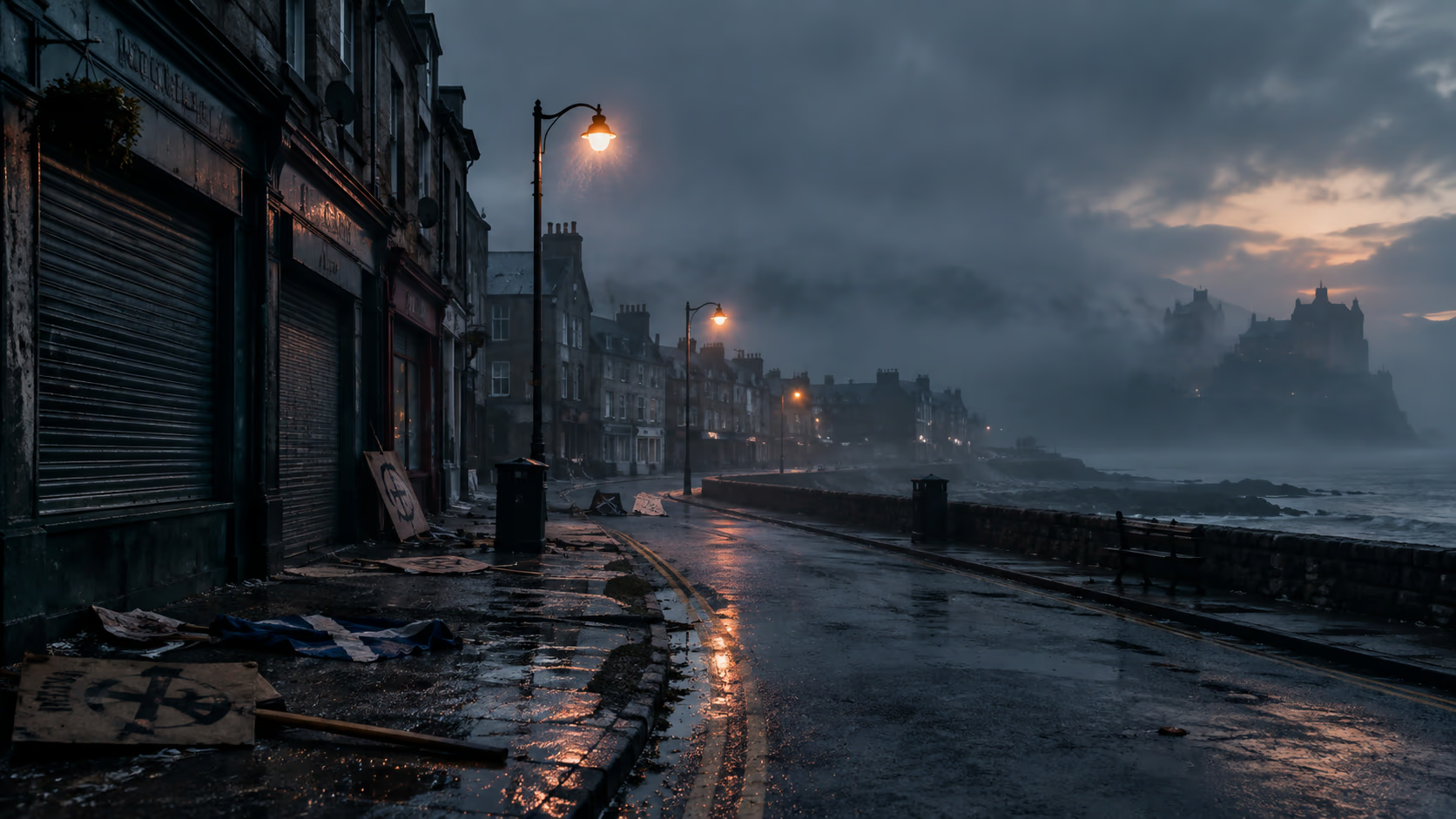
The action takes place in 1996, on the fictional Scottish island of St. Amelia, where protagonist Simon Ordell is called back to "put things right" — and where, predictably, he finds a town lying quiet beneath a thick fog that isn't nearly as abandoned as it looks. Familiar ground, so far. What changes is how you experience it.
- **Perspective:** the game runs entirely in first person, built on Unreal Engine 5, with no HUD elements mediating how you read the environment.
- **The CRTV:** a handheld device, a kind of pocket television, that the player uses to tune into unstable signals, sketch outlines of enemies, and solve environmental puzzles. It's not a cosmetic gadget — it's where presentation and mechanics actually fuse together.
- **Combat:** heavy, deliberately clumsy, without the timing-based parry dance that defined much of post-*Resident Evil 4* survival horror. Weapons degrade, ammo is scarce, and the single firearm available is described as mediocre by design, not by technical limitation.
- **Evasion:** a hide-and-peek system against enemies who, once they spot the player, give chase relentlessly until they lose the trail.
- **Structure:** Otherworld segments and environmental puzzles still exist as pacing breaks, but the narrative weight clearly sits with the town itself.
- Three difficulty settings, joint publishing from Konami Digital Entertainment and Annapurna Interactive (the same duo behind *Stray*), and simultaneous release on PS5, Steam, and the Epic Games Store.
Two comparisons help place this. The first is internal to the series: *Silent Hill f*, released before Townfall, had already taken the franchise to 1960s Japan to pull it away from the worn-out suburban American visual roots — a geographic shift, but still in third person, still with the camera creating distance between player and monster. Townfall makes the opposite and more radical move: it stays within recognizable aesthetics (fog, siren, a clock we already know is about to stop making sense), but it removes the distance. The second comparison is external, and it's the one getting the most mileage in forums lately: the ghost of *P.T.*, Kojima's cancelled demo for the *Silent Hills* that never was. There's no real affiliation between the projects, but the logic of claustrophobic first-person exploration, without immediate combat, without a map, invites the comparison — and Screen Burn seems aware of it, to the point where the resemblance functions almost as homage to a game an entire generation only knows through YouTube videos.
### From No Code to Screen Burn Interactive: How a Small Studio Inherited the Crown
This is where the story stops being about a game and becomes about an editorial choice by Konami that, back in 2022, looked almost counterintuitive.
#### The Pattern Konami Had Already Tested With Other Studios
No Code is a name that only resonates with people who follow niche narrative horror. The Scottish studio made *Stories Untold*, an anthology of four short stories built around text-puzzle mechanics, and then *Observation*, a sci-fi thriller told from the perspective of an artificial intelligence aboard a space station. Neither is a mass commercial hit. What both are, though, is a demonstration of how to tell a story through interfaces — screens, signals, noise — instead of traditional cutscenes. It was precisely that résumé that led series producer Motoi Okamoto to trust them with the project: he had played both titles and saw in them the right language for a Silent Hill that needed to reinvent itself without betraying itself. Annapurna Interactive, the co-producer, is said to have been the one who bridged Konami and a studio that would otherwise hardly have been on the shortlist to inherit one of horror's most respected IPs. In July 2025, midway through development, No Code changed its name to Screen Burn Interactive — a rebrand that happened quietly, without much public explanation, but that coincided with the phase in which the studio stopped being "the makers of Observation" and became, definitively, "the makers of Silent Hill: Townfall."
This fits a broader pattern Konami adopted once it decided to resurrect the series after years of hibernation following the cancellation of Kojima's project: spreading different pieces of the franchise across different studios, each with its own specialty. Bloober Team got the *Silent Hill 2* remake. NeoBards handled *Silent Hill: Ascension* in episodic interactive format. And now a small British studio, with zero track record in traditional survival horror, gets a fully original entry. It's not the most obvious strategy — it would be easier to hand everything to one large studio and keep things consistent — but it's the more interesting one, because it tests whether the Silent Hill brand survives being reinterpreted by different authorial voices instead of replicated by formula.
#### The Bet That Could Backfire
And this is where the less comfortable part comes in: in my assessment, this decentralization carries a cost Konami hasn't publicly paid yet, but one that's going to show up in the first weeks of sales. A considerable chunk of the Silent Hill fanbase wants exactly what Townfall refuses to give them — the third-person camera, the ability to watch your own character stumble in fear, the slower inventory-exploration rhythm that defined *Silent Hill 2* and *3*. By pushing the series toward a format that resembles *Alien: Isolation* or *Amnesia* more than classic Silent Hill, Screen Burn is betting that the modern horror audience prefers immersion over mechanical nostalgia. It's a bet that could work very well critically — early reactions lean that way, with recurring praise for how the absence of a HUD heightens tension — but it risks alienating exactly the most loyal buying segment, the ones who pre-order because they recognize the logo, not because they trust the studio.
There's another factor nobody's discussing with the weight it deserves: 2026 is a year of absolute saturation in the genre. Between remakes, sequels, and a growing number of first-person horror indies trying to replicate the success of titles like *Amnesia: The Bunker*, the average player's attention span is more fragmented than at any other point this decade. Townfall isn't only going to compete with the memory of *Silent Hill 2*. It's going to compete with September's own release calendar. That doesn't diminish the quality of what Screen Burn has built — the fusion between the CRTV and the environmental storytelling, with boats named after children and shops shuttered forever telling a story without a single line of dialogue, is the kind of detail that separates a good game from a memorable one — but it means Konami is playing two simultaneous bets: a creative one, about whether the reinvention works, and a commercial one, about whether the market has enough attention space left to notice in time.
## What the Critics Haven't Asked Yet
Nobody has publicly asked, so far, what happens to the series after Townfall if the experience is critically acclaimed but sells below expectations — a perfectly plausible scenario for a small-studio spin-off within an IP that already survived a traumatic cancellation. Will Konami keep spreading the brand across different studios even if one of them stumbles commercially? Or does it go back to centralizing everything, with Screen Burn Interactive becoming a well-received but isolated footnote in the series' recent history? For now, what exists is a game that decided to pull the camera out from behind the player's shoulder and put it exactly where it hurts most.
<br>Link: https://bleacherreport.com/articles/25501387-silent-hill-townfall-review-gameplay-impressions-videos-and-top-features