Reanimal: Meet the Actors Behind Its Haunting Voices
Sep 21st '26 9:58am:
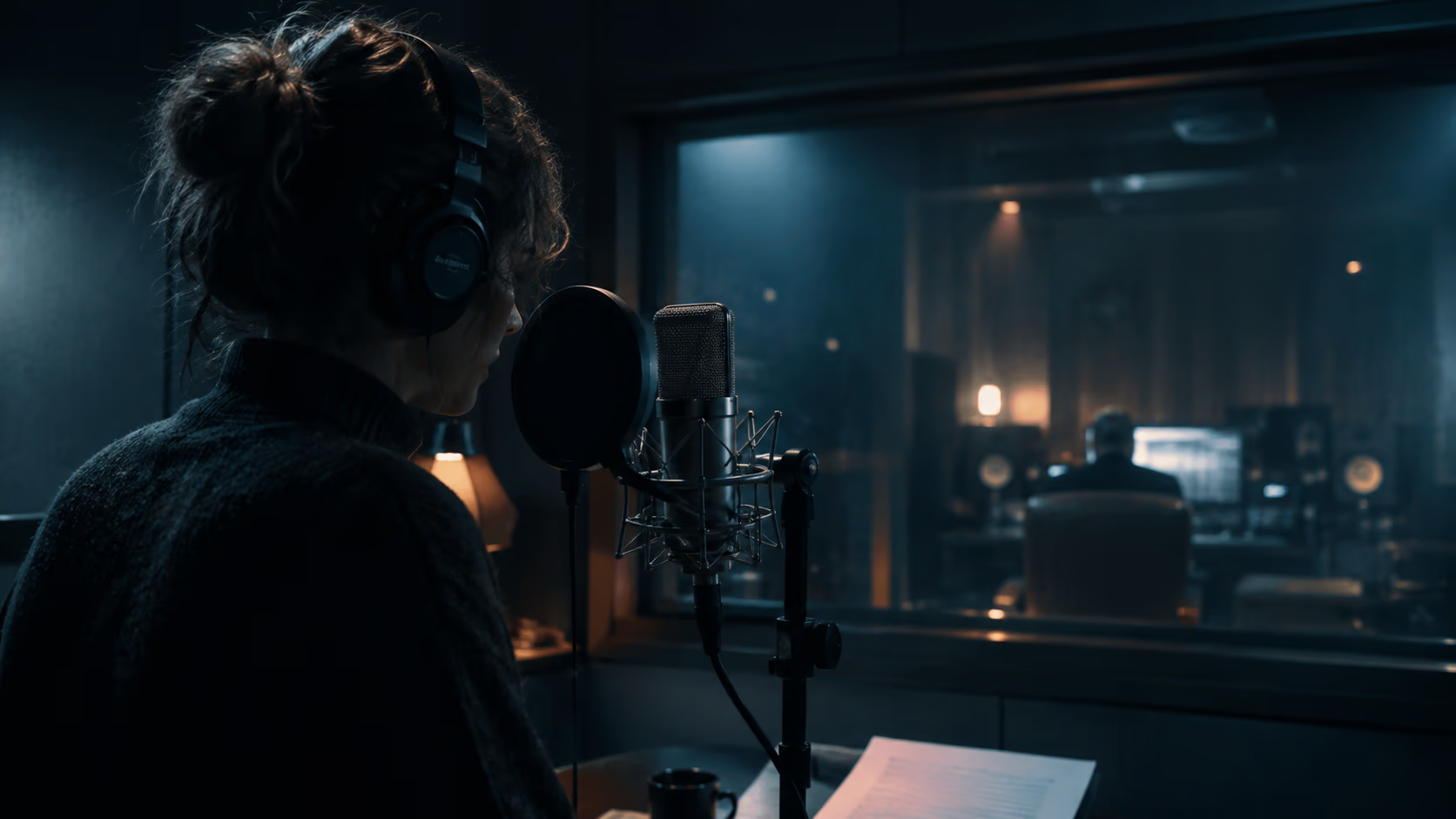
There is something strangely unsettling about the voices in *Reanimal*. They do not come from the kind of famous actors whose names immediately jump out of a game's marketing campaign. Instead, the English cast includes Pearl Wolstenholme, L.M. Fly, Molly Jenkins, Cali Worthington and Philip Edeheim, with additional voices from Emma Widing, Tuva Westin, Tyra Wikström, Stella Vasselbring and others. For most players, these names will mean very little at first. That makes discovering who is actually behind the characters almost as interesting as the game itself. ([IMDb][1])
*Reanimal* was released on February 13, 2026, from Tarsier Studios and THQ Nordic. Its story follows a brother and sister trying to rescue their missing friends and escape the island they once called home, now transformed into a deeply disturbing nightmare. The game can be played alone or in local and online co-op, with its shared camera deliberately designed to increase claustrophobia and tension. ([IMDb][2])
And that is what makes the cast worth looking at.
Because in a game built around fear, silence and vulnerable children wandering through a world that feels impossibly large, the voice does not need to belong to a celebrity.
Sometimes it needs to disappear completely into the nightmare.
## The Reanimal cast is full of names most players won't recognize
Look through the main English credits and the first thing that stands out is what is missing.
There is no Hollywood superstar being prominently marketed as the face of the game. No instantly recognizable voice that makes you stop and say, "Wait, I know that actor."
Instead, the principal voice cast is listed as **Pearl Wolstenholme, L.M. Fly, Molly Jenkins, Cali Worthington and Philip Edeheim**. Molly Jenkins is credited as Hood, while Cali Worthington voices Bucket. ([IMDb][1])
The wider cast adds another layer. Emma Widing, Tuva Westin, Tyra Wikström and Stella Vasselbring are credited under **Teatergruppen Spindelbarnen**, while Christian Vasselbring, Jacob Carlsson and Zsombor Szakács provide additional voices. Ellie-Mae Siame is also credited as Bandage in current IMDb listings. ([MobyGames][3])
That makes the cast feel less like a conventional AAA celebrity lineup and more like a collection of performers assembled specifically to inhabit this strange world.
And once you start looking at their credits, the story gets more interesting.
### Molly Jenkins is one of the easiest voices to trace
Molly Jenkins is probably the name that gives players the clearest path outside *Reanimal*.
She voices **Hood**, one of the game's characters, and has screen credits outside gaming, including work on *The Stand Up Sketch Show*, *Doctors* and *Hollyoaks*. ([IMDb][1])
That matters because Hood is exactly the kind of character where vocal performance can become more important than a long list of dialogue.
Tarsier's games have never needed characters to spend minutes explaining themselves. A frightened voice, a reaction to something seen in the darkness, or even a brief exchange between two characters can carry more emotional weight than an exposition-heavy scene.
Jenkins therefore isn't simply providing another recognizable voice.
She is helping sell the vulnerability that sits at the center of *Reanimal*.
And that vulnerability is important.
The characters are small. The environments are enormous. The creatures are grotesque. Even ordinary spaces can feel threatening.
A voice has to make you believe that the person behind it is genuinely trapped there.
## Pearl Wolstenholme is one of the biggest mysteries
Then there is **Pearl Wolstenholme**.
Her name appears near the top of the game's voice credits and she is also listed among the principal stars of *Reanimal* on IMDb. Yet compared with the names players normally encounter in major game productions, her publicly visible acting credits are surprisingly limited. ([IMDb][1])
That creates a fascinating contrast.
A player can spend hours listening to a character in *Reanimal*, become emotionally attached to what happens to them, and then discover that the person behind that voice does not have the kind of enormous public profile normally associated with a major video game performance.
It almost feels backwards.
Hollywood tends to sell the actor first and the character second.
*Reanimal* largely does the reverse.
You meet the character.
You hear the voice.
You experience the fear.
Only afterward do you go looking for the person responsible.
That is probably why the cast feels so mysterious.
There is very little celebrity baggage attached to many of these performances.
You are not constantly thinking about another movie or another franchise while listening.
The voice belongs to *Reanimal*.
## L.M. Fly has an even stranger connection to the game
**L.M. Fly** is another particularly interesting name in the credits.
Fly is listed as one of the game's voice actors, but the same person also appears in the development credits for **concept art and 3D asset art**. MobyGames lists L. M. Fly under both areas of the art department as well as voice acting. ([MobyGames][3])
That is the kind of credit that can easily disappear when players only look at the game's cast.
It also gives *Reanimal* a slightly different feel as a production.
The people who help create the game's world are not necessarily locked into one narrow role.
Someone can contribute visually to the nightmare and then contribute vocally to it as well.
That is a very different picture from the popular idea of game development as a giant machine where every person performs one isolated task.
The credits suggest something much messier and more human.
And for a studio like Tarsier, that feels appropriate.
The studio's horror has always been intensely visual, but sound is part of the same language. The grotesque creature design, the environments and the performances all need to feel like they came from the same nightmare.
L.M. Fly's unusual combination of credits makes that connection particularly visible.
## Philip Edeheim is not just another voice in the credits
**Philip Edeheim** presents another surprise.
He is listed among the voice actors, but MobyGames also credits him as one of the game's **producers**, alongside Andreas Johnsson. ([MobyGames][3])
That is a detail most players would never know.
When people think about a video game's voice cast, they generally imagine professional actors arriving at a studio, recording their lines and leaving the production behind.
Edeheim's credits paint a different picture.
He was involved in the production itself and is also credited as a voice actor.
It is difficult to look at that without being reminded that the credits of a modern game often reveal a much more complicated production than the finished product suggests.
The player sees the final character.
The credits show the people who were moving between disciplines, studios and responsibilities to make that character possible.
There is something oddly fitting about discovering that after spending hours inside *Reanimal*.
The game itself is built around fragments.
You rarely receive everything at once.
You see part of an environment. Hear something in the distance. Discover something disturbing. Then much later, another piece makes the earlier moment feel different.
The credits have their own version of that structure.
You recognize the voice first.
The person behind it comes later.
## The children's voices tell another part of the story
The group credited as **Teatergruppen Spindelbarnen** deserves special attention.
Emma Widing, Tuva Westin, Tyra Wikström and Stella Vasselbring are credited as voices, with Christian Vasselbring, Jacob Carlsson and Zsombor Szakács listed for additional voices. ([MobyGames][3])
That is not the sort of cast list that immediately becomes a headline.
But it makes sense when you consider the atmosphere of *Reanimal*.
Tarsier's horror has always been fascinated by childhood.
The studio does not simply put children into a scary setting and call it horror. It makes the scale of the world itself frightening. Doors are too large. Creatures are enormous. Rooms seem to have been designed for somebody much bigger.
The children are physically small, but the emotional burden placed on them is huge.
That makes young voices particularly powerful.
A child's voice coming from somewhere in the darkness does not need to scream to make a scene uncomfortable.
Sometimes hearing a distant voice is enough.
## Reanimal's voice cast changes completely depending on your language
There is another detail that can easily confuse anyone researching the cast.
There isn't just one voice cast for *Reanimal*.
The game supports voice acting in **English, French, German, Japanese, Polish, Portuguese (Brazil), Russian, Spanish (Mexico) and Chinese**, among other supported language options listed by PlayStation. ([PlayStation Store][4])
So the actors above represent the English-language cast.
Switch the language and you are effectively hearing another performance of the same nightmare.
The Brazilian Portuguese version, for example, credits **Cassiano Ávila, Monalisa Capella, Noah Gelly and Rodrigo Horta**. The Japanese version includes Kotomi Otsuka, Azusa Aoi, Rio Shiomi, Yuki Haga, Mari Kawano and Yuki Onodera. ([MobyGames][3])
The German version has its own cast as well, including Gerhard Fehn, Joana Taskiran, Ben Wilper, Julius Henschel, Lina Haase and Marie Anna Walter. ([MobyGames][3])
This matters because voice acting is not merely a technical translation.
A different actor changes rhythm, emphasis and personality.
The same character can feel subtly different depending on the language coming through your speakers.
And *Reanimal* is particularly sensitive to that because its atmosphere is so dependent on sound.
## The game has an unusually large production behind those voices
There is another reason the cast is easy to overlook.
The credits for the Windows version contain **530 people and 568 credits**, according to MobyGames. That includes the development team, voice production, localization, recording, casting and numerous other departments. ([MobyGames][3])
That number puts the voice cast into perspective.
Pearl Wolstenholme, L.M. Fly, Molly Jenkins and the other performers are only a small part of an enormous production.
But their work has an unusual responsibility.
Art can make you look.
Sound can make you feel that something is standing behind you.
That distinction becomes especially important in horror.
A monster can be hidden in darkness. A sound cannot.
You hear footsteps before you see anything.
You hear a voice before you know who is speaking.
Sometimes you hear something and never discover exactly where it came from.
That is where voice acting becomes more than dialogue.
It becomes atmosphere.
### The most important voices may be the ones you never recognize
There is a temptation in modern gaming to treat a famous actor as a guarantee of quality.
It is easy to understand why. A recognizable name provides instant marketing value. Put a famous actor on a poster and people immediately know there is a story behind the character.
But *Reanimal* demonstrates the other side of that equation.
A voice does not need to be famous to become memorable.
In fact, being unfamiliar can sometimes be useful.
When you recognize an actor, part of your brain is inevitably making a connection with something else. You remember where you've heard them before. You picture another character. You bring another performance into the room.
An unfamiliar voice has none of that baggage.
It belongs to the character.
That may be one reason the cast of *Reanimal* feels so elusive when you start researching it.
The performances are there.
The actors are there.
But the celebrity machinery isn't.
And perhaps that is exactly what a game like this needs.
## The credits reveal a side of Reanimal most players never see
The further you look into the credits, the harder it becomes to describe *Reanimal* as simply a game with "unknown voice actors."
That description is too easy.
The cast includes performers with acting experience, members of a theater group, people who worked in other areas of the game's production and entirely different voice casts for localized versions. ([MobyGames][3])
There is also a dedicated voice production infrastructure behind them, including casting and voice direction through PitStop Productions and recording and localization work involving several external studios. ([MobyGames][3])
In other words, the fact that most players do not recognize the names does not mean the production treated the voice work as an afterthought.
Quite the opposite.
There is a substantial production process hiding behind those few seconds of dialogue players hear while exploring the island.
That is the part that is easy to miss.
You see a character on screen.
You hear a voice.
Then you keep playing.
But somewhere behind that moment was an actor sitting in a recording booth, a voice director shaping the performance, engineers recording and editing it, casting teams finding the right performer, and localization teams recreating the performance for another language.
None of that appears on screen.
It simply becomes part of the fear.
And perhaps that is why discovering these actors after finishing *Reanimal* feels strangely satisfying.
The game spends so much time hiding things from you.
Even its voices have secrets.
[1]: https://www.imdb.com/title/tt34387536/fullcredits/?utm_source=chatgpt.com "Reanimal (Video Game 2026) - Full cast & crew - IMDb"
[2]: https://www.imdb.com/pt/title/tt34387536/?utm_source=chatgpt.com "Reanimal (Videogame 2026) - IMDb"
[3]: https://www.mobygames.com/game/255127/reanimal/credits/windows/?utm_source=chatgpt.com "Reanimal credits (Windows, 2026) - MobyGames"
[4]: https://store.playstation.com/en-gb/product/EP4389-PPSA23372_00-ANIMALGAMEGLOBAL?utm_source=chatgpt.com "REANIMAL"