American Truck Simulator Changes Course with Ford’s Road Trip
Sep 20th '26 3:49pm:
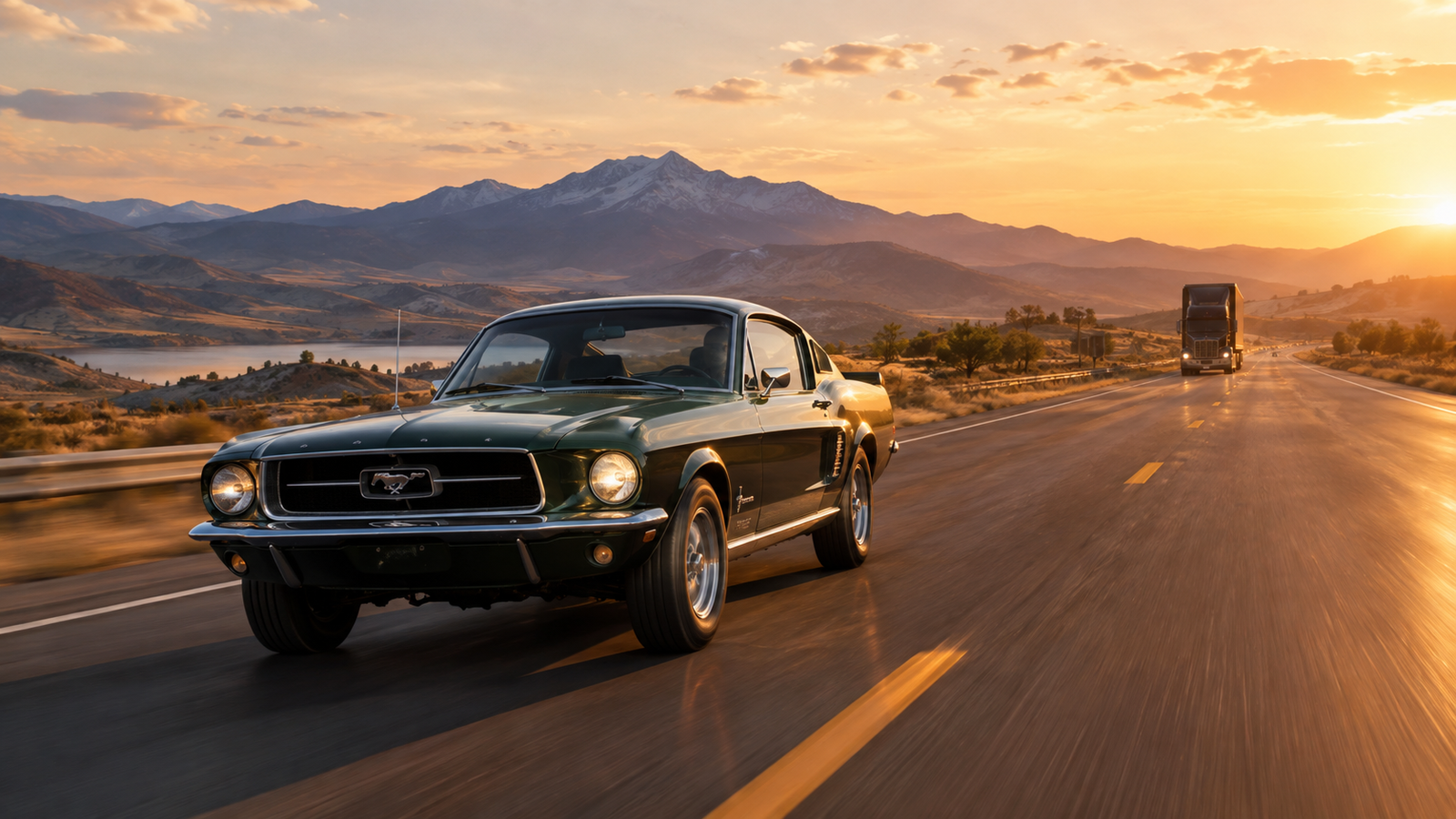
SCS Software has confirmed that **Road Trip: Ford**, the new DLC for *American Truck Simulator*, will launch on **September 29, 2026**, accompanied by an official trailer that gives a clearer look at what the project is trying to accomplish. The expansion puts four drivable Ford vehicles at the center of the experience, but the real change lies elsewhere: for the first time, *American Truck Simulator* is beginning to treat its enormous map not simply as a network of roads for hauling cargo, but as a world that can be explored in different ways.
## Road Trip Is More Than Just a Car Pack
The first impression can be misleading.
When SCS announced the **Ford Car Pack**, it would have been easy to imagine nothing more than another vehicle DLC. A classic Mustang, an F-150, a Bronco, and a Crown Victoria might have looked like a collection running alongside the traditional content of *American Truck Simulator*. But the September 29 release makes it clear that the idea is broader.
Road Trip creates a new layer of gameplay within the simulator. Players can leave the cab of a truck and take control of much smaller vehicles, traveling across the same territory from a completely different perspective. SCS also confirms the ability to take on **small delivery jobs**, customize the vehicles, change their paint schemes, and freely explore American landscapes.
That difference in scale sounds simple until you think about what it does to the map itself.
A road that feels long when seen from the driver's seat of a truck can take on a different character when driven in a Mustang. A city that normally functions as a waypoint can become a destination. An area that players normally cross simply to complete a delivery can suddenly have a reason to be visited.
That is where Road Trip begins to look like something more than a simple add-on.
### Four Fords, Four Ways to Look at the Map
The first pack includes four vehicles from very different eras and with very different identities:
* **1967 Ford Mustang Fastback**
* **2023 Ford F-150**
* **2023 Ford Bronco**
* **1998–2012 Ford Crown Victoria**
SCS itself presents these models as part of the new driving experience introduced by Road Trip.
The selection is interesting because it does not rely on a single type of driver.
The Mustang represents the classic image of the great American road trip. The F-150 brings a vehicle associated with both work and travel. The Bronco naturally fits a more adventurous fantasy. The Crown Victoria, meanwhile, carries an entirely different identity, closely associated with the history of large American sedans.
The cars do not necessarily need radically different mechanics for the change to be noticeable. Simply having vehicles with different dimensions, driving positions, and handling characteristics alters the player's relationship with the environment.
Road Trip is also not being built as a separate game. It uses the world of *American Truck Simulator*. That decision matters because it allows SCS to focus on changing the way players interact with a territory they already know.
And that leads to the more interesting part.
## The Same Map Can Feel Like a Different Game
For years, the main question in *American Truck Simulator* was relatively simple: **Where am I taking this load?**
Road Trip introduces another question: **What is there along that road worth discovering?**
The difference looks small on paper, but it can significantly change the structure of a play session.
SCS has confirmed that Road Trip will include the **Atlas**, a feature designed to encourage exploration of selected locations across the map. The system can be accessed through the in-game computer in the navigation section. Tourist Boards direct players toward specific locations, and reaching those places can reveal additional exploration points in the surrounding region.
The most interesting detail is that the Atlas is not restricted to cars.
SCS has clarified that players who prefer to continue driving trucks can also use the feature, provided they own a Road Trip DLC that unlocks the functionality.
That avoids creating an overly rigid division between the two audiences.
A player who bought *American Truck Simulator* because they enjoy trucks does not have to abandon what they were already doing. They can continue making long-distance deliveries while using the Atlas to discover places they might otherwise never have had a reason to visit.
It is a subtle change in philosophy.
The truck remains at the center of the game. But the map itself begins to gain value.
## SCS Is Turning the Simulator Into a Road-Trip Experience
There is an important difference between **driving** and **traveling**.
The first concept is about controlling a vehicle. The second is about the distance covered, the places encountered, and the feeling that the road itself is part of the experience.
Road Trip seems particularly interested in that second idea.
SCS describes the feature as a way to explore the landscapes of the United States from a new perspective and discover points of interest through the Atlas. The company specifically mentions examples such as traveling along Route 66 between Chicago and Los Angeles, crossing the hills of the Midwest, or driving through the mountains of Montana.
That matters because *American Truck Simulator* has something that few games can reproduce on the same scale: **distance**.
The maps are not simply there to connect levels. They are the content.
For a long time, that distance was primarily justified by deliveries. Players accepted spending dozens of minutes on the road because there was a load waiting at the destination.
Road Trip adds a second justification: **the journey itself can be the objective**.
That is not a minor change.
## The Atlas Could End Up Being More Important Than the Cars
It is tempting to look at the Mustang or the Bronco as the main attraction of the DLC. After all, licensed vehicles are much more visually striking than a new exploration mechanic.
But when looking at the project's future, **the Atlas may be the more important piece**.
The reason is simple: new cars can be added indefinitely. A new Mustang can attract attention for a few weeks. Eventually, however, the novelty fades.
An exploration system is different.
If SCS continues adding interesting locations, information, objectives, and discoveries, the Atlas could turn older sections of the map into places worth visiting again.
That is particularly useful for a game that continues to expand.
SCS does not necessarily have to create an entirely new region to offer a different experience. It can take hundreds of miles that players already know and change the reason they travel them.
The road has not changed.
The reason for driving it has.
## The Ford Pack Also Solves an Important Problem
Another point worth considering is the relationship between the cars and the Road Trip system.
Official SCS documentation describes the Ford pack as DLC for the new Road Trip module and confirms the four vehicles: the 1967 Mustang Fastback, 2023 F-150, 2023 Bronco, and Crown Victoria. The pack also introduces the ability to drive the cars, take on small delivery contracts, customize them, and explore the map through locations associated with the Road Trip experience.
That creates a different commercial structure from a traditional map DLC.
With a geographic expansion, the main value comes from adding territory. Here, the territory already exists. The value comes from **using that territory in a new way**.
That is an interesting strategy for a simulator that has already accumulated an enormous amount of content.
SCS does not necessarily need to produce an entirely new region to offer something different. It can take hundreds of miles players already know and change the reason they travel them.
There is something rather elegant about that.
A player might spend months ignoring a particular road because it never appears on a profitable route. Then an Atlas location turns that same road into a destination.
The road did not change.
The reason to drive it did.
## The Change Could Also Affect People Who Never Cared About Trucks
This may be the most interesting commercial aspect of Road Trip.
*American Truck Simulator* has always had a very specific identity. The game demands patience. Distances are long, the pace is deliberately relaxed, and much of the satisfaction comes from controlled repetition.
For players who enjoy that kind of experience, that is precisely the appeal.
For another audience, it can be the barrier.
A player interested in classic cars may have no desire to spend hours making deliveries in a truck. But they might want to drive a **1967 Mustang** along an American highway.
SCS appears to be creating that entry point without dismantling the original structure.
Road Trip does not turn *American Truck Simulator* into a racing game. It does not abandon cargo transportation. Instead, it adds another layer that could appeal to people interested in road trips, vehicles, and exploration.
That distinction matters.
If the project works as intended, players do not have to choose between a "truck simulator" and a "car game." The same map can support both fantasies.
## Small Deliveries Matter More Than They Seem
Among all the announced features, **small deliveries** could be one of the most understated changes.
They could also be one of the most useful.
Official documentation confirms that personal cars can be used for small delivery contracts.
That solves an obvious design problem.
If the cars were only there for free driving, they could eventually feel like toys detached from the rest of the game's structure. Fun for a while, but disconnected from the systems that keep *American Truck Simulator* moving.
Small deliveries create a bridge.
There is now a practical reason to get into a car and head out onto the road.
The Mustang does not need to become a miniature truck. The game simply needs to create a category of work that makes sense for the vehicle's size.
That difference in scale could be one of the things that makes Road Trip feel like part of *American Truck Simulator*, rather than a separate mode inserted into it.
## What SCS Is Building Beyond Ford
The launch on **September 29, 2026** is the concrete event, but the project is larger than this single pack.
SCS has already presented Road Trip as a way of expanding how players interact with the world of ATS. In earlier announcements, the company explained that the concept would allow players to explore the map not only in Class 8 trucks, but also through vehicles such as pickups and sports cars.
The development that followed reinforced that direction.
The project began as an idea about "driving other vehicles."
Now it includes an exploration system, vehicle customization and purchasing, small deliveries, and additional ways of interacting with the map.
That is a significant difference.
The concept started with the question of what it would be like to drive a car in *American Truck Simulator*.
It has evolved into something closer to a parallel layer of gameplay.
The distinction matters.
A single vehicle is content.
A system that gives multiple vehicles a purpose can become a platform.
## The Real Test Begins After September 29
It is easy to make a beautiful car.
It is much harder to make that car have a reason to exist inside a truck simulator.
That will be the real test for Road Trip.
The 1967 Mustang Fastback can be perfectly modeled. The F-150 can have excellent handling. The Bronco can be fun to drive. None of that guarantees that the new system will remain interesting after the first week.
What could sustain the experience is precisely the combination of **vehicles, exploration, and activities**.
If the Atlas can reveal locations that genuinely make players want to leave their usual routes, the novelty gains longevity. If small deliveries can create their own gameplay loop, the cars stop being simple attractions. And if future packs can introduce different vehicles without fragmenting the experience, Road Trip could become a permanent part of *American Truck Simulator*.
There is also a question of balance.
Trucks cannot suddenly feel secondary inside *American Truck Simulator*. The game's identity was built around them, and they remain the foundation of the experience.
SCS appears to understand that by emphasizing that the Atlas can also be used by truck drivers who have no interest in abandoning their heavy vehicles.
That detail says quite a lot about the strategy.
The intention does not appear to be replacing the game that already exists.
It is expanding what players can do inside it.
## The Mustang Is Only the First Door
There is an interesting irony in all of this.
The **1967 Mustang Fastback** is one of the most recognizable vehicles in the pack, but the most important aspect of Road Trip is not necessarily the car that appears in the trailer or marketing material.
It is the possibility of looking at *American Truck Simulator* and realizing that the road does not have to exist only to carry cargo from point A to point B.
For years, the map was infrastructure for the truck.
Now SCS is trying to turn it into a destination.
The launch of **Road Trip: Ford on September 29** will be the first real test of that idea. From that point on, players will be able to see whether driving a Mustang along a Montana highway, searching for a location through the Atlas, or accepting a small delivery can create the same sense of progression as a long-haul truck journey.
And perhaps that is the most interesting part of all.
SCS is not simply adding four cars to *American Truck Simulator*.
It is asking players whether, after so many years of looking at the map through the windshield of a truck, they still want to discover what lies beyond the road.
<br>Source: https://blog.scssoft.com/2026/09/road-trip-ford-release-date-video.html