From Paper Passwords to Auto-Save: What Crash Bandicoot Reveals About Us
Sep 18th '26 9:16am:
In June 2024, Crash Bandicoot's official social media account announced that the **N. Sane Trilogy** had surpassed 20 million units sold across all platforms — a figure combining physical and digital copies since the remaster's 2017 launch. It's a round milestone, the kind that makes a good headline, but it hides a more uncomfortable question than it seems: why do we keep buying, over and over, the same experience of jumping over crates and running from boulders that we already had back in 1996? The answer isn't in the marsupial. It's in us, and in how the industry decided, over nearly thirty years, to dissolve almost all the friction that made that original game memorable.
## The Game That Demanded Memory, Not Automatic Checkpoints
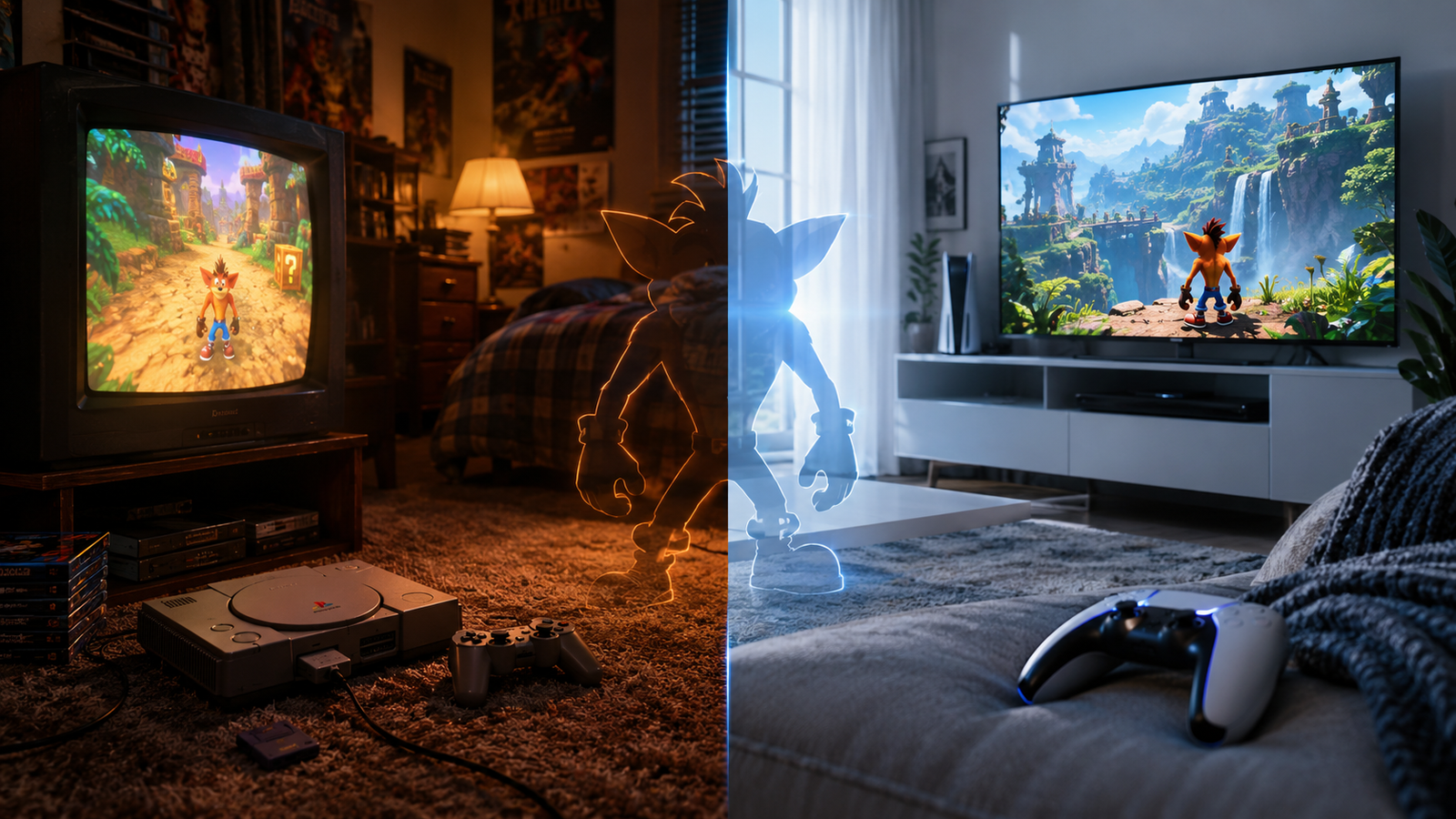
Anyone who played the original Crash Bandicoot on PlayStation remembers one thing before anything else: there was no autosave. Every time you turned off the console, you had to write down — or memorize — a password the game generated, a sequence of icons (the Aku Aku mask, a wumpa fruit, a skull) representing your progress up to that point. Losing that piece of paper meant, literally, losing the entire game. There was no cloud, no Sony account syncing data across devices. There was a notebook next to the TV, or, at best, a 1 MB memory card that held maybe three or four different games — and that, if it corrupted (and it did corrupt, with alarming frequency whenever the console overheated), took everything down with it.
<br>That requirement wasn't a design flaw Naughty Dog later decided to fix out of kindness. It was a direct consequence of the technical limitations of the time, yes, but it also shaped the emotional relationship players had with the game. Every completed level carried more weight because there was real risk of losing it. When the remastered version arrived in 2017, with automatic saving at every checkpoint and PlayStation Network cloud sync, the game became objectively more playable — and subjectively lighter, in the sense that it lost emotional weight. This isn't a criticism of the remake itself, which is technically flawless, by the way; it's an observation about what gets lost when you remove the possibility of losing everything.
<br>Difficulty also changed in nature, not just in curve. On PS1, Crash's levels were designed to punish failed memorization: an enemy always appeared in the same spot, a platform always vanished at the three-second mark, and the only way forward was to die, go back, and memorize the pattern the way you'd memorize a dance routine. There were no YouTube videos showing the right path — home internet in Portugal in 1997 still ran at 33.6 kbps over a phone line, when it existed at all, and even those with access weren't going to look up walkthroughs for a kids' platformer. Information lived in the head of whoever was playing, or in playground word-of-mouth. Today, at the slightest hint of frustration, a player has three mental monitors open: the game, a gameplay video playing in the background on their phone, and a Reddit thread with the exact location of the hidden gem.
<br>This isn't an argument of "it was harder in my day and therefore better" — that's exactly the lazy trap this kind of essay should avoid. The point is different: Crash Bandicoot's difficulty in 1996 was, in part, a difficulty born of **informational isolation**, not just level design. Removing that isolation — which the internet did irreversibly — changes the experience of playing even without altering a single line of the original game's code.
### A Pattern Repeating Across the Entire Remaster Industry
Crash isn't an isolated case, it's a symptom. The wave of remasters that began in earnest around 2013, with games like *The Last of Us Remastered*, and intensified with *Spyro Reignited Trilogy* in 2018 and *Tony Hawk's Pro Skater 1+2* in 2020 — the latter, incidentally, also handled by Vicarious Visions, the same studio behind the N. Sane Trilogy before it was absorbed into Blizzard — almost always follows the same commercial logic: take an intellectual property with massive brand recognition and near-zero audience-acquisition cost, and sell it again to a generation that either already played it and wants nostalgia without friction, or never played it and discovers it through influencers.
<br>What changes, remaster to remaster, is the degree of fidelity to the original rules. Some studios choose to keep the difficulty intact and only modernize the graphics and the save system — that was roughly the path taken by the N. Sane Trilogy, which, incidentally, became known for being, in some spots, **harder** than the originals due to subtle changes in jump physics, something that sparked heated discussion among longtime players at launch. Others go further and introduce explicit assist modes — infinite lives, visual danger indicators, slowed-down speed options — the way Nintendo has with several of its recent remakes. Neither approach is wrong. But both confirm that the industry no longer trusts players to accept friction without being warned in advance and given an easy way out.
### The Uncomfortable Prediction: Nostalgia Is Getting More Expensive and More Artificial
This is where the part that, honestly, bothers me most as a long-term observer of this market comes in. Microsoft bought Activision Blizzard for close to $70 billion, a deal that closed in October 2023, and inherited the entire Crash Bandicoot IP along with it. Shortly after, it emerged that Toys for Bob — the studio behind *Crash Bandicoot 4: It's About Time*, released on October 2, 2020 — decided to go independent, though it continues working on projects published by Microsoft itself. In other words: one of the most profitable nostalgia franchises of recent years is now in the hands of a company whose main console strategy runs on subscriptions (Game Pass) rather than one-off game sales.
<br>This carries an implication almost nobody is discussing openly: if the business model shifts toward subscription, the incentive to release "definitive," complete remasters starts competing with the incentive to slice up content — releasing one level at a time, one skin at a time, one seasonal event at a time, similar to what already happened with *Crash Team Rumble*, the multiplayer spin-off launched in 2023 that had a short life and was discontinued less than a year later. Playing Crash in 1996 meant buying a disc, putting it in the console, and having everything that would ever exist of that game right there. Playing Crash today, depending on the title, can mean entering a living ecosystem, with battle passes, temporary events, and content that disappears if you don't play in time. In my assessment, this — more than graphics or difficulty — is what truly separates the two eras: the idea that a game is a finished object, versus the idea that a game is a service under permanent construction.
<br>It's not certain this path continues. *Crash Team Rumble* failed commercially, and there are signs — including public comments from people tied to Toys for Bob — that Microsoft may prefer to bet on more traditional single-player titles for the franchise going forward, closer to *It's About Time* than to live-service experiences. But the fact that the attempt existed at all, with a brand so clearly tied to pure nostalgia, says a lot about the structural pressure any valuable IP faces today.
## What Nobody Writes in the Patch Notes
There's a small, almost ridiculous detail that sums up this whole shift well: in the original PS1 games, the Aku Aku mask granted temporary invincibility, and the player physically saw the item floating behind Crash — three masks stacked up, a tactile sense of being "protected." In the remastered version, that visual was recreated with near-perfect fidelity. But the context around it changed completely: now there's an option to turn on a mode that automatically reduces incoming damage, available in the accessibility settings, with no penalty, with no need to find the mask in the level at all. The object that was once a reward for careful exploration became, for anyone who wants it, a menu toggle.
<br>This isn't decline, it's the industry maturing enough to recognize that not every player has the same free time a teenager had in 1998, sitting in the living room waiting for their parents to give up the TV after dinner. But it's not neutral either. Every accessibility option that removes friction also strips away a little of that very specific feeling of hard-won victory that made a kid in the '90s run to tell their friends they'd finally beaten the train level in *Crash 3: Warped* without losing a single life.
<br>Maybe the right question isn't "was it better before or is it better now." Maybe it's this: when Microsoft eventually decides — and it will decide, it's just a matter of time — what to do next with Crash Bandicoot, will it choose to recreate that original friction as a deliberate design feature, sold as a "classic mode," or will it keep treating it as an outdated technical obstacle nobody needs to face anymore? The answer to that question will say more about the future of platformers than any graphics comparison ever could.