Master Chief: the tank, the BMX helmet, and the visor that built an icon
Sep 16th '26 7:09am:
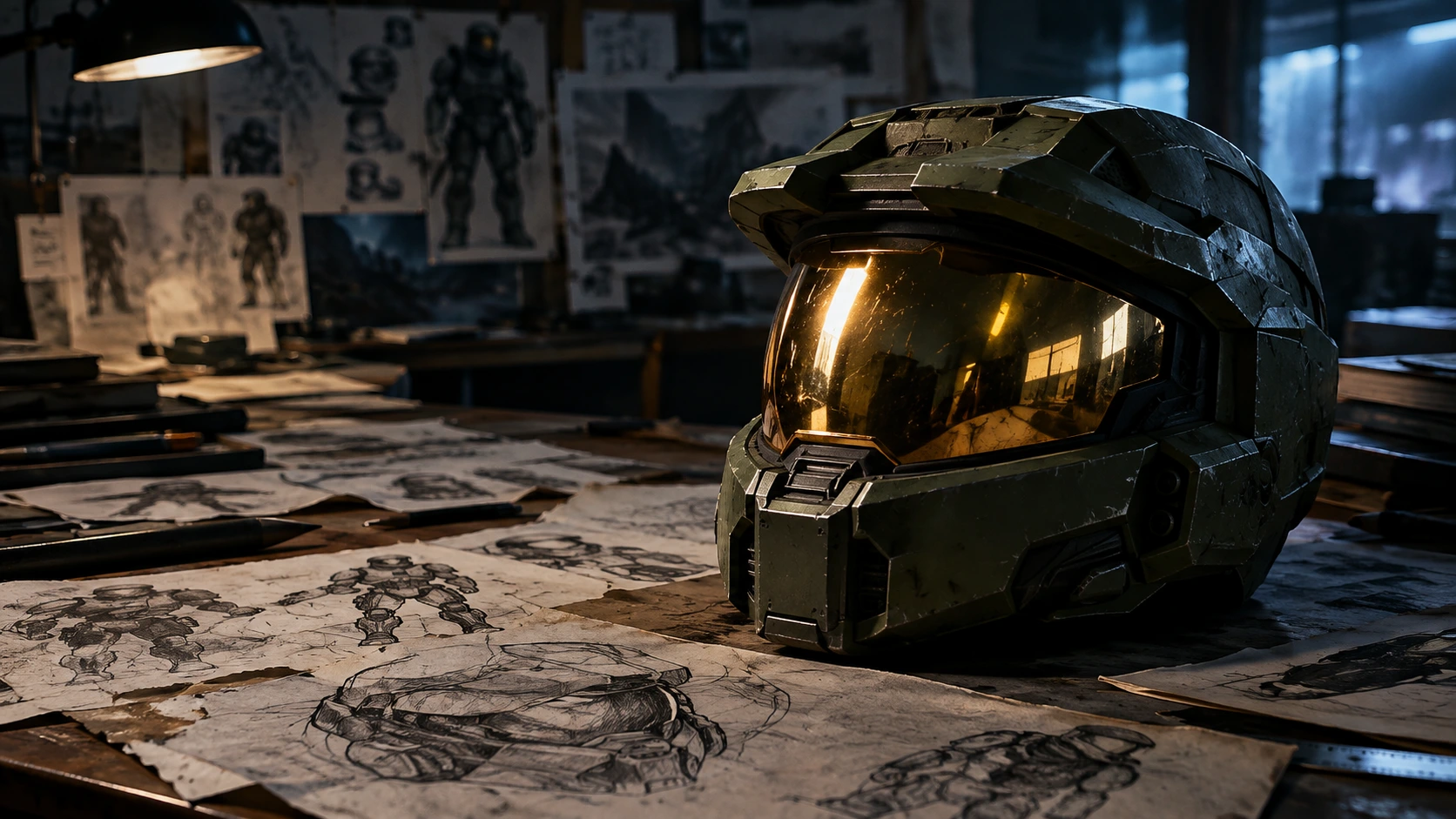
Marcus Lehto, the former Bungie art director responsible for Master Chief's look, recently revealed it took nine complete versions of the character before landing on the design that appeared in Halo: Combat Evolved in 2001. The revelation came during a lecture at Kent State University, his alma mater, and was later published by the school's own magazine in November. This isn't just a piece of production trivia: the process shows that gaming's most famous soldier almost ended up looking like Boba Fett, covered in straps, holsters, and tactical pouches — a far cry from the clean silhouette that became an Xbox logo.
## The Nine Designs Bungie Scrapped Before the Golden Visor
According to Lehto, the earliest attempts were "too slender, too stylized." There was an almost tribal version, with smooth, bone-like armor plates, which he himself called one of the strangest sketches to come out of the process. Another phase of the design covered the Spartan head to toe in visible military gear — bandoliers, a knife on the back, a utility belt — giving him more of a sci-fi bounty hunter vibe than the "empty vessel" Bungie actually wanted to hand the player.
The turning point, according to the creator himself, came from references that had nothing to do with space or science fiction:
- An **M1 Abrams tank**, whose bulk and straight lines inspired the volume of the chest and shoulders.
- The silhouette of an **Apache helicopter**, which lent the design a compact, aggressive war-machine feel.
- A **BMX helmet** from the 1990s, a direct reference behind the protruding brim that became the Chief's signature helmet shape.
- The aesthetic of the **1960s space race**, which shaped the gold visor — a visual nod to the visors worn in NASA and Soviet-era spacesuits.
That mix is revealing for a simple reason: none of those references came from another video game. At a time when much of FPS character design still leaned on pulp sci-fi clichés — armor cluttered with gratuitous detailing, helmets sprouting antennas and blinking lights — Bungie went looking for inspiration in real, functional, almost brutalist objects. It's the same logic that makes a Formula 1 car look beautiful without ever having been designed to. Form follows function, and the beauty is a byproduct.
It's worth comparing this to what was happening elsewhere in the market at the same time. Doom and Quake, the genre's defining references up to that point, treated the protagonist as almost irrelevant — the first-person camera rarely showed the body, and when it did, it was generic. Bungie went the opposite direction: it bet heavily on a specific visual identity for a character the player wouldn't always even see face-on. It was as much a marketing gamble as a design one, and it paid off far better than anyone on the team expected in 1999.
## From a Mac RTS Announced by Apple to Xbox's Biggest Exclusive
Here's the detail that tends to get left out of shallower Halo retrospectives: the game didn't even start as an FPS, and it almost never launched on Xbox at all. In 1999, still in development at Bungie as a hybrid real-time strategy and tactical action game for Mac and PC, Halo was first shown to the public at Macworld — with Steve Jobs personally taking the stage to announce it. It was a proud moment for a small Chicago developer that, up to that point, was better known for Myth than for any blockbuster ambitions.
The problem is that Microsoft, busy assembling its Xbox launch lineup, saw that presentation and decided "Steve Jobs can't have that" — according to Lehto's own account. The response was to buy Bungie outright, relocate the team from Chicago to Redmond, and rebuild the project from scratch as a first-person shooter exclusive to a console. The RTS died right there. What remained, launched on November 15, 2001 alongside the Xbox itself, would go on to become one of the most profitable franchises in gaming history — and the reason a big chunk of a generation bought Microsoft's console before they even knew what "Xbox Live" was.
That detail reframes how we should read Master Chief's design. A character originally conceived for an isometric strategy camera, where the player controls several soldiers at once, doesn't need the same silhouette strength as a first-person shooter protagonist, seen mostly from the outside in cutscenes and menu screens. The real pressure to get the design right probably only kicked in after the genre shift — which may explain why Lehto took so long, and burned through so many discarded versions, to reach the final result. He was, in practice, redesigning a character for a game that had already changed identity underneath him.
### A Character Designed to Have No Personality
The phrase Lehto uses to describe the philosophy behind the Chief is a curious one: an "empty vessel." The idea was that any player could project themselves into that armor, with no visible face, no distinctive accent, no personality quirk competing with the experience of actually playing. That explains why, throughout practically the entire Bungie era of the franchise — Combat Evolved, Halo 2, Halo 3 — the Chief barely speaks and never once removes his helmet on camera.
In my own reading, that decision has aged in an interesting way. It worked perfectly in the 2000s, when FPS audiences still treated the protagonist as an extension of the controller in their hands, almost a biography-less avatar — think Duke Nukem, Doomguy, or Gordon Freeman himself, who also never speaks. But starting with Halo 4, already under 343 Industries, the franchise realized that silence had become a creative limitation rather than a strength, and it began leaning into the Chief's relationship with the AI Cortana as the emotional core of the story. The "empty vessel" got a heart — and, not coincidentally, that's exactly when part of the older fanbase started complaining that "it doesn't feel like Halo anymore."
### The Signatures Nobody Saw, Hidden Inside the Game
One detail that rarely gets told is that Lehto treated the creative process itself as a space for leaving personal traces, almost like an artist signing a corner of a painting where only someone looking closely would ever find it. He had his own initials engraved on the Master Chief's boot in the 3D model. He did the same with his own birthdate, carved discreetly into the Scorpion tank model. And, according to players who dug through the Halo 3 multiplayer beta files, he even hid a human face underneath the mask of the Spartan multiplayer models — a detail that quietly pokes fun, from inside the game itself, at the rule that the Chief never shows his face.
That kind of gesture says more about Bungie's development culture at the end of the 1990s than any press release from that era ever could. It was a small studio, without the layers of corporate sign-off that now surround any asset belonging to a multibillion-dollar Microsoft franchise — every one of those easter eggs would probably have to clear an entire brand committee if proposed today, and it's entirely possible it would get vetoed. It's hard to imagine 343 Industries, operating under the direct control of Xbox Game Studios, allowing that kind of unassuming prank in a character model that is now a global trademark asset.
## The Icon That No Longer Belongs Only to the Man Who Drew It
There's a real irony in all of this. The character built to be an "empty vessel" — no visible face, no distinctive voice beyond Steve Downes's deep timbre, no on-screen biography — became as recognizable as Mario or Sonic, two characters that are exactly the opposite: full of facial expression, personality tics, loud color. The Chief proved you could build a pop icon on top of absence rather than excess.
That tension is even more visible now, with the announcement of Halo: Campaign Evolved, the remaster of the original game marking the franchise's 25th anniversary in 2026. The question nobody seems to be asking out loud is this: can you visually update a design that was deliberately built to be neutral, without accidentally giving it too much personality in the process? The Chief's TV series has already shown the character's face under the helmet — a choice that split the older fanbase right down the middle. It's worth remembering that Lehto burned through nine design attempts specifically to protect that ambiguity. Twenty-five years later, it's the industry itself that keeps deciding, game by game, how much of that ambiguity is still worth holding on to.