Before Wi-Fi, There Was a Modem Screaming: The Lost World of BBS Door Games
Aug 23rd '26 8:39am:
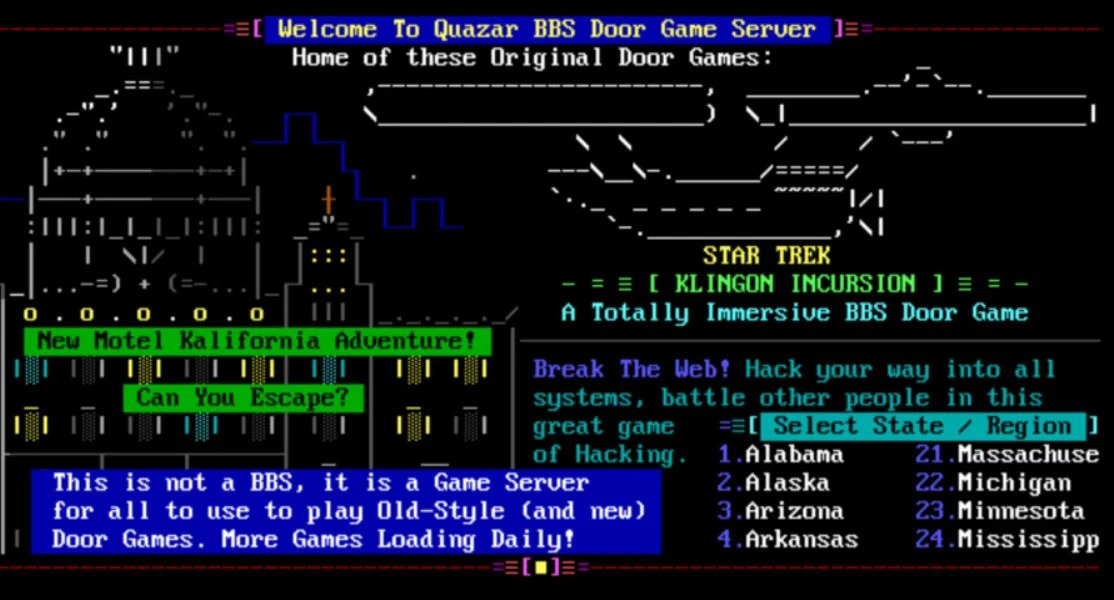
There was a kid in Coimbra, back around 1991, who blew his entire allowance on phone minutes just to call a BBS thirty kilometers away — long-distance rates, brutally expensive — only to play ten turns of Trade Wars 2002 and hang up. Ten turns. Five minutes of actual gameplay, if that. And he'd spend the rest of the day thinking about his moves, imagining what his rivals were plotting, with absolutely no way of finding out until he called back. Sounds insane today, but that's literally how multiplayer gaming was born, long before broadband existed, long before the web itself was even a real thing.
<br>A BBS, Bulletin Board System, was basically a computer hooked up to a phone line through a modem, usually sitting in someone's bedroom — yes, someone's, a single person, the so-called sysop, who ran the whole thing after work in the evenings. And the most brutal limitation, the one that shaped everything else, was that most of these systems could only accept one connection at a time. One. If you called and the line was busy, it just rang and rang and nobody else got in until whoever was ahead of you hung up. Door games were programs the BBS would "open a door" to run inside it, and that's where this bizarre genre of asynchronous multiplayer flourished — a genre almost nobody today would even recognize as multiplayer, but that's exactly what it was.
<br>The undisputed king, the game that basically defined the whole genre, was Trade Wars 2002. It came out in 1984 and was a space trading and territorial conquest sim where you formed alliances, betrayed people, built commercial empires — all with people you never saw, never heard the voice of, only exchanged messages left inside the game itself between one turn and the next. And here's the part that trips up almost everyone hearing about this for the first time: the limited turns weren't some technical constraint the creators reluctantly accepted. That was the design. That was the whole point. Since only one person could be connected at a time on most BBSs, capping each player at three, five, ten turns a day forced rotation — you had to log off so the next guy could get in — and at the same time it created this weirdly delicious tension of playing your turns in the morning, spending the whole day speculating about what your rivals were doing with theirs, and only finding out the answer that night. Sound familiar? It should. It's basically the direct ancestor of that "energy" system limiting how many lives you get per day in modern free-to-play mobile games. The idea never died, it just changed clothes.
<br>Then there was LORD, Legend of the Red Dragon, which showed up in 1989 and solved a real problem: Trade Wars was complex, it had a learning curve steep enough to scare people off. LORD brought humor, pop culture references from the era, combat simple enough to understand in five minutes — and it became the entry point for thousands of people who never would've stuck around long enough to learn Trade Wars' denser economic mechanics. Along with Barren Realms Elite and Usurper, this was basically the top three that any decent-sized BBS, the kind with a real reputation in the local community, would run in the '90s.
<br>And it's worth saying this clearly, because it's the most common mistake people make when writing about this topic without actually understanding the difference: door games are not the same thing as MUDs, Multi-User Dungeons. MUDs did allow multiple people connected simultaneously, in real time, interacting with each other inside the same virtual world — but that was only possible because they ran on university networks, actual Internet or BITNET connections, not on dial-up phone lines from some homebrew BBS with a single modem waiting for the phone to ring. They're close cousins, born around the same era, but the underlying architecture is completely different, and mixing the two up is kind of like confusing a letter sent by mail with a phone call just because both involve communicating over distance.
<br>Worth pausing here for a second to think about what this actually meant socially, because it wasn't just a game — it was an entire community built around a brutal technical constraint. People knew each other by the handles they used inside the BBS, built reputations over months, carried rivalries for years against players they probably never crossed paths with on the street. And there was this funny thing where the sysop, the BBS owner, was often this almost mythical figure inside that little universe — controlled who got in, how long each person could stay connected, sometimes even stepped into the games themselves if he thought someone was cheating.
<br>Maybe you've heard your dad, or an older uncle, mention offhand that he "used to call so-and-so's BBS" or that he'd "burn through all his turns at lunch" and never quite understood what he meant. Now you do. And it's probably worth asking him what his nickname was in there — I'd bet he still remembers, and I'd bet even more that he's got a story about someone who betrayed him in a Trade Wars alliance that he's never quite let go of.