From Kratos to Hades: How Norse and Greek Myths Took Over Gaming
Aug 4th '26 5:37pm:
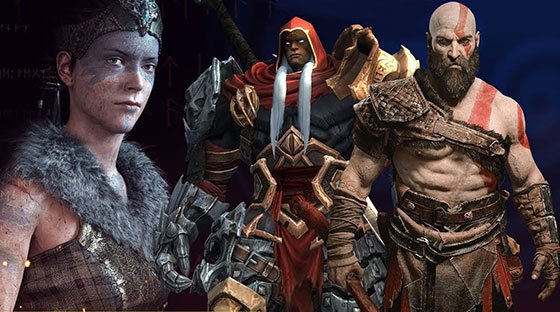
There's something oddly satisfying about watching an axe fly out and return to the hand that threw it, or about dying for the hundredth time only to wake up again at the gates of the Greek underworld as if nothing happened. It's no coincidence that the two pantheons dominating AAA video games these past few years are precisely Norse and Greek. There's a commercial logic behind this, sure, but there's also a narrative logic worth unpacking.
The Norse boom has an easy birth date to point to: 2018, when Sony Santa Monica decided to reinvent Kratos and switch his mythology mid-career, like someone changing jobs after burning every bridge at the last one. God of War stopped being about killing Zeus and became about a father trying not to mess up his son the same way he himself was messed up, only now surrounded by Norns, Odin's ravens, and the constant looming promise of Ragnarök. It was such an overwhelming success that it practically reopened the floodgates for everything else: Assassin's Creed Valhalla, Hellblade, and a fair number of indie games that decided vikings and runes sold well.
Greek mythology never needed that reopening because the door had never really closed. Since the original Kratos in 2005, the gods of Olympus have been recurring material, and Hades, from Supergiant, showed in 2020 that there was still plenty left to explore there, just from a completely different angle. Instead of grand epic, Hades takes the myth of Persephone and Zagreus and turns it into a roguelike about repetition, about trying and failing and trying again, which happens to fit almost perfectly with the permadeath structure that's already typical of the genre. The mechanic and the myth nearly explain each other.
That kind of fit is what separates a game that uses mythology as a pretty backdrop from one that uses it as the design's backbone. The Nine Realms linked by Yggdrasil in God of War aren't just decoration, they're literally the structure organizing the open world and justifying how the player travels between zones. Hades' eternal cycle isn't just a narrative excuse for the player to keep playing after dying, it's the very definition of the game. When mythology shapes mechanics this way, the result tends to be more interesting than when it's just aesthetic varnish over a generic system.
It's also worth pausing on creative license, because that's where most curious players get a bit lost. Kratos, in the original games, doesn't kill the entire Olympian family because that happened in some ancient myth, that's almost entirely a Sony Santa Monica invention, a dramatic exaggeration built to serve the game's revenge narrative. Similarly, Ragnarök's Odin as a cold, calculating manipulator sits pretty far from the wise, somewhat tragic Odin of Norse mythology, though to be fair, the Norse sources were already inconsistent about this long before any game existed. Studios aren't trying to be faithful to some sacred text, they're taking recognizable archetypes and bending them until they serve the story they want to tell, and honestly I think that's what makes these games work, more than any academic faithfulness would.
Then there's the part you feel before you even understand it: art direction and sound. Runes carved into stone, the cold bluish palette of Norse games, war horns and low drums in the soundtrack, all of that communicates "cold, hard, inevitable fate" before a single line of dialogue plays. On the Greek side, marble architecture, golden light, lyres and choruses that echo classical tragedy create an almost theatrical feeling, closer to drama than survival. It's a detail that goes unnoticed by a lot of people but it makes all the difference in how each game feels while you're playing it, not just while reading about it.
Which leaves the obvious question: why is it always Norse and Greek, and rarely Egyptian, Hindu, or any African mythology, all of which also have incredibly rich material to draw from? I suspect the answer has less to do with story quality and more to do with Western audience familiarity, coming from decades of movies, comics, and school textbooks about these two pantheons specifically. It's easier to sell Thor and Zeus to someone who already knows them from somewhere else than to introduce a completely new pantheon and hope marketing does the rest on its own.
There are already some faint signs that Egyptian mythology might be next in line for its own AAA moment, especially since Assassin's Creed has already gone there before, though in a more historical than mythological way. Whether it'll happen the same way it happened with the Norse wave, I honestly couldn't say, but I doubt Norse and Greek are anywhere close to running out of what they still have to give to video games.