The Video Game Crash That Nearly Killed the Industry — and Built the One We Have Today
Jun 29th '26 5:04pm:
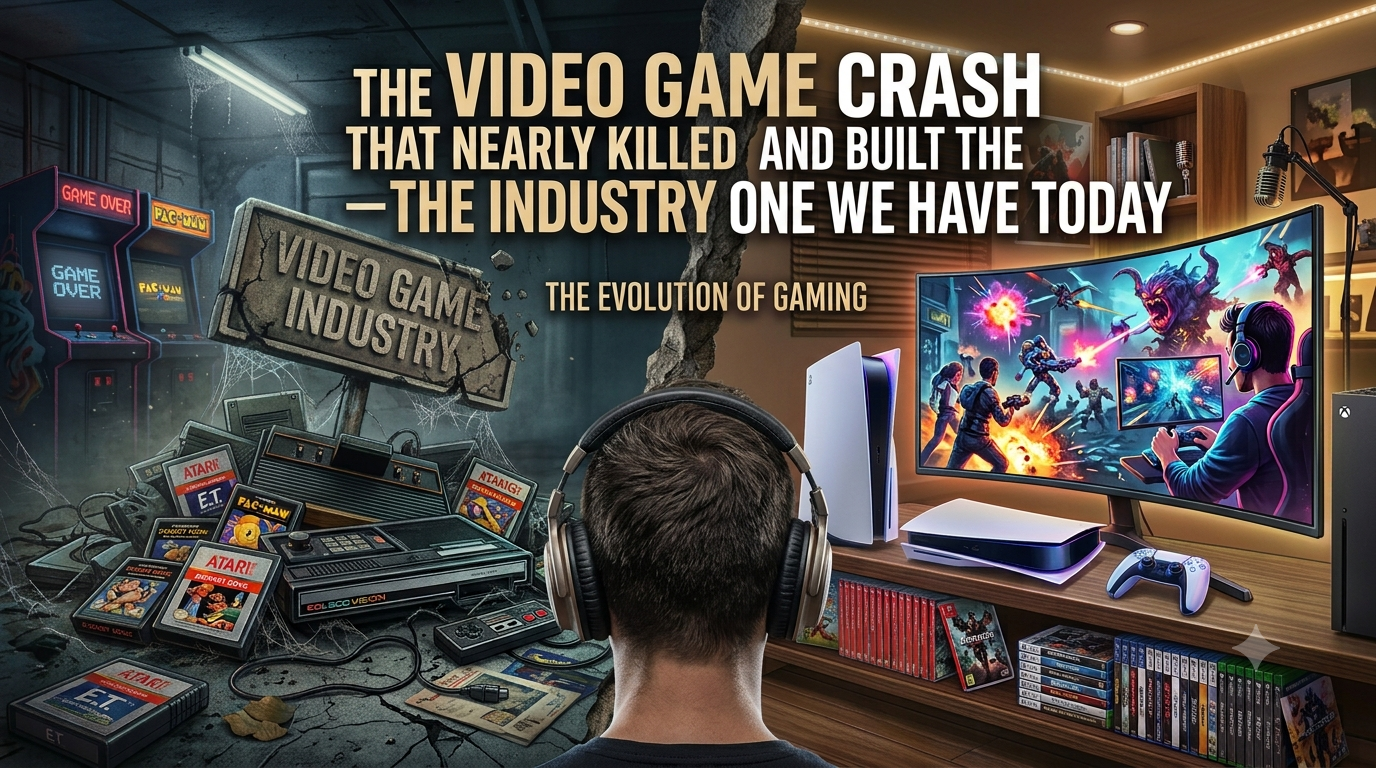
If you’ve ever looked at a modern game — one of those massive, insanely detailed ones — and thought “how did we even get here?”, it’s worth going back a bit. Not that far, just to the early 80s. Because there was a moment when the video game industry basically faceplanted.
And yeah, that’s not an exaggeration.
## What was going on before everything fell apart
In the early 1980s, especially in the United States, video games were booming. Home consoles, arcades, all of it growing at the same time. Atari was pretty much *the* name in home gaming.
The problem is, growth was a bit too fast. And kind of messy.
Suddenly, it felt like any company could make games. You didn’t need much experience, there weren’t clear standards. Money was flowing, so… more games, more releases, more rushing things out.
That started to backfire.
## When quantity became the problem
It wasn’t just that there were a lot of games. It was the kind of games being released.
* Rushed development
* Recycled ideas over and over
* Bugs and clunky mechanics
* Basically no control over what hit the market
The most famous example is E.T. the Extra-Terrestrial (Atari 2600 video game). It was made in a matter of weeks to ride the wave of the movie by Steven Spielberg. Expectations were huge. The result… not so much.
People bought it, played for a bit, got frustrated. And that kind of experience started repeating itself.
Not overnight, but slowly, people stopped trusting what they were buying.
## The crash (and it got rough)
Between 1983 and 1985, the U.S. video game market shrank hard. Companies shut down, others just disappeared quietly. Retailers stopped stocking games because they weren’t selling.
For a while, there was this real sense of “okay, maybe this whole thing is over.”
Sounds strange now, but at the time it wasn’t. If you step outside today’s context, it really did look like a trend that went too far and collapsed.
## So what actually went wrong?
If you had to boil it down: lack of control.
Atari, for instance, didn’t have a strong system to limit or properly vet who could publish games on its platform. That opened the door to… pretty much anything.
And when the market gets flooded with low-quality stuff, people pull back. First they buy less, then they stop buying at all.
Feels obvious now. Back then, not so much.
## The turnaround (this is where it gets interesting)
The company that really helped reset things was Nintendo.
When they brought the Nintendo Entertainment System to the U.S., it wasn’t just another console. They introduced strict rules.
* Mandatory licensing
* Limits on how many games a company could release
* Control over cartridge production
* And that “Seal of Quality”
It wasn’t just red tape. It was a way of saying: we’re not letting things spiral again.
And honestly, it worked.
## How that still shapes things today
A lot of what we see now in gaming traces back to that period, even if it’s not obvious at first glance.
### Curation still matters — just in a different form
Today you’ve got platforms run by companies like Sony, Microsoft, and Valve Corporation.
Each one handles control a bit differently. Some are more open, others more strict. But none of them want a repeat of early-80s chaos.
Even in more open ecosystems like Steam, there are filters, user reviews, algorithms… it’s not perfect, but it’s also not a free-for-all.
### Trust became a big deal
After that crash, it was clear that trust isn’t something you can assume.
Now, before buying a game, people usually:
* Check reviews
* Watch real gameplay
* Follow streamers or creators
* Avoid pre-orders (well, sometimes)
Not everyone does all of this, sure. But overall behavior changed a lot over time.
And when a studio releases something broken or misleading, the backlash hits fast. Sometimes it sticks.
### Platform holders have serious power now
Back then, platform control was loose. Today, not at all.
Companies running platforms set the rules, control distribution, and even influence pricing and visibility. That level of control came out of the need to keep things from getting out of hand again.
### Marketing can’t just be hype (at least in theory)
In the 80s, a lot of games sold based on name recognition or licensing deals.
That still happens now, but there’s more pressure to show actual gameplay. Trailers, demos, betas… people want to see what they’re getting.
Does it always go smoothly? Not really. But the expectation is there.
### The market spread out
One big difference today is how many segments exist.
* Consoles
* PC
* Mobile
* Live-service games
* Subscription models
That kind of spread makes things a bit more resilient. If one area struggles, others can carry some of the weight.
Back then, that safety net didn’t really exist.
### Japan stepped in
After the U.S. crash, Japanese companies took the lead. Nintendo drove a lot of the recovery, and later Sega played a big role too.
That shift influenced game design, development culture, even the way teams were structured.
You can still feel that influence now, even in Western studios.
## And still… some patterns come back
Even with all the lessons learned, the industry sometimes drifts into familiar problems.
* Games launching unfinished
* Aggressive monetization
* Tons of generic content
* Overcrowded digital stores
The difference is, there are more ways to react now. Reviews go public instantly, patches can fix things (sometimes), and players push back quickly.
Still, it’s not like the risk disappeared.
## Where that leaves things
The crash of 1983 wasn’t just a bad moment. It was more like a forced reset.
Without it, the industry might’ve kept going in a much messier direction. Or maybe it would’ve crashed later, even harder… hard to say.
What’s clear is that a lot of what feels “normal” today — quality control, platform oversight, concern for player experience — came out of that period.
And if you look at some current trends, every now and then it does feel a bit familiar. Like the industry is always hovering somewhere between healthy growth and pushing things a little too far
Anyway, it didn’t kill gaming. But it definitely changed what it became.