Why Modern Games Look Amazing but Feel Like a Grind to Make (And How We Got Here)
Jun 29th '26 10:33am:
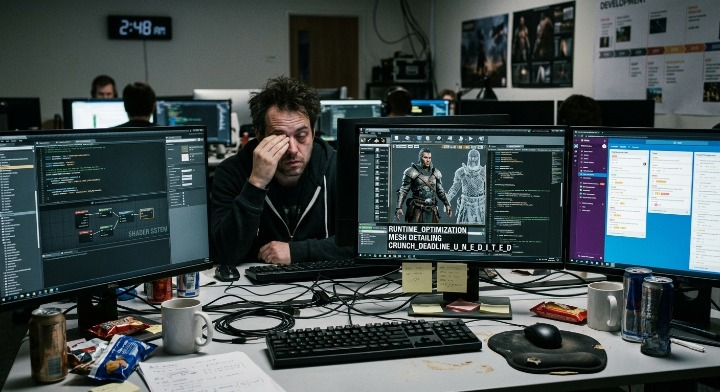
The pressure to make games look incredibly realistic has caused a lot of problems in the industry lately. If you look at this [report on gaming industry crunch and workplace issues](https://creativesunite.eu/article/crunch-in-the-gaming-industry-a-persistent-crisis-in-the-digital-playground), it's pretty clear that behind almost every beautiful trailer is a team of exhausted developers working insane hours. There is a weird gap between how good a game looks and the messy reality of how it actually gets made.
But looking back at how we reached this point—which is basically the theme of **image_b14a7b.png**, tracing things from early pixel art to modern photorealism—it is actually a pretty wild story of people just trying to hack old hardware to make cool stuff. It wasn't just a linear path of upgrades; it was a constant battle against physical limitations, memory caps, and corporate deadlines that pushed artists to their absolute limits.
---
## The actual phases of how graphics changed
It helps to break this down into a few main eras, mostly defined by what the hardware would let you get away with. When you look at the progression, it's less about steady progress and more about sudden jumps when a new piece of silicon hit the market.
### The 8-Bit and 16-Bit Hard Borders
In the 8-bit and 16-bit days (think late 80s and early 90s with systems like the NES or Sega), you couldn't just draw whatever you wanted. Everything was built block by block. Memory was so tiny that artists had to count every single pixel. You didn't have a canvas; you had a grid of tiny boxes, and if your character design took up even one pixel too many, the game literally wouldn't fit on the cartridge.
Developers had to think like engineers just to put a smiling face on a screen. Every sprite sheet was a puzzle of optimization, forcing artists to reuse animation frames or share art assets across completely different parts of the game just to save a few bytes of data.
### The Wild West of Early 3D
Then the mid-90s rolled around and everything changed with 3D. The original PlayStation and Nintendo 64 moved away from flat sprites to polygons. Honestly, those early 3D games looked incredibly blocky and kind of ugly today, but back then it was mind-blowing. The math involved was heavy—handling stuff like texture mapping and trying to figure out what the virtual camera should actually see using Z-buffering.
Artists who had spent a decade mastering 2D pixel art suddenly had to throw all their knowledge away. They had to learn how to build three-dimensional meshes out of flat triangles. If you gave a character too many triangles, the frame rate would drop into the single digits. It was a brutal transition period where a lot of classic studios actually went bankrupt because they couldn't figure out how to make the technical leap to the third dimension.
### The Real-Time Realism Chase
Now, we are at a point where things look almost too real. Systems use real-time ray tracing, which basically means the computer calculates how individual light rays bounce off surfaces to create realistic reflections and shadows. Game engines can handle millions of polygons at once now, which is a massive leap from the days when rendering a single couch would slow a game down.
We have moved from trying to trick the brain into seeing an object to literally simulating the physics of light hitting that object. Studios now use photogrammetry, which involves taking thousands of high-resolution physical photos of real-world rocks, trees, and clothes, and then running them through software to generate in-game assets. It's incredibly detailed, but it has changed the job of a game artist from pure creation to something closer to data management.
---
## What developers were actually up against
Getting to this level wasn't easy at all. Early developers weren't thinking about art styles half the time; they were just trying to get the game to not crash the system. The technical debt was massive, and the tools were incredibly primitive.
### Memory was a nightmare
Older consoles had barely any RAM. You couldn't even store a few frames of a character running without running out of space, so everything had to be tiny. To put it in perspective, an entire game on an early cartridge would often take up less space than a single low-resolution JPEG photo does on your phone today. If you wanted a boss to look huge, you couldn't actually make a massive moving sprite; you had to make the boss part of the background layer and move the screen around it to fool the player.
### The color problem
Systems could only show a few colors on screen at the same time. Sometimes you were stuck with just 4 or 16 colors per object, which makes drawing realistic skin or metal basically impossible. If you wanted to shade a character's jacket to make it look wrinkled, you had to sacrifice a color that you might have needed for their eyes or shoes. This forced a very specific, high-contrast art style because subtle shadows simply weren't an option on the hardware.
### No dedicated graphics cards
Back then, the main CPU did everything. It had to run the game logic, figure out the enemy AI, process the controller inputs, and draw every single pixel all at once. There was no separate chip to offload the visual heavy lifting. If you wanted a lot of enemies on screen, you had to accept that the graphics would have to be incredibly simple, or the whole game would slow down to a crawl.
### The Uncanny Valley
This is a big problem now. As characters look more human, the tiny flaws—like eyes that don't move quite right, static hair, or weird lip-syncing—make them look creepy instead of realistic. When graphics were simple pixels, your brain filled in the blanks and imagined the emotions. Now that the characters look ninety-nine percent like real actors, that missing one percent sticks out like a sore thumb and completely breaks the immersion.
---
## How people actually broke the rules to make things work
Developers back then were incredibly creative at finding loopholes. They didn't just accept the limitations; they found weird workarounds that ended up defining how games looked. The community and the engineers basically weaponized the flaws of the technology.
### The CRT Monitor Illusion
Take dithering, for example. Since consoles couldn't show smooth color gradients, artists would alternate two different colored pixels in a checkerboard pattern. On old CRT TVs, these pixels would bleed into each other naturally, making it look like a completely new color or a smooth shadow.
If you look at those old sprites on a modern LCD screen today, they look blocky, harsh, and weirdly checkered. But on an old television, it looked perfect because they designed it specifically for the hardware's bleeding side-effects. It was a form of physical anti-aliasing built right into the glass of the television.
### Efficient Asset Recycling
Another trick was palette swapping. Instead of drawing a whole new enemy and wasting cartridge space, they would just take the same sprite and change the color code. That's why you get Scorpion and Sub-Zero in Mortal Kombat, or different colored Koopas in Mario. It was pure efficiency. By changing a few lines of color data rather than importing new art assets, developers could double the variety of enemies in a game without using up any extra storage space.
### Fake 3D Depth
They also simulated depth before 3D was a thing using parallax scrolling. By making the background images move slower than the foreground when you walked, your brain assumed the world had actual depth, even though it was totally flat. Some advanced games would layer five or six different backgrounds moving at slightly different speeds to create the illusion of a massive, sweeping landscape on a console that couldn't handle basic three-dimensional math.
```
+--------------------------------------------------+
| [Layer 3: Distant Mountains - Moves Very Slow] |
| [Layer 2: Clouds/Trees - Moves Medium Speed] |
| [Layer 1: Player/Ground - Moves Fast] |
+--------------------------------------------------+
```
### Hiding the Horizon
When 3D finally arrived, the rendering distances were terrible. Consoles couldn't draw objects that were far away without dropping frames. So, developers got creative with the environment. Silent Hill famously used a thick, heavy layer of fog to cover up the fact that the world wasn't rendering more than ten feet in front of the character.
What started as a desperate technical fix to keep the frame rate stable ended up creating one of the most iconic, terrifying atmospheres in horror gaming history.
---
## A few final thoughts
The shift from simple pixel squares to these massive, ray-traced worlds is cool to look at, but it makes you realize how much harder it is to build games now. The industry has traded technical constraints for human constraints. Back then, a couple of guys in a room could hack together a masterpiece by abusing hardware limitations and clever programming. Today, achieving photorealism takes hundreds of people, hundreds of millions of dollars, and years of grueling work, which often leads back to that workplace crunch and industry instability we keep seeing in the news.
As we keep pushing for every strand of hair to react to the wind and every puddle to reflect the sky perfectly, it's worth remembering that some of the best games ever made were built out of tiny squares and pure cleverness.
If you want to see a good breakdown of how this looked visually over the years, this [Video Game Graphics History video](https://www.youtube.com/watch?v=0K2NGWS6Yw8) shows the actual jumps between console generations pretty well. It's worth a look if you want to see how these technical tricks actually played out on screen.