Did Sony Kill Nintendo? The Truth Behind the N64 Cartridge Gamble
Jun 26th '26 8:49am:
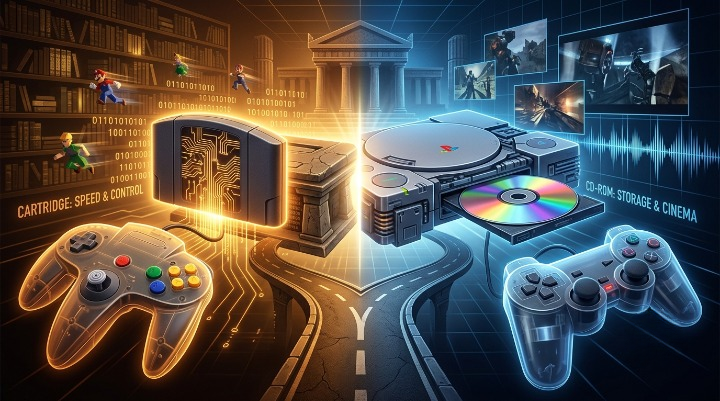
The decision by Nintendo to stick with cartridges for the Nintendo 64 (N64), while the entire industry was migrating to the CD-ROM format in the mid-1990s, remains one of the most debated design and business choices in video game history.
Below, we analyze in detail the backstage of this decision, the technical, financial, and strategic factors involved, and the lasting impact this had on the Japanese giant.
---
## **A Tense Meeting in Kyoto and the Birth of a Rival**
In early 1993, within Nintendo’s headquarters in Kyoto, engineers and executives were gathered to define the future of "Project Reality," the initiative that would eventually become the Nintendo 64. The table was surrounded by prototypes and market reports. At that time, the long-standing partnership with Sony to create a CD peripheral for the Super Nintendo (the "Play Station") had already collapsed publicly and embarrassingly. Sony, feeling betrayed after Nintendo announced a parallel partnership with Philips, decided to forge its own path and transform the project into its own home console.
While Sony polished the laser reading technology of its new system, Nintendo’s leadership, under the command of veteran Hiroshi Yamauchi, made a decision in completely the opposite direction: the successor to the SNES would continue to use silicon cartridges based on ROM (Read-Only Memory).
For Nintendo engineers, the CD was seen as a slow, fragile medium prone to mass piracy. For the rest of the game development world, that decision seemed like an act of anachronistic stubbornness. What followed was one of the biggest shifts in market leadership in entertainment history, where a broken alliance gave birth to the greatest rival Nintendo has ever faced.
---
## **The Technical Problem and the Developer's Pain**
The choice of media format was not just an aesthetic or storage issue; it dictated the software’s programming architecture. The major problem that emerged on the horizon of the fifth generation of consoles was the **storage space bottleneck** versus the **data access speed**.
### **The Problem: The Megabyte Barrier**
Nintendo 64 cartridges had an extremely limited storage capacity compared to CDs. At the console’s launch in 1996, the largest cartridges offered only **8 MB (64 Megabits)** of space. At the end of the system's life cycle, with advanced compression techniques, the largest cartridges reached **64 MB (512 Megabits)**, used in games like *Resident Evil 2* and *Conker’s Bad Fur Day*.
In contrast, a single Sony PlayStation or Sega Saturn CD-ROM could store up to **650 MB** of data. We are talking about a difference of orders of magnitude. For developers creating three-dimensional (3D) worlds for the first time, the storage scarcity on the N64 meant they needed to save on every texture, audio line, and polygonal model.
### **The Pain: The Sacrifice of Artistic Vision**
This technical limitation generated profound pain in the development community, forcing them to prune their artistic ambitions. On CD-ROM, it was possible to include orchestrated soundtracks in digital audio format (Red Book), full voice acting for the characters, and the famous FMV (Full Motion Video) cutscenes, which helped tell complex stories with cinematic quality.
On the Nintendo 64, all this was unfeasible. Music had to be synthesized in real-time using MIDI sequencers by the console’s audio chip, occupying fractions of megabytes. Spoken dialogue was reduced to grunts, laughs, or short, repetitive phrases.
The pain was so intense that it led Squaresoft (now Square Enix) to break a partnership of over a decade with Nintendo. Square realized that the epic *Final Fantasy VII*, with its gigantic pre-rendered backgrounds and hours of cinematic animations, would never fit on an N64 cartridge—the game eventually required 3 CDs on PlayStation. The exodus of major third-party studios to Sony's side was a wound that cost Nintendo dearly in terms of market share.
---
## **The Technical Factors: Why Did Nintendo Choose Silicon?**
Despite the obvious space limitations, Nintendo’s decision was not purely arbitrary. There were solid technical justifications that, in the view of the engineers led by Genyo Takeda, made the cartridge superior for the gaming experience they wanted to deliver.
### **1. Practically Zero Loading Times**
The biggest advantage of ROM cartridges is the transfer speed and random access time. Game data could be read almost instantly by the N64 processor.
On CD-based consoles of the time, the laser reader had to physically move the lens to the correct track on the spinning disc, read the data into RAM, and then process it. This resulted in long and frequent loading screens (the famous *Now Loading* screens). For Nintendo, which always prioritized fluid gameplay and immediate gratification, breaking the rhythm of fast-paced platformers like *Super Mario 64* with waiting screens was unacceptable.
### **2. The Cartridge as an Extension of the Hardware**
Unlike the CD, which is a purely passive storage medium, the cartridge functions as a printed circuit board connected directly to the system bus. This allowed developers to include co-processing chips, extra memory chips, or specialized hardware inside the cartridge itself to assist the main console—a tactic Nintendo had already used with absolute success on the SNES with the Super FX chip in *Star Fox*.
Furthermore, cartridges allowed saving progress directly onto the cartridge via SRAM batteries or non-volatile EEPROM memories, eliminating the mandatory need for external memory cards (Memory Cards), although the N64 also used the *Controller Pak* for some specific games.
### **3. Durability and Physical Robustness**
Nintendo always saw its primary market focused on children and families. Rigid plastic cartridges were virtually indestructible: they withstood drops, bumps, dust, and did not require the careful handling demanded by CDs, which scratched extremely easily, becoming unusable. The console had no motorized moving parts (like the rotation motors and laser lenses of CD readers), which drastically reduced the rate of manufacturing defects and the need for technical support.
---
## **Business Factors and Market Control**
Beyond engineering, sticking with cartridges served an aggressive economic strategy of intellectual property control and ecosystem monetization that Nintendo had been refining since the 8-bit NES.
### **The Royalties Model and Exclusive Manufacture**
During the 8-bit and 16-bit eras, Nintendo operated a business model where it was the exclusive manufacturer of all cartridges for its platforms. If a partner company like Capcom or Konami wanted to release a game for the SNES, they couldn’t just manufacture the tapes themselves. They had to order the production directly from Nintendo, paying the manufacturing cost and licensing fee (royalties) upfront.
With the cartridge on the N64, Nintendo attempted to extend this production monopoly. While Sony allowed publishers to manufacture their CDs in any licensed pressing plant for negligible costs of a few dollars per unit, Nintendo charged high prices for each cartridge produced in its integrated factories. This guaranteed gigantic profit margins for Nintendo even before the game reached store shelves.
### **Piracy Prevention**
In the mid-90s, home CD burners began to gain popularity, and PlayStation game CDs became easy targets for illegal copies through modchips.
Nintendo knew that cloning or counterfeiting proprietary ROM silicon chips and their specifically shaped plastic shells was an industrial process too expensive and complex for the average consumer or small-time pirates. Maintaining the cartridge was the company's protective wall against revenue loss from piracy, a choice that proved effective, as the N64 suffered far less from the black market than the original PlayStation.
---
## **Legacy Impact and the Paradigm Shift**
Insisting on cartridges cost Nintendo the absolute leadership of the home console market it had held since the 1980s. The Nintendo 64 sold approximately **32.9 million units** globally, a respectable number, but one that was steamrolled by the over **102 million units** of the first PlayStation.
However, this severe space scarcity generated a fascinating creative phenomenon. Forced to work with extreme limitations, studios like Nintendo EAD (led by Shigeru Miyamoto) and Rareware needed to focus obsessively on **pure gameplay mechanics, collision physics, and software engineering**.
Without space for long explanatory videos or pre-rendered graphics, N64 games needed to rely on dynamic worlds generated in real-time mathematically. Titles like *The Legend of Zelda: Ocarina of Time* created intelligent camera systems (Z-Targeting) and spatial logic that defined how the industry designs 3D games to this day.
---
## **The Unexpected Insight: Silicon's Long-Term Revenge**
When analyzing the media war of the 90s, the traditional historical narrative dictates that Nintendo made a gross and strategic mistake and that the optical format (CDs, DVDs, Blu-rays) won the dispute definitively.
However, the true insight emerges when we look at long-term technological evolution with today's historical distance: **Nintendo's hardware vision regarding storage was not wrong; it was just thirty years ahead of its time.**
The CD-ROM and its optical disc successors were, in fact, a **temporary and inefficient detour** in computer history, adopted only because the cost per megabyte of flash memory and semiconductor chips was still too high at the time.
If we fast-forward to today's console market, we realize that technology based on the N64's cartridge principles has won on all fronts:
* The company’s current best-selling console, the **Nintendo Switch**, completely abandoned discs and uses flash memory-based cards.
* The most robust current-generation consoles on the market (like the PlayStation 5 and Xbox Series X) operate with ultra-high-speed **NVMe SSD** storage. The modern physical discs of these platforms now serve merely as physical installation license keys; the game runs entirely from solid-state chips soldered to the motherboard.
The pain developers felt in 1996 with the N64 was the price paid for a technology that had not yet reached commercial scale maturity to hold large data volumes. Nintendo preferred sacrificing storage capacity to keep the philosophy of immediate data access alive. Decades later, the entire tech industry eventually converged on exactly the same fundamental principle: eliminating moving mechanical parts and reading digital worlds directly from silicon at the speed of light.