Why Did Some SNES Games Look Next-Gen While Others Looked Like 8-Bit?
Jun 23rd '26 12:35pm:
If you pick up two Super Nintendo cartridges released in the same year, the visual disparity can be downright bizarre. Take 1994, for instance. While plenty of games still looked like leftovers from the 8-bit era—complete with static backgrounds and incredibly basic color palettes—*Donkey Kong Country* hit the shelves with pre-rendered 3D graphics that felt like they were running on entirely different hardware.
The question a lot of people asked back then, and one that still puzzles gaming historians, is pretty straightforward: how was this possible when the console inside your living room hadn't changed at all? The SNES's main processor (the Ricoh 5A22 CPU) clocked in at a measly 3.58 MHz. Honestly, that is a ridiculously slow speed when you stop to think about it.
The reality is that there wasn't a single silver bullet. It was a mix of clever math tricks, exploding cartridge budgets, and, above all, a brilliant bit of engineering misdirection that put extra processors directly onto the game boards.
---
## Nintendo's Clever Workaround: In-Cartridge Chips
Unlike the consoles that followed, where the graphical power of the system was set in stone, the Super Nintendo was designed with a somewhat open architecture. Nintendo knew early on that its CPU was a bit sluggish—a classic weakness when compared to the Sega Genesis. To compensate, they added extra pins to the cartridge slot, which allowed developers to bridge auxiliary chips directly into the game's hardware.
Essentially, the cartridge gave the console a temporary brain transplant.
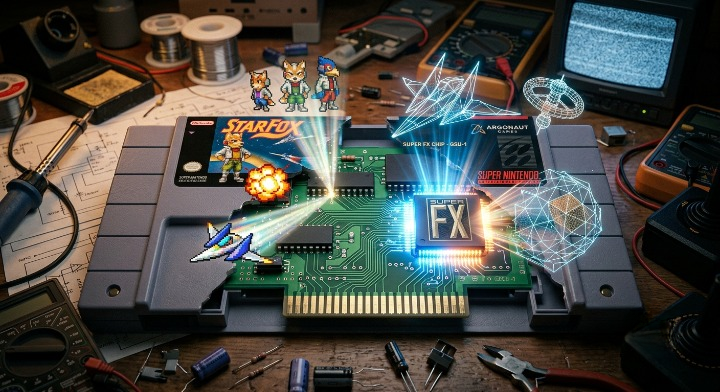
The most famous example of this is undoubtedly the **Super FX** chip, which put *Star Fox* on the map in 1993. It was a RISC co-processor designed by Argonaut Games that ran at 10.7 MHz (and later hit 21.4 MHz in its revised versions). While the stock SNES struggled with basic physics calculations, the Super FX drew polygons inside its own internal RAM and fed the finished frame straight to the TV screen. That's why *Star Fox* had actual tridimensional depth, while other space shooters from the same year relied on flat 2D sprites pretending to look deep.
But it wasn't just the Super FX. Capcom used its own proprietary chip, the Cx4, to handle wireframe rotations and vector math for the bosses in *Mega Man X2* and *X3*. There was also the DSP chip series, heavily utilized to compute track physics in games like *Super Mario Kart*.
Studios with deep pockets put a mini-computer inside the gray plastic shell; companies without that kind of cash just had to make do with what came out of the box.
---
## The Space Race (And Dropping Component Prices)
Another factor we tend to overlook is the raw size of ROM memory. In the early '90s, the biggest bottleneck for graphics wasn't always chip speed, but simply having enough storage to hold the artwork. High-quality pixel art, detailed backgrounds, and fluid animations take up a massive amount of digital real estate.
Around 1990 or 1991, standard cartridges held between 4 and 8 Megabits (Mb). To be fair, that was tiny. Artists had to constantly reuse tiles for backgrounds and cut character animation frames just to make everything fit.
Over time, manufacturing costs for these memories plummeted, and cartridge sizes ballooned. The jump is pretty stark when you look at the timeline:
* **Super Mario World (1990):** Ran on a 4 Megabit chip. The game looks great because of brilliant art design, but the sprites are simple and backgrounds repeat heavily.
* **Street Fighter II (1992):** Used 16 Megabits. This was a massive leap for the time, making it possible to bring those giant arcade sprites into the home.
* **Donkey Kong Country (1994):** 32 Megabits. A staggering amount of space used almost entirely to store heavy animation frames.
* **Tales of Phantasia (1995/1996):** Pushed the absolute limit at 48 Megabits, featuring anime-like backgrounds and even compressed vocal audio in the opening track.
So, when you saw a game from 1995 that looked infinitely better than another title from the exact same year, in most cases it just came down to budget. One studio could afford to bankroll a 32 Mb cartridge, while the other was stuck working within the constraints of an 8 Mb chip to keep costs down.
---
## Optical Illusions and the Rare Trick
By 1994, the console war with the Genesis was brutal, and the PlayStation was already looming on the horizon. That's when Rare came up with a purely artistic pivot that changed the entire playing field, without needing to spend extra money on expensive custom chips: a process they called *Advanced Computer Modeling*.
They didn't bother trying to make the SNES render actual 3D in real time because they knew the console would probably catch fire. Instead, they used high-end *Silicon Graphics* workstations—the same hardware Hollywood was using at the time—to model characters and entire environments in a true 3D virtual space.
Once everything was modeled with realistic light, shadows, and textures, they took "snapshots" of these assets and turned them into static 2D images. The game code running on the SNES was standard two-dimensional fare, but because the sprites originated from 3D models, our eyes picked up on volume and lighting depth that no pixel artist could replicate by hand at the time. It was a masterclass in visual marketing.
---
## Mastering the Hardware and the Long Game
To be fair, the sheer experience of the programmers counted for a lot too. The SNES's native graphics chip, the PPU, featured some incredible hardware tricks, but it took years for software houses—especially Western ones—to truly master them.
Take the famous **Mode 7**, which allowed background layers to rotate and scale to mimic a 3D floor. It started out fairly basic in titles like *F-Zero* and *Pilotwings*. By the end of the console's lifecycle, however, developers learned to couple Mode 7 with horizontal scanline interrupts (known as HDMA). This trick allowed them to create distorted fog effects, transparent water reflecting the sky, or curved horizon lines, as seen in *Chrono Trigger* or *Terranigma*.
The SNES also handled transparency natively via hardware, but it took a while for programmers to figure out how to manipulate color registers frame-by-frame to simulate dynamic lighting. The iconic campfire scene at the beginning of *Chrono Trigger*, or the pitch-black atmosphere of *Super Metroid*, are perfect examples of this technical maturation.
Ultimately, the massive visual gap on the Super Nintendo was a story of financial backing and engineering experience. The console you bought back in 1991 had the exact same capabilities under the hood for its entire lifespan, but the hardware wizardry surrounding it evolved so much it felt like you got a new console without ever leaving your living room.