The Mistake of the Century? Why Nintendo Rejected CDs for the Nintendo 64
Jun 21st '26 11:21am:
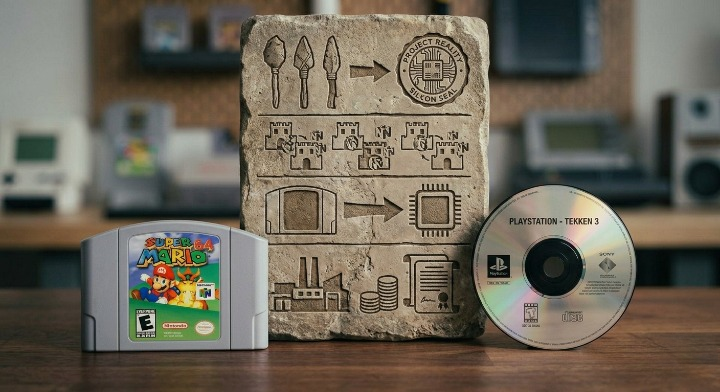
In the mid-90s, the video game industry went through one of its most radical transitions. While Sony with the PlayStation and Sega with the Saturn embraced the CD-ROM as the inevitable future, Nintendo shocked the market by announcing that its next big bet — the Nintendo 64 (N64) — would stick with rigid plastic cartridges and silicon memory chips.
The decision cost the Japanese giant dearly in terms of third-party studio support, but it wasn't just some old-fashioned whim. Below, we break down the real reasons behind this historic choice.
## Why did Nintendo insist on cartridges for the N64 when CDs offered nearly 10 times more space for a fraction of the price?
The short, precise answer comes down to three non-negotiable factors for the company’s leadership at the time: instant loading speeds to make fluid 3D worlds possible without interruptions, a ironclad anti-piracy control to protect their multi-million dollar intellectual properties, and the astronomical profit made from licensing and manufacturing the cartridges, which kept external publishers dependent on Nintendo's own production ecosystem.
---
The technological clash: N64 cartridge vs. PlayStation CD-ROM
---
## The Historical Context: The Format War of the 90s
To understand the mindset of Nintendo’s legendary president, Hiroshi Yamauchi, we have to look back to 1993. The CD-ROM format was on the rise, promising to change everything with so-called Full Motion Video (FMV) — those pre-rendered cinematic videos — and studio-quality audio soundtracks.
The ultimate irony of this story is that Nintendo actually planned a CD drive for the Super Nintendo (SNES) in partnership with Sony. After brutal contractual disagreements, Nintendo canceled the project behind their partner's back. Sony, outraged by the public humiliation, took that base technology and developed the original PlayStation. Even while watching its rival build its worst nightmare out of laser discs, Nintendo stood firm on silicon under the codename *Project Reality* (which would become the N64).
## 1. The Technical Factor: Performance and Access Speed (RAM vs. ROM)
The most noble technical reason for choosing cartridges lies in the hardware architecture designed by Silicon Graphics for the N64.
Cartridges are ROM (Read-Only Memory) media based on semiconductors. The console's processor can communicate with the cartridge chip almost at the speed of light. On the other hand, CD-ROM drives back then were painfully slow — the original PlayStation drive read data at a 2x speed (about 300 KB per second).
### The Loading Times Nightmare
Anyone who played on the first PlayStation remembers all too well those famous black screens or progress bars that lasted 30 seconds or a minute before a race or a fight would start. For Shigeru Miyamoto and Nintendo’s engineering team, this completely broke the immersion. On the N64, loading times were practically zero.
### The N64’s Unified Memory
The Nintendo 64 had only 4 MB of unified RAM (expandable to 8 MB with the *Expansion Pak*). Because cartridges read data instantly, developers could stream textures and 3D geometries straight from the cartridge to the screen, without needing to overload the console's precious RAM.
If the N64 had used CDs, the scarce RAM would have to store the data read from the slow disc, which would require much more internal memory in the console, making the base hardware prohibitively expensive for consumers.
## 2. The Business Model: The Profit Was in the Manufacturing
People often focus the debate on engineering, but Nintendo's true driving force has always been financial. In the business model established during the NES and SNES eras, Nintendo wasn't just a game creator; it was the exclusive manufacturer of third-party hardware.
* **The CD Model (Sony):** Producing a CD-ROM cost less than $1 per unit. Sony charged a fixed royalty fee (around $10 per disc) and allowed publishers to manufacture their own games quickly across hundreds of disc factories worldwide.
* **The Cartridge Model (Nintendo):** An N64 cartridge contained complex chips and circuit boards that cost between $15 and $30 to produce. On top of that, only Nintendo could manufacture them at its facilities in Japan.
Nintendo forced publishers (third-parties like Capcom, Konami, and Square) to order cartridges months in advance, paying the production costs upfront. If a game flopped in stores, the loss was entirely on the publisher, while Nintendo had already profited from manufacturing the physical cartridge. Switching to CD would mean giving up this highly lucrative manufacturing monopoly.
## 3. Piracy Panic: The Ghost That Haunted Kyoto
Software piracy in Southeast Asia and the Americas was one of the factors that weighed heaviest on Hiroshi Yamauchi's decision. By the mid-90s, CD burners for personal computers were starting to become mainstream. Anyone with a PC and a blank disc could duplicate a PlayStation game for a tiny fraction of the cost.
Cartridges, on the other hand, were fortresses. Copying a proprietary silicon chip required extremely expensive industrial reverse-engineering equipment. While copying peripherals did hit the gray market (like the *Doctor V64*), they were expensive and inaccessible to the general public. Nintendo preferred the security of a closed ecosystem over the popularity of a vulnerable format.
## Hidden Consequences: The Price of Pride
While the decision made sense in Nintendo's financial and engineering reports, it triggered a devastating side effect: a severe lack of storage space, which ended up shaping its game library and causing it to lose its market leadership to Sony.
| Feature | N64 Cartridge (Standard/Max) | CD-ROM (PlayStation/Saturn) |
| --- | --- | --- |
| **Data Capacity** | 4 MB to 64 MB (historical max) | ~650 MB |
| **Access Time** | Instant (Nanoseconds) | Slow (Milliseconds + optical seek) |
| **Cost per Unit** | High ($15 - $30 USD) | Tiny (Less than $1 USD) |
| **Production Time** | 2 to 3 months (advance order) | A few days / weeks |
### The Third-Party Exodus
The space limitation (650 MB versus an average of 12 MB to 32 MB on cartridges) forced drastic shifts in the industry. The most iconic case was **Final Fantasy VII**.
Square (now Square Enix) had actually developed a technical prototype of *Final Fantasy* on N64 hardware. However, the team's vision for the game required hours of cinematic video cutscenes and an orchestrated background soundtrack. Storing all of that on a cartridge would require dozens of expensive, interconnected cartridges. Square abandoned Nintendo and made *Final Fantasy VII* a massive PlayStation exclusive (split across 3 CDs), taking millions of RPG fans with them.
Without massive support from external publishers, who didn't want to risk their capital on Nintendo's expensive cartridges, the N64 became a console heavily carried by its in-house talent: the masterpieces of Nintendo itself (like *Super Mario 64*, *The Legend of Zelda: Ocarina of Time*) and its British partner Rare (*GoldenEye 007*, *Banjo-Kazooie*).
By the end of that generation, Sony's PlayStation closed its cycle with over 102 million units sold globally, while the Nintendo 64 stagnated at 32.9 million units. The lesson was learned: for the next generation (GameCube), Nintendo finally gave in to optical discs, though they still opted for a proprietary mini-DVD format — holding onto their protective and controlling instincts for as long as they possibly could.